Middle of its segment, modest efficiency
The Meyer Burger Panel+ White XL series consists of modules designed for maximum energy yield in real roof conditions - even under poor sunlight, higher temperatures, and partial soiling. A key advantage is the combination of n-type HJT cells with the company's proprietary SmartWire connection technology, which ensures high operational stability and reduces the risk of power drops over time. In practice, you get more energy production from the same area without having to use oversized modules that make logistics and installation more difficult.
The Panel+ White XL also stands out for its resistance to micro-cracks and attention to the durability of the layers, which will be appreciated by investors focused on long-term operation. Its clean aesthetics and refined finish make it a good choice for modern roofs - where the appearance of the installation is as important as its parameters. The series is particularly suitable for homes, small businesses, and premium projects where reliability and predictable performance are a priority, rather than just the initial price.
Ranking
Signals from the data
Residential, commercial and hot-climate.
Tight roof space, roofs where every square metre has to count and weight-limited structures.
Bottom 1% of the HJT 500-550 W segment, against a median of 22.90%. Ranked 12,102nd in the whole database.
Bottom 1% of the HJT 500-550 W segment, against a median of 229.5. Ranked 12,141st in the whole database.
Bottom 1% of the HJT 500-550 W segment, against a median of 53.1. Ranked 12,917th in the whole database.
Combining n-type heterojunction (HJT) cells with the proprietary SmartWire (SWCT) interconnection technology instead of conventional busbars reduces microcracks and resistive losses, resulting in lower LID/LeTID degradation and more stable output at high temperatures compared to PERC panels.
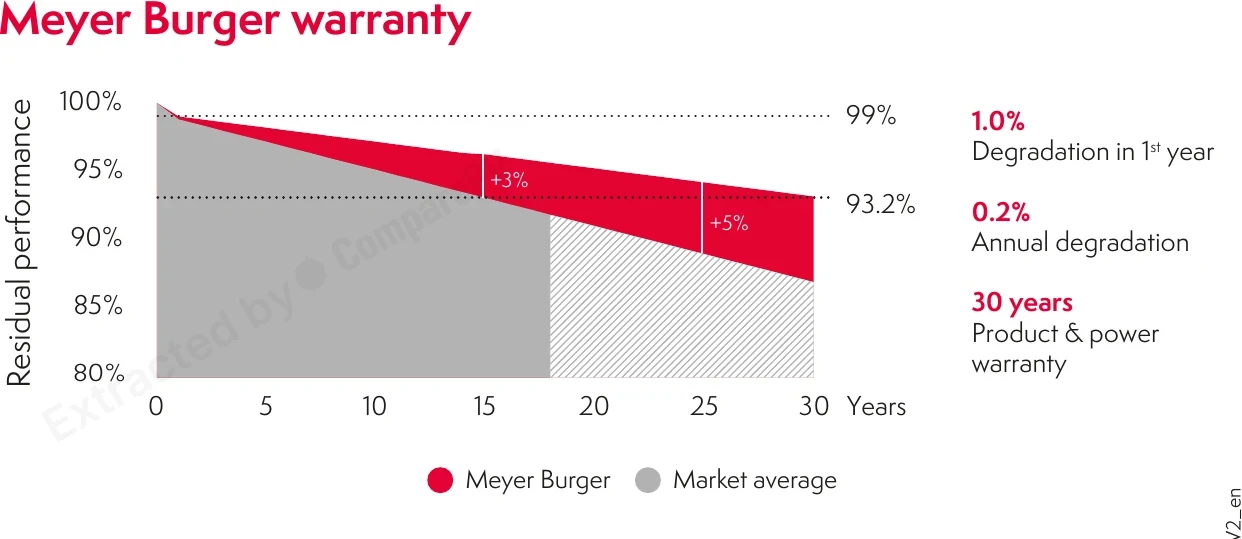
The manufacturer specifies 30 years of both product and power warranty - well above the segment standard, where typical values are 12-15 years for product warranty and 25-30 years for linear power warranty.
The bifacial construction enables additional energy yield from the rear side of the module, which is particularly beneficial on light-colored/reflective roof surfaces and in ground-mount installations.
Meyer Burger is a Swiss company headquartered in a country with strong quality standards, founded in 1953, and for years operated as a recognized Tier-1 supplier in the European market, which historically built investor confidence in its HJT technology.
The white frame and backsheet (White), combined with microcrack resistance, deliver a clean, understated installation appearance - an advantage for premium projects where roof aesthetics matter alongside electrical parameters.
The series was discontinued (2024-2025), and Meyer Burger Technology AG itself filed for insolvency in Germany and Chapter 11 bankruptcy in the US in 2025, halting module production in Arizona and selling its manufacturing equipment to Waaree. This means genuinely limited availability of service, spare parts, and warranty support for end customers.
Despite the formally stated 30-year product and power warranty, the manufacturer's 2025 bankruptcy calls into question the actual enforceability of these obligations over coming decades - a typical risk after a renewable energy manufacturer's insolvency, when warranty claims fall into bankruptcy proceedings or get assumed by another entity under different terms.
Efficiency of 20.1-20.8% is noticeably lower than comparable 540-560 Wp modules from other manufacturers, e.g. Exiom EX540-560M(B) (21.7%), Fellow Energy FE72-18X (21.7%), or Premier Energies 144 HC PERC Bifacial (21.67%) - a gap of roughly 0.9-1.6 percentage points means less power from the same roof area.
- Efficiency of 20.1% is 2.8pp below the HJT 500-550W median (22.9%)
- Power density of 200.5 W/m² is 29.0 W/m² below HJT 500-550W median (229.5 W/m²) - needs more roof space
- Temperature coefficient of -0.26%/°C matches the HJT 500-550W median
- At 34.4 kg (7.3 kg above HJT 500-550W median of 27.1 kg), requires checking roof load capacity
- 90% bifaciality enables rear-side power generation, boosting yield by 4-14% on reflective surfaces
Specifications
Datasheet charts
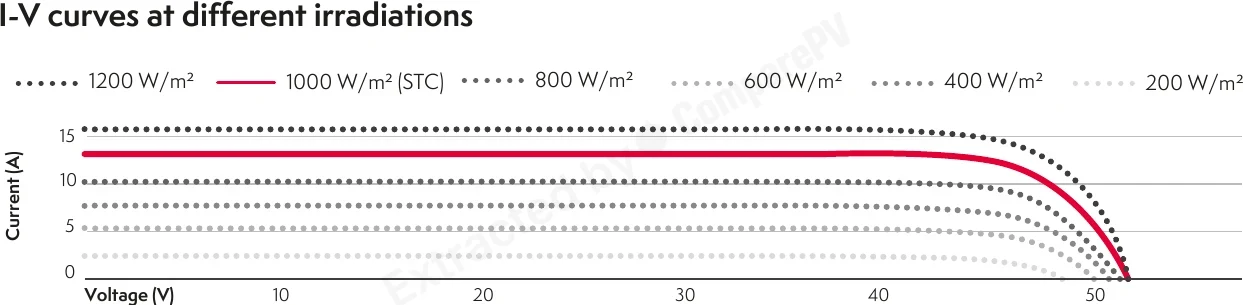
Measured curves published by Meyer Burger in this model's datasheet. A chart carrying a wattage was measured on that variant alone - only the ones that describe 540 Wp appear here. The rest cover the whole series.
Simulations
Degradation from this panel's own datasheet figures. No inverter, soiling or shading losses.
Model: bifaciality × albedo × 0.6 view factor. A first-order estimate, not a yield simulation.



Found 1119 panels of the same or similar size to this one, within ±10 mm. See them here Found 1125 panels of the same or similar size to this one, within ±25 mm. See them here Found 1236 panels of the same or similar size to this one, within ±50 mm. See them here Found 4166 panels of the same or similar size to this one, within ±100 mm. See them here