
Middle of its segment, heavy for its output
The Leapton LP182*210-M-48-NB series consists of modules based on N-type TOPCon solar cells in a 210R format, designed for high efficiency and stable operation under real-world conditions. The use of dual glass construction (glass-to-glass) enhances resistance to stress and material aging, resulting in greater predictability of performance over the long term. This solution is particularly appealing to investors who want to minimize the risk of performance degradation and prioritize durability over compromises.
A key feature of the series is bidirectional energy harvesting, which allows for better utilization of reflected light - important on bright roofs, when mounted on the ground, and in installations with elevated structures. The modules are attractive for residential and commercial installations, where power density per unit area and aesthetics are important - the full black finish variants are particularly well-suited for modern architecture. An additional advantage is extended product and linear warranty, which supports the overall profitability of the investment.
Ranking
Signals from the data
Residential, commercial and BIPV.
Weight-limited structures and hot climates.
Bottom 16% of the TOPCon 450-500 W segment, against a median of 52.2.
Bottom 20% of the TOPCon 450-500 W segment, against a median of -0.290.
N-type TOPCon technology (efficiency up to 22.77%) delivers lower LID/LeTID degradation and better high-temperature performance than older PERC cells, translating into higher real-world annual yield, especially in summer.
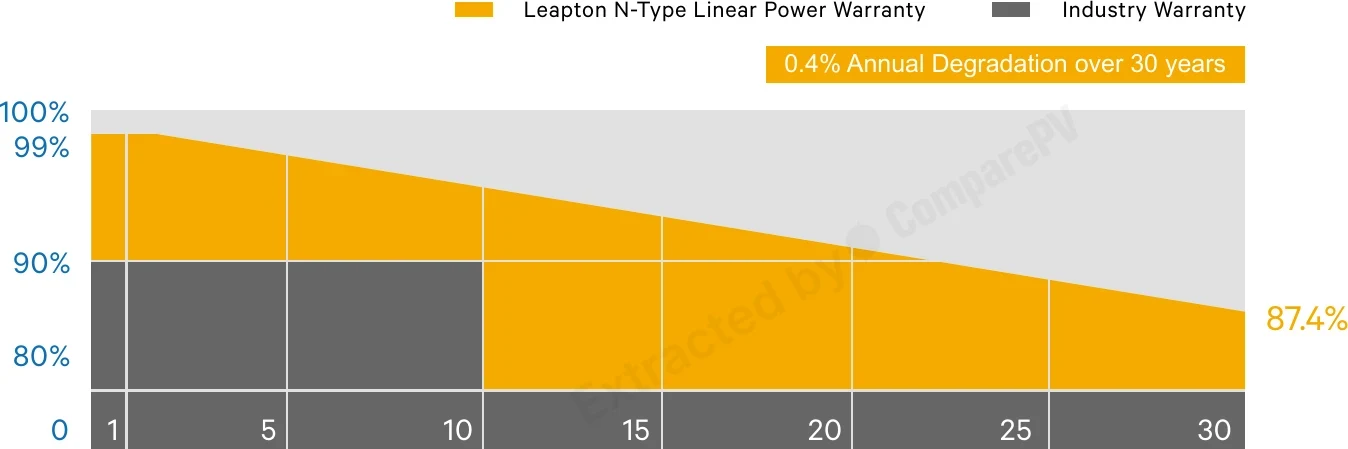
Leapton guarantees power retention for 30 years (annual degradation ~0.4%) with a 25-year product warranty - this is top-segment standard for N-type modules and matches LEDVANCE and Solitek offerings from the same peer set.
Glass-glass design increases mechanical resistance (TÜV Nord tested: 2400 Pa wind load, 5400 Pa snow load) and reduces moisture ingress, meaningfully lowering the risk of premature degradation compared to glass-backsheet construction.
The bifacial module enables an additional energy gain of roughly 5-25% depending on ground albedo - a significant advantage for ground-mount installations or bright roof surfaces where monofacial modules miss reflected-light potential.
Leapton Energy (Japan, founded 2012) is listed as a BNEF Tier-1 manufacturer, confirming financial stability and eligibility for bank-financed projects - a key argument for commercial investment financing.
Double glass increases module weight compared to glass-backsheet designs, which can raise transport and installation costs and require a stronger mounting structure, particularly on weaker roof surfaces.
- Efficiency of 22.8% matches the TOPCon 450-500W median
- At 227.7 W/m² power density, roof space requirements are typical for TOPCon 450-500W panels
- At -0.30%/°C, hot weather performance is typical for TOPCon 450-500W panels
- At 25.0 kg, weight matches the TOPCon 450-500W median
- Bifacial design (80% factor) captures reflected light - adds 4-12% yield on ground-mount or white roof
Specifications
Datasheet charts
Measured curves published by Leapton in this model's datasheet. A chart carrying a wattage was measured on that variant alone - only the ones that describe 455 Wp appear here. The rest cover the whole series.
Simulations
Degradation from this panel's own datasheet figures. No inverter, soiling or shading losses.
Model: bifaciality × albedo × 0.6 view factor. A first-order estimate, not a yield simulation.





Found 1395 panels of the same or similar size to this one, within ±10 mm. See them here Found 1425 panels of the same or similar size to this one, within ±25 mm. See them here Found 3614 panels of the same or similar size to this one, within ±50 mm. See them here Found 3962 panels of the same or similar size to this one, within ±100 mm. See them here