
Middle of its segment, heavy for its output
The Leapton LP182*182-M-54-NB series is designed for high productivity in real-world conditions, even when the installation doesn't have ideal exposure. The use of N-type cells and the MBB (multi busbar) architecture helps to minimize losses and stabilize performance over the long term, which will be appreciated by investors focused on predictable energy production. These are glass-glass bifacial modules, so they can utilize reflected light from the ground, while also being better able to withstand loads and operate in demanding environments.
In practice, this means fewer problems with degradation, better resistance to PID effects, and higher output in less sunny conditions. The series is suitable for modern residential and commercial installations, especially on bright roofs, carports, and ground-mounted structures. An additional advantage is the Full Black aesthetic or the version with a black frame - without compromising between appearance and technology.
Ranking
Signals from the data
Residential and commercial.
Weight-limited structures.
Bottom 11% of the TOPCon 400-450 W segment, against a median of 51.4.
N-type TOPCon cells combined with a multi-busbar architecture reduce LID/LeTID degradation and improve high-temperature performance (Pmax temperature coefficient of -0.3%/°C) compared to older PERC cells, resulting in more stable energy yield over the module's lifetime.
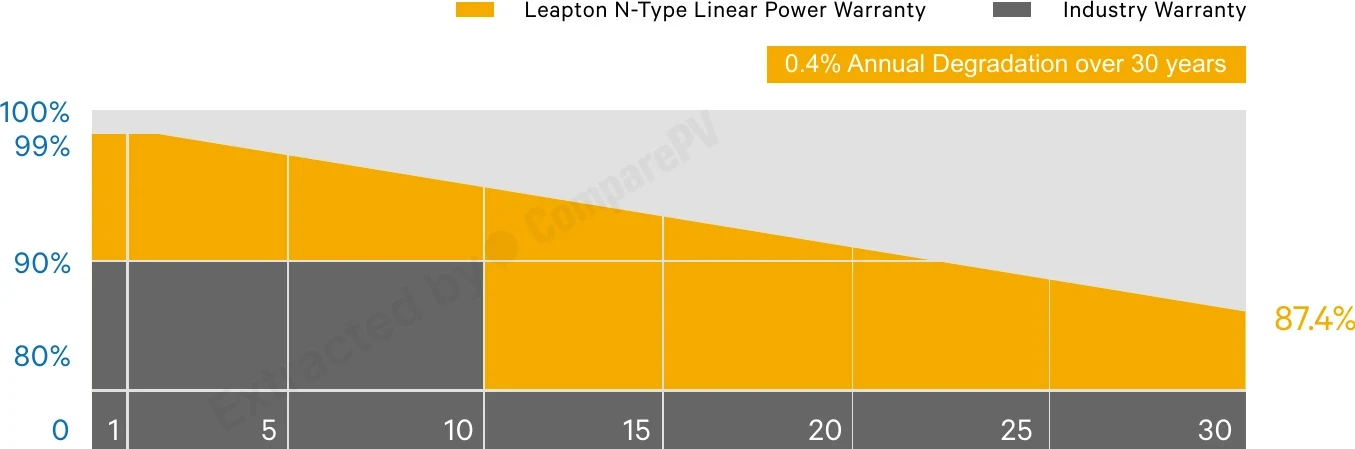
The manufacturer guarantees 99% power output after the first year and 87.4% after 30 years, backed by a 25-year product warranty - a stronger and longer warranty package than the standard 25 years/84.8% offered by many tier-1 competitors.
The dual-glass bifacial design captures light reflected from the ground, generating an additional 5-25% output compared to monofacial modules, while also improving mechanical durability and reducing PID compared to backsheet-based constructions.
Leapton Energy, founded in 2012 in Kobe, is listed as a Tier-1 manufacturer by BloombergNEF, which facilitates bank financing for projects and reflects financial stability and manufacturing scale.
Leapton Solar was recognized as a Top Performer in the independent Kiwa PVEL 2025 PV Module Reliability Scorecard, confirming production quality beyond the manufacturer's own claims.
The series' efficiency range of 21.52-22.52% trails comparable 450 Wp modules from competitors - SunKean/Sunket SKT430~450M10-108D5 reach 23.04%, and Sunova Tangra S Pro HD reaches 22.5%. For the same roof area, this means slightly lower energy yield per m² compared to these alternatives.
- At 21.8% efficiency, this panel is on par with typical TOPCon 400-450W modules
- At 217.7 W/m² power density, roof space requirements are typical for TOPCon 400-450W panels
- At -0.30%/°C, hot weather performance is typical for TOPCon 400-450W panels
- At 25.0 kg, this panel is 3.0 kg heavier than the TOPCon 400-450W median (22.0 kg) - more demanding for installation crews
- 80% bifaciality enables rear-side power generation, boosting yield by 4-12% on reflective surfaces
Specifications
Datasheet charts
Measured curves published by Leapton in this model's datasheet. A chart carrying a wattage was measured on that variant alone - only the ones that describe 435 Wp appear here. The rest cover the whole series.
Simulations
Degradation from this panel's own datasheet figures. No inverter, soiling or shading losses.
Model: bifaciality × albedo × 0.6 view factor. A first-order estimate, not a yield simulation.







Found 1395 panels of the same or similar size to this one, within ±10 mm. See them here Found 1425 panels of the same or similar size to this one, within ±25 mm. See them here Found 3614 panels of the same or similar size to this one, within ±50 mm. See them here Found 3962 panels of the same or similar size to this one, within ±100 mm. See them here