Jolywood JW-HD144N-R0-585

JW-HD144N-R0-585

585 Wp N-type Bifacial 80%
ComparePV verdict

Strong in heat, no clear weak spot

Rank 4,041 of 14,005
Compare panels Datasheet PDF
Power (Wp)
585
Typical for its class
Efficiency (%)
22.70
Strong · top 24%
Density (Wp/m²)
226.5
Typical · median 224.5
Temp (%/°C)
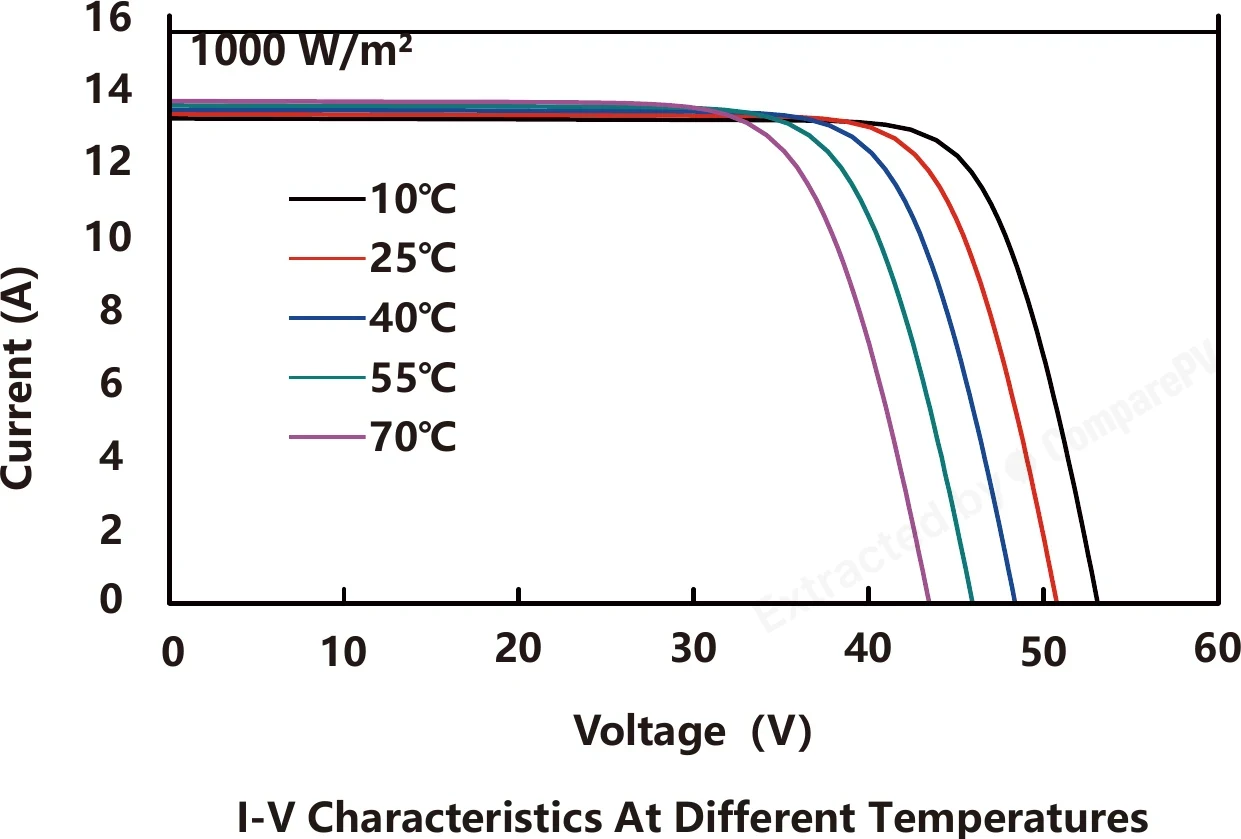
-0.280
Strong · top 9%
Weight (kg)
31.5
Typical · median 29.5 kg
Warranty (yrs)
30
Typical · median 30 yrs

The Jolywood JW Pro series features panels built with n-type TOPCon technology, specifically engineered to genuinely boost energy yield in conditions where conventional modules quickly lose their edge. Central to this is the bifacial dual-glass construction - the double glass enhances sealing and environmental resilience, while the two-sided cell operation harnesses reflected light from the ground surface. As a result, the JW Pro performs exceptionally well on highly reflective surfaces such as light-colored roofs, membranes, gravel, and ground-mounted structures, where ground reflectivity plays a key role.

In practice, users experience lower degradation and more stable long-term performance, which is crucial for calculations based on self-consumption, PPA, or project financial metrics. Additionally, the series excels in high temperatures and low-light conditions, translating to more predictable yields during seasonal transitions and hot periods.

This series is tailored for investors who prioritize not just nominal power output, but higher energy returns, longevity, and reliability - especially in commercial, industrial, and utility-scale setups.

Ranking

259 panels in the segment N-type 550-600 W
Metric This panel Median Position in segment Overall rank
Module efficiency 22.70% 22.45% Strong · top 24% 3,307
Power density 226.5 224.5 Typical 3,500
Temperature coefficient -0.280 -0.290 Strong · top 9% 1,309
Weight per kWp 53.8 52.3 Typical 7,897
Performance warranty 30 yrs 30 yrs Typical 21
Colour key Strong - top 25% Typical - middle 50% Weak - bottom 25%

Signals from the data

7 positive · 2 caution
Best for

Commercial, utility-scale, hot-climate and shaded-installations.

Strengths
-0.280 %/°C temperature coefficient

Top 9% of the N-type 550-600 W segment, against a median of -0.290. Ranked 1,309th in the whole database.

22.70% module efficiency

Top 24% of the N-type 550-600 W segment, against a median of 22.45%.

What owners get
N-type TOPCon – low degradation

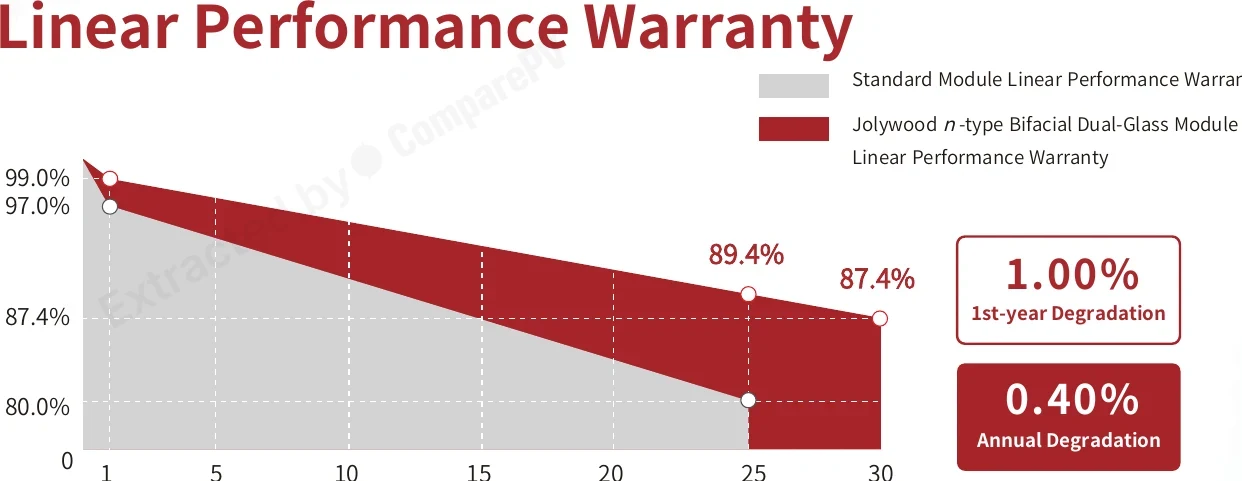
N-type TOPCon cells degrade at 0.4%/year (1.0% in year 1), guaranteeing ≥87.4% of rated power after 30 years. Standard PERC modules degrade at ~0.55%/year, translating to a real yield gap of 3–5% over a 30-year project horizon. The N-type architecture also eliminates LID and LETID effects inherent to P-type technologies.

Dual-glass – environmental durability

The glass-glass construction provides certified resistance to salt mist, ammonia, PID, sand, and high humidity — critical for coastal, agricultural, and industrial installations. Eliminating the rear backsheet removes the primary failure mode of delamination and moisture ingress seen in framed modules after 10–15 years of field operation.

Bifacial design – albedo yield gain

Bifacial operation delivers up to 30% additional rear-side power under favorable albedo conditions (white membrane, gravel, snow, light concrete). In typical ground-mount configurations, the bifacial gain ranges from 5–15%, directly improving LCOE without incremental BoS cost.

Up to 23% efficiency – segment-competitive

The top 595 Wp variant reaches 23.0% module efficiency — on par with peer comparables Solarspace Lumina II (23.03%) and Ulica Solar TOPCon 595W (23.03%), and materially above Sunova TS-BW78 (21.3%). Higher efficiency reduces module count for a given system size, lowering BoS costs, cabling runs, and roof loading.

BNEF Tier-1 bankable since 2008

Jolywood is confirmed on the BloombergNEF Tier-1 module manufacturer list (Q1 2026), signaling bankability for project finance. Operating since 2008 and recognized as a pioneer in commercial N-type cell manufacturing, Jolywood's R&D track record and production continuity reduce counterparty risk for long-term PPA and financed projects.

Trade-offs
12-year product warranty only

JW Pro carries a 12-year product warranty, falling short of the 15-year standard offered by multiple Tier-1 peers in the premium TOPCon segment — including JA Solar (Tiger Neo), Longi (Hi-MO X6), and Risen. The shorter coverage period shifts the risk of latent defects and manufacturing failures to the system owner earlier in the asset's lifecycle.

Higher weight – rooftop load constraint

144-cell dual-glass modules typically weigh 33–36 kg, approximately 30–50% more than equivalent framed modules (22–26 kg). On existing rooftops with limited structural load capacity, this requires a structural audit and may generate additional reinforcement costs or necessitate a reduction in module count per roof section.

Notes from the database
  • Efficiency of 22.7% matches the N-type 550-600W median
  • Power density of 226.5 W/m² matches the N-type 550-600W median
  • Temperature coefficient of -0.28%/°C matches the N-type 550-600W median
  • Weight of 31.5 kg is 2.0 kg above N-type 550-600W median (29.5 kg) - verify structural support
  • Bifaciality factor of 80% can add 4-12% extra yield with reflective mounting surface

Specifications

Open datasheet PDF
Nominal power (Pmax) 585 Wp Nameplate at 1000 W/m², 25 °C
Module efficiency 22.70 % Strong Segment median 22.45%
Vmpp · Impp 44.61 V · 13.11 A Operating point at max power
Voc · Isc 51.97 V · 13.88 A Sizes the string length
Max system voltage 1500 V Longer strings than 1000 V modules
Dimensions 2278×1134×30 mm · 2.58 m² of roof
Weight 31.5 kg Typical Typical · median 29.5 kg
Cells 144 · N-type Monocrystalline
Bifaciality 80 % Rear output as a share of front
Coefficient Pmax -0.280 %/°C Strong top 9% of its segment
Coefficient Voc · Isc -0.250 · 0.045 %/°C
NOCT 42 °C At 800 W/m², 20 °C ambient
Product warranty 12 years Hardware defects only
Performance warranty 30 years Typical median 30 yrs · median 30 yrs
End-of-warranty output 87.4 % Equals 511 W guaranteed
Degradation 1.00 → 0.40 % First year, then annual

Datasheet charts

Open datasheet PDF

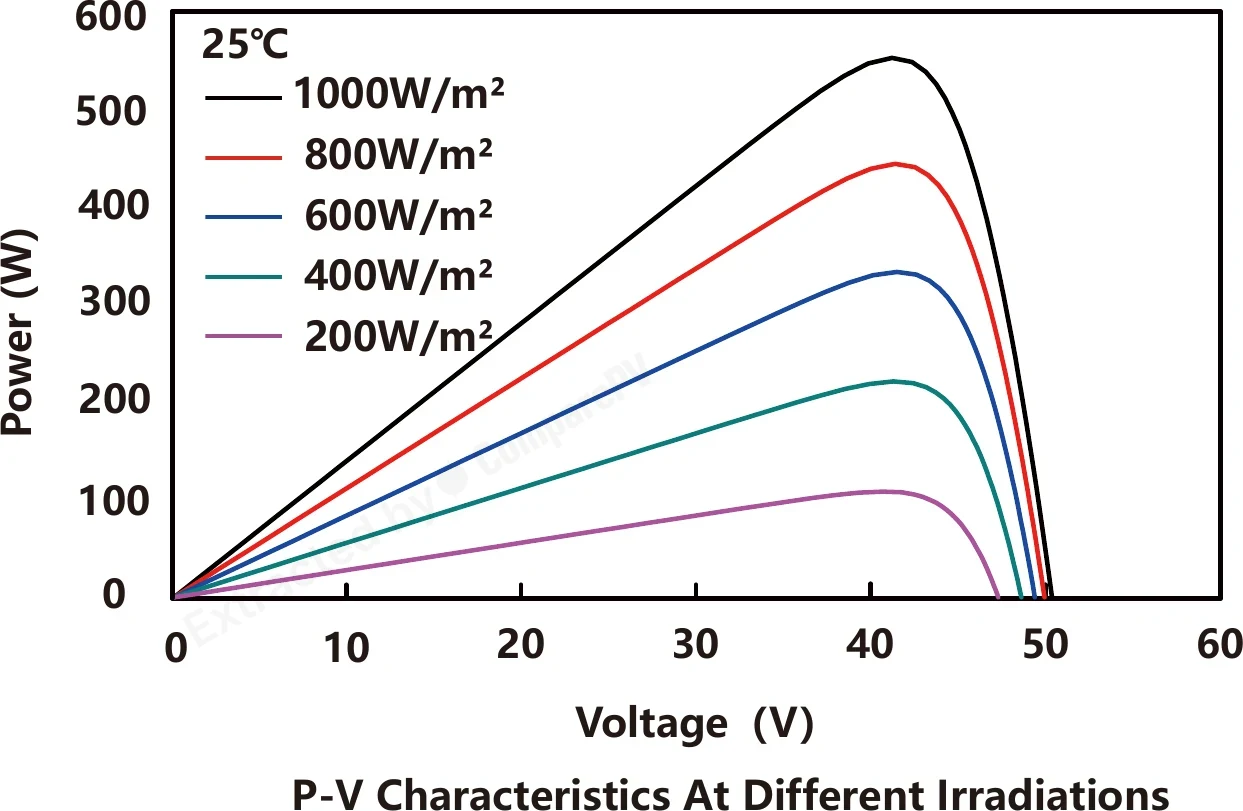
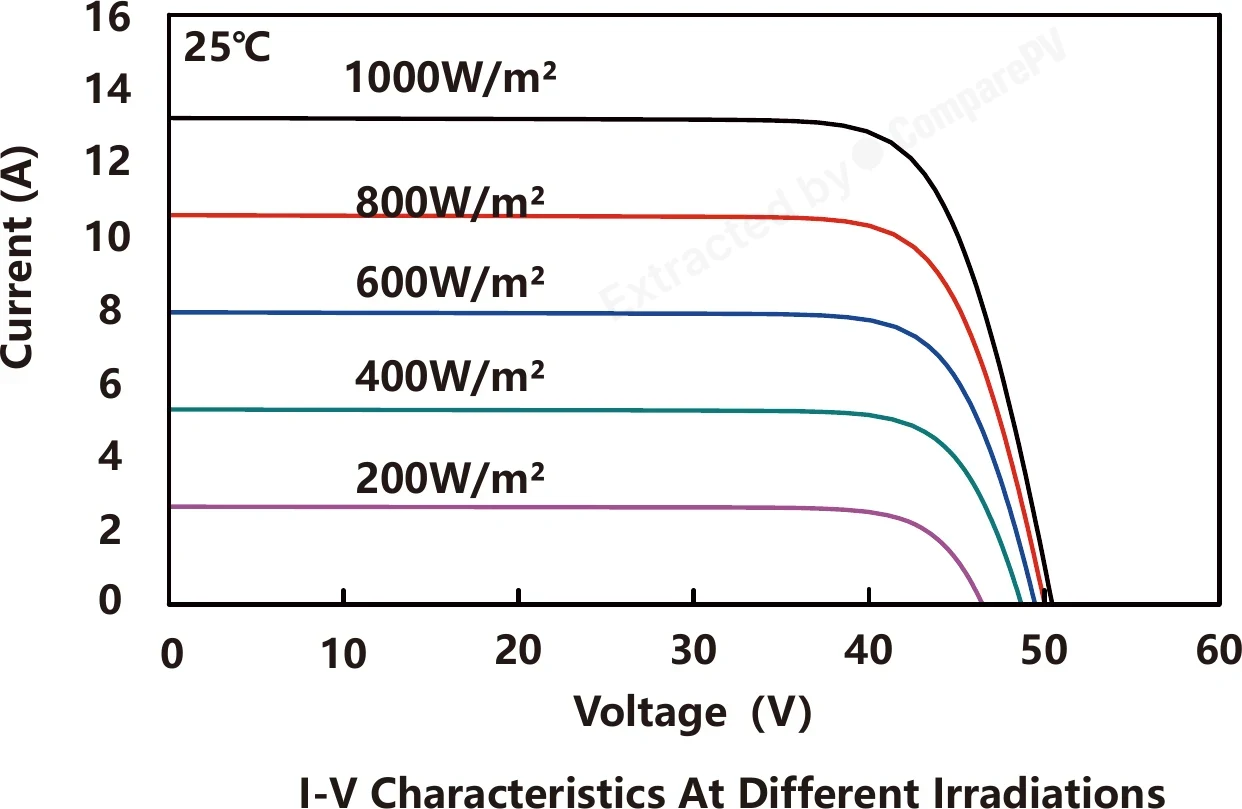
Measured curves published by Jolywood in this model's datasheet. A chart carrying a wattage was measured on that variant alone - only the ones that describe 585 Wp appear here. The rest cover the whole series.
Simulations

Live - change any input
Lifetime output & value
30 years at 1200 kWh/kWp/year and €0.50 per kWh
Power in year 30
-
Lifetime energy
-
Energy value
-
With bifacial gain
-

Degradation from this panel's own datasheet figures. No inverter, soiling or shading losses.

Heat losses
-0.280 %/°C against a segment median of -0.290
-
Bifacial gain
Rear gain over light concrete: -
-

Model: bifaciality × albedo × 0.6 view factor. A first-order estimate, not a yield simulation.

Filter these
Size
Panel Power Eff. Temp. Weight Difference
Jolywood JW-HD144N-R0-585 585 W 22.70% -0.280 31.5 kg You are here
LR7-60HVH-560M 560 W 24.80% -0.260 25.0 kg -25 W, lighter, +2.1 pp
LR7-60HVH-555M 555 W 24.60% -0.260 25.0 kg -30 W, lighter, +1.9 pp
AIKO-A635-MAE72Mw 635 W 24.60% -0.260 27.0 kg +50 W, lighter, +1.9 pp
AIKO-A630-MAH72Dw 630 W 24.40% -0.260 32.5 kg +45 W, cooler, +1.7 pp
LR7-60HVHL-550M 550 W 24.40% -0.260 16.3 kg -35 W, 15 kg lighter, +1.7 pp
JW-HT144N-565 565 W 21.87% -0.300 27.5 kg -20 W, lighter, -0.8 pp
JW-HD144N-R0-570W 570 W 22.10% -0.280 31.5 kg -15 W, -0.6 pp
JW-HD144N-R0-575W 575 W 22.30% -0.280 31.5 kg -10 W, -0.4 pp
JW-HD144N-R0-580W 580 W 22.50% -0.280 31.5 kg Very close match
AIKO-A650-MAE72Mw 650 W 25.20% -0.260 27.0 kg +65 W, lighter, +2.5 pp
AIKO-A645-MAE72Mw 645 W 25.00% -0.260 27.0 kg +60 W, lighter, +2.3 pp
AIKO-A640-MAE72Mw 640 W 24.80% -0.260 27.0 kg +55 W, lighter, +2.1 pp

Found 2326 panels of the same or similar size to this one, within ±10 mm. See them here Found 2368 panels of the same or similar size to this one, within ±25 mm. See them here Found 2382 panels of the same or similar size to this one, within ±50 mm. See them here Found 2547 panels of the same or similar size to this one, within ±100 mm. See them here

Common questions

6 answered
What is the temperature coefficient of the Jolywood JW Pro and does it lose significant power in summer heat?
The JW Pro series features a temperature coefficient of Pmax of approximately -0.28 %/°C, placing it among the top performers in its power class. For every 10°C rise in cell temperature, the module loses only about 2.8% of rated output. By comparison, conventional p-type PERC cells typically reach -0.35 %/°C. In practice, this means noticeably higher yield on hot summer days when rooftop temperatures exceed 60–70°C.
What warranty does the Jolywood JW Pro Series come with?
Jolywood provides a 12-year product warranty and a 30-year linear power warranty. After 30 years of operation, the module is guaranteed to retain at least 87.4% of rated power. First-year degradation is capped at 1%, with subsequent annual degradation of no more than 0.4%. This is one of the most competitive degradation profiles currently available for commercial-grade PV modules.
How much additional energy does the bifacial design of the Jolywood JW Pro actually deliver?
Rear-side energy gain depends on ground albedo. On bright white gravel, a light-colored roofing membrane, or sandy soil, you can realistically expect 10–30% more yield per square meter compared to an equivalent monofacial module. On gray concrete or dark roofing tiles, the benefit is roughly 5–10%. The rated 595 W peak power is measured under STC from the front side only, so bifacial gain is real-world yield on top of that figure.
How does n-type TOPCon technology in the Jolywood JW Pro differ from standard PERC modules?
N-type TOPCon cells incorporate a tunnel oxide passivated contact layer that significantly reduces charge carrier recombination. This translates to higher module efficiency (up to 23%), lower first-year degradation (1% vs. approximately 2–3% for PERC), and inherent resistance to light-induced degradation (LID) and light and elevated temperature-induced degradation (LeTID). The result is more stable, predictable yield over the full 30-year warranty period — critical for PPA-based or LCOE-driven project financing.
Are Jolywood JW Pro panels suitable for ground-mounted systems and utility-scale solar farms?
Yes, the JW Pro series is engineered specifically for commercial, industrial, and utility-scale ground-mounted arrays. Its reinforced steel frame, made from a zinc-aluminum-magnesium alloy, is approximately 50% stronger than standard aluminum frames, providing reliable performance under high wind and snow loads. The bifacial dual-glass construction maximizes energy output on high-albedo ground surfaces such as gravel, sand, or concrete — common in large ground-mount installations.
How heavy is the Jolywood JW Pro 595W panel, and can a standard roof structure support it?
The JW-HD144N-R0 595W module weighs approximately 28 kg with dimensions of 2,278 × 1,134 × 29 mm. This is typical for dual-glass modules in this power class — lighter glass-backsheet modules rated 400–420 W generally weigh 20–22 kg. Before mounting on an existing roof, a structural engineer should verify the rafter system's load-bearing capacity, particularly when replacing an older array or a heavy roofing material.
Add to compare