Light for its output, short guarantee
The Jinko Solar JS-PERC series is designed to genuinely increase energy yield under typical operating conditions - even when the weather is variable and sunlight is lower. The modules utilize mono PERC cells, which allow them to better "collect" light and operate more stably under weaker illumination. In practice, this means higher energy production in the morning, evening, and on cloudy days, as well as improved overall system profitability without the need to add more panels.
The JS-PERC series stands out for its focus on quality: multiple electroluminescence (EL) tests help detect microcracks and reduce the risk of power loss over time. Additionally, the module design supports lower losses in partially shaded conditions, which is important on roofs with chimneys, skylights, or trees nearby.
This series is particularly suitable for individuals and businesses that want predictable yields and durability - whether in residential or commercial installations, where energy cost and reliability are key factors.
Ranking
Signals from the data
Residential and commercial.
Owners who want a long output guarantee.
Top 16% of the PERC 500-550 W segment, against a median of 53.0.
Top 23% of the PERC 500-550 W segment, against a median of -0.350.
Bottom 22% of the PERC 500-550 W segment, against a median of 30 yrs.
JinkoSolar has maintained BNEF Tier-1 bankability status for over 8 consecutive quarters and earned PVEL Top Performer recognition across all 7 reliability categories in the 2025 PV Module Reliability Scorecard - for the 11th year in a row. This is one of the strongest combined signals of financial and technical credibility in the market.
Peak module efficiency of 21.7% exceeds every listed peer: Shinson S-Max (21.48%), Phono Solar Bifacial Twinplus (21.48%), and Boviet VEGA (21.3%). Within the mono PERC technology class, this positions the JS-PERC Series at the top of the segment.
Nine variants span both residential prosumer systems and commercial or utility-scale arrays. A unified brand and PERC technology stack across the full range simplifies BoS standardization and service procurement.
Multiple electroluminescence (EL) inspections during manufacturing detect microcracks before shipment. This is above-standard QC practice in mass-production PERC, reducing the risk of early in-field power degradation.
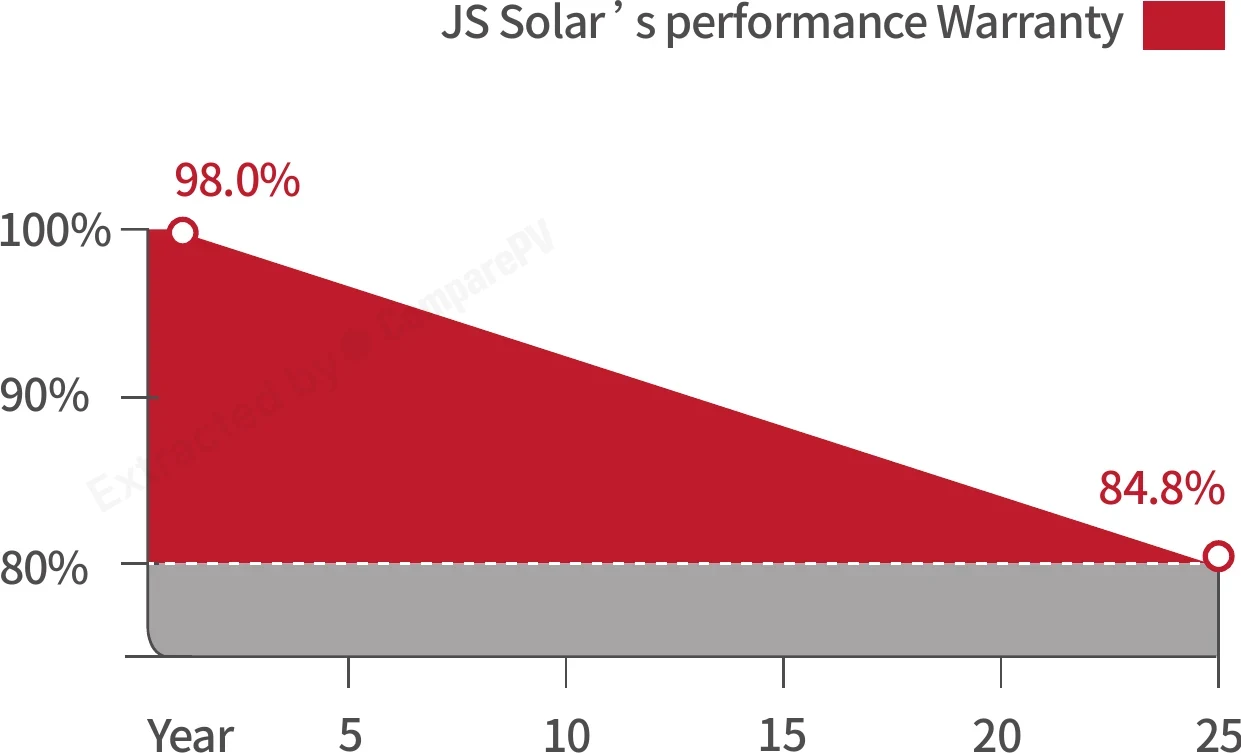
P-type PERC cells exhibit LID of 1.5-3% in year one and annual degradation of ~0.6-0.8% vs ~0.4-0.5% for N-type TOPCon (PVEL 2025 dataset). Over 25 years, PERC modules retain ~82-84% of nameplate power, while N-type TOPCon retains 85-87%. The warranted floor of 83.1% at year 25 leaves a very narrow margin.
The JS-PERC Series is strictly monofacial (is_bifacial: false). The direct competitor Phono Solar Bifacial Twinplus (up to 555 Wp, 21.48% efficiency) adds 5-15% energy yield from reflected irradiance. On installations with high-albedo surfaces (gravel ballast, snow, white TPO membrane), this represents a real missed yield opportunity.
- At 20.9% efficiency, this panel is on par with typical PERC 500-550W modules
- Power density of 209.0 W/m² matches the PERC 500-550W median
- At -0.34%/°C, hot weather performance is typical for PERC 500-550W panels
- 27.0 kg weight - 1.3 kg lighter than PERC 500-550W median (28.3 kg), reducing installation effort
- Ranked #10148 out of 14129 panels for efficiency in the database
Specifications
Datasheet charts
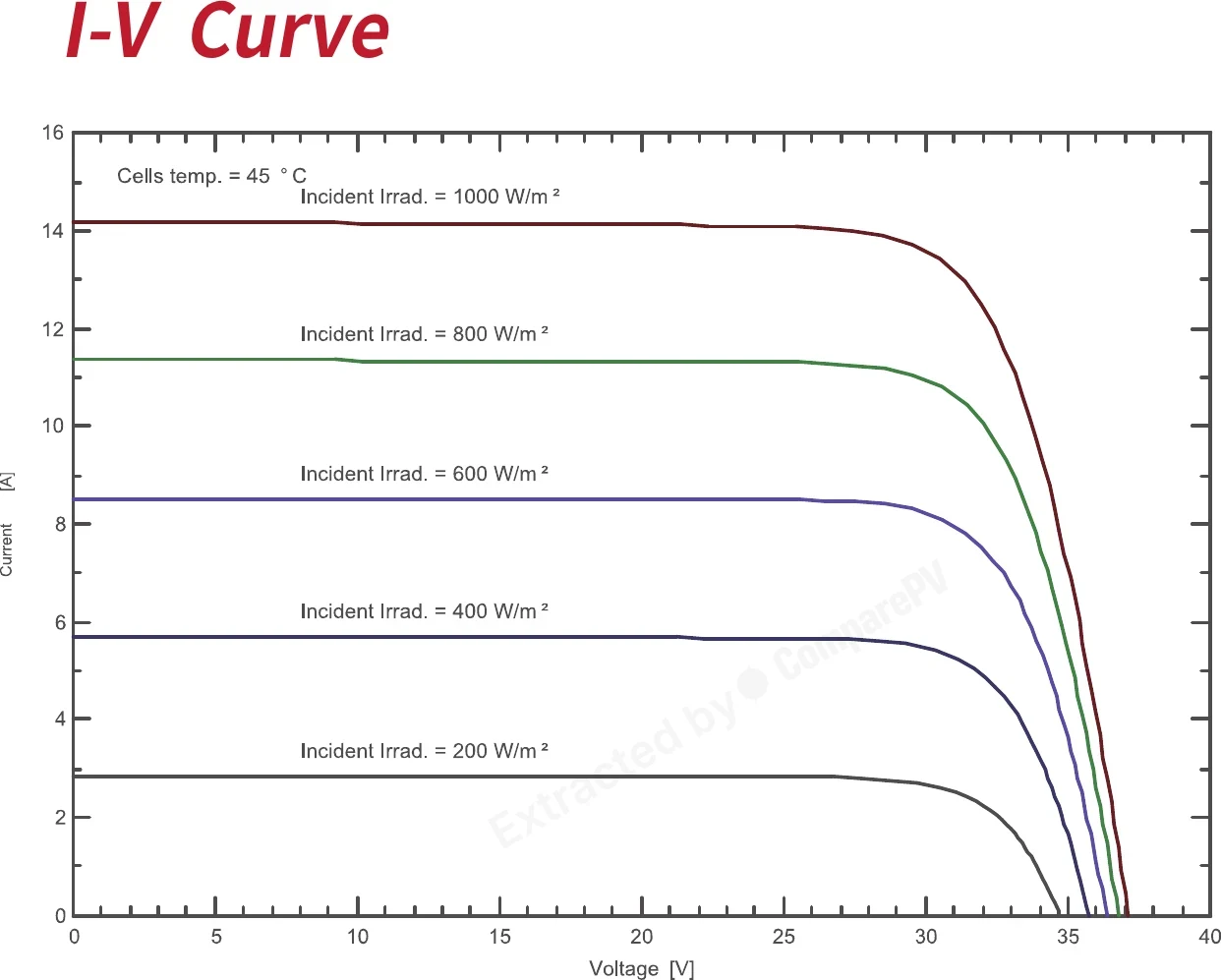
Measured curves published by Jinko Solar in this model's datasheet. A chart carrying a wattage was measured on that variant alone - only the ones that describe 540 Wp appear here. The rest cover the whole series.
Simulations
Degradation from this panel's own datasheet figures. No inverter, soiling or shading losses.




Found 2327 panels of the same or similar size to this one, within ±10 mm. See them here Found 2369 panels of the same or similar size to this one, within ±25 mm. See them here Found 2383 panels of the same or similar size to this one, within ±50 mm. See them here Found 2548 panels of the same or similar size to this one, within ±100 mm. See them here
About the JS-PERC SERIES series
These answers cover the whole series. Where a figure differs, the specification above is this module's own.