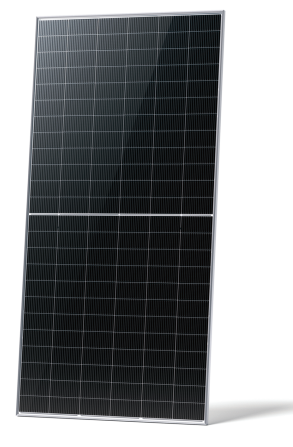
Jinko Solar JKM575N-72HL4-BDX

Jinko Solar JKM575N-72HL4-BDX

575 Wp TOPCon Bifacial 80%
ComparePV verdict

Middle of its segment, heavy for its output

Rank 5,107 of 14,129
Compare panels Datasheet PDF
Power (Wp)
575
Typical for its class
Efficiency (%)
22.26
Typical · median 22.44%
Density (Wp/m²)
222.6
Typical · median 224.4
Temp (%/°C)
-0.290
Typical · median -0.290
Weight (kg)
37.7
Weak · 6.5 kg above median
Warranty (yrs)
30
Typical · median 30 yrs

The Jinko Solar Tiger Neo 72HL4-BDX (JKM575-600N) series is designed for maximizing yield in large-scale installations - where every percentage point of energy and long-term operational stability matter. The application of N-type TOPCon cells minimizes typical start-up losses and helps maintain high efficiency over the long term, while Hot 2.0 technology enhances module reliability under elevated temperatures and reduced irradiance conditions.

What truly distinguishes the BDX version is its bifacial glass-glass construction - the panel can also utilize light reflected from the substrate, resulting in higher yields, especially on light-colored surfaces, ground-mounted farms, and floating installations. Additionally, SMBB improves current collection and reduces the impact of microshadowing, and high PID resistance enhances operational safety in demanding grid environments.

This makes it an excellent choice for investors seeking low LCOE, predictable production, and long-term reliability in commercial and utility-scale projects.

Ranking

1,022 panels in the segment TOPCon 550-600 W
Metric This panel Median Position in segment Overall rank
Module efficiency 22.26% 22.44% Typical 5,656
Power density 222.6 224.4 Typical 5,612
Temperature coefficient -0.290 -0.290 Typical 2,220
Weight per kWp 65.6 53.8 Weak · bottom 1% 13,202
Performance warranty 30 yrs 30 yrs Typical 21
Colour key Strong - top 25% Typical - middle 50% Weak - bottom 25%

Signals from the data

5 positive · 3 caution
Best for

Utility-scale, commercial, floating, hot-climate and cold-climate.

Not ideal for

Weight-limited structures.

Watch-outs
65.6 kg per kWp

Bottom 1% of the TOPCon 550-600 W segment, against a median of 53.8. Ranked 13,202nd in the whole database.

What owners get
N-type TOPCon: low annual degradation

N-type TOPCon cells deliver ≤0.4%/year degradation (vs ~0.7%/year for P-type PERC) and only 1% first-year LID power loss. After 30 years the module retains ≥87.4% of rated power, directly lowering LCOE in utility-scale and commercial projects.

30-year linear power warranty

A 30-year linear warranty with ≤0.4%/year degradation exceeds most peer comparables, where mid-tier models typically stop at 25 years with ~84.8% end-of-warranty power. This improves project bankability and reduces lender risk.

Bifacial glass-glass with SMBB

The glass-glass construction with ~85% bifaciality (mass-production typical for Tiger Neo) enables 5-15% additional energy yield from reflected albedo in ground-mount and floating PV installations. SMBB (Multi-Busbar) technology reduces current path resistance and mitigates micro-shading impact, while the dual-glass encapsulation withstands snow loads of 5,400 Pa and wind loads of 2,400 Pa.

Jinko: #1 BNEF bankability, PVEL Top Performer

JinkoSolar is the only module manufacturer rated bankable by 100% of Bloomberg BNEF survey participants (2025) - for the 10th consecutive year. The Tiger Neo series has held PVEL Top Performer status for 11 consecutive years (2015-2025), reducing credit risk and simplifying due diligence in project-financed deals.

Strong PID and LeTID resistance

N-type cell architecture inherently suppresses PID (Potential-Induced Degradation) and exhibits very low LeTID (Light and elevated Temperature Induced Degradation) compared to P-type PERC, which is especially relevant in high system-voltage (up to 1,500 V DC) and high-temperature environments.

Trade-offs
Lowest efficiency among peer comparables

At 22.26% module efficiency, this series ranks last among the listed peer comparables: Sunpro Power 210R TOPCon Bifacial reaches 23.35% (+1.09 pp), VSUN 75N-144BMH-DG - 22.70% (+0.44 pp), Luxor ECO LINE N-TYPE - 22.51% (+0.25 pp). In large-scale installations, lower efficiency translates into greater land area or a higher module count to achieve the same peak power output.

~28 kg glass-glass weight vs. glass-backsheet

The dual-glass encapsulation increases module weight to ~28 kg, while comparable-wattage glass-backsheet modules typically weigh 22-24 kg. On existing rooftop installations this may require structural assessment and reinforced racking, adding BoS costs.

Notes from the database
  • Efficiency of 22.3% matches the TOPCon 550-600W median
  • At 222.6 W/m² power density, roof space requirements are typical for TOPCon 550-600W panels
  • Temperature coefficient of -0.29%/°C matches the TOPCon 550-600W median
  • Weight of 37.7 kg is 6.5 kg above TOPCon 550-600W median (31.2 kg) - verify structural support
  • 80% bifaciality enables rear-side power generation, boosting yield by 4-12% on reflective surfaces

Specifications

Open datasheet PDF
Nominal power (Pmax) 575 Wp Nameplate at 1000 W/m², 25 °C
Module efficiency 22.26 % Typical Segment median 22.44%
Vmpp · Impp 43.73 V · 13.15 A Operating point at max power
Voc · Isc 52.30 V · 13.89 A Sizes the string length
Max system voltage 1500 V Longer strings than 1000 V modules
Dimensions 2278×1134×30 mm · 2.58 m² of roof
Weight 37.7 kg Weak Weak · 6.5 kg above median
Cells 144 · TOPCon Monocrystalline
Bifaciality 80 % Rear output as a share of front
Coefficient Pmax -0.290 %/°C Typical median -0.290 of its segment
Coefficient Voc · Isc -0.250 · 0.045 %/°C
Product warranty 12 years Hardware defects only
Performance warranty 30 years Typical median 30 yrs · median 30 yrs
End-of-warranty output 87.4 % Equals 503 W guaranteed
Degradation 1.00 → 0.40 % First year, then annual

Simulations

Live - change any input
Lifetime output & value
30 years at 1200 kWh/kWp/year and €0.50 per kWh
Power in year 30
-
Lifetime energy
-
Energy value
-
With bifacial gain
-

Degradation from this panel's own datasheet figures. No inverter, soiling or shading losses.

Heat losses
-0.290 %/°C against a segment median of -0.290
-
Bifacial gain
Rear gain over light concrete: -
-

Model: bifaciality × albedo × 0.6 view factor. A first-order estimate, not a yield simulation.

Filter these
Size
Panel Power Eff. Temp. Weight Difference
Jinko Solar JKM575N-72HL4-BDX 575 W 22.26% -0.290 37.7 kg You are here
LR7-60HVH-560M 560 W 24.80% -0.260 25.0 kg Cooler, lighter, +2.5 pp
LR7-60HVH-555M 555 W 24.60% -0.260 25.0 kg Cooler, lighter, +2.3 pp
LR7-60HVHL-550M 550 W 24.40% -0.260 16.3 kg Cooler, 21 kg lighter, +2.1 pp
JAT60S40-540/LR 540 W 24.40% -0.260 23.5 kg -35 W, lighter, +2.1 pp
GK-5-60HG-540M 540 W 24.40% -0.260 23.3 kg -35 W, lighter, +2.1 pp
JKM545-54QL6-DV-F1-EU 545 W 24.27% -0.260 27.5 kg -30 W, lighter, +2.0 pp
AIKO-A625-MAH72Dw 625 W 24.20% -0.260 32.5 kg +50 W, lighter, +1.9 pp
JKM525M-72HL4-TV 525 W 20.36% -0.350 28.9 kg Hotter, lighter, -1.9 pp
JS182MHC144-525 525 W 20.31% -0.350 26.5 kg Hotter, lighter, -2.0 pp
JKM530M-72HL4-TV 530 W 20.55% -0.350 28.9 kg Hotter, lighter, -1.7 pp
JS182MHC144-530 530 W 20.51% -0.350 26.5 kg Hotter, lighter, -1.8 pp
JKM535M-72HL4-(V)-F3-EN 535 W 20.71% -0.350 28.0 kg Hotter, lighter, -1.6 pp
JKM535M-72HL4-BDVP 535 W 20.75% -0.350 34.3 kg -40 W, hotter, -1.5 pp
AIKO-A650-MAE72Mw 650 W 25.20% -0.260 27.0 kg +75 W, lighter, +2.9 pp
AIKO-A645-MAE72Mw 645 W 25.00% -0.260 27.0 kg +70 W, lighter, +2.7 pp
AIKO-A640-MAE72Mw 640 W 24.80% -0.260 27.0 kg +65 W, lighter, +2.5 pp

Found 2327 panels of the same or similar size to this one, within ±10 mm. See them here Found 2369 panels of the same or similar size to this one, within ±25 mm. See them here Found 2383 panels of the same or similar size to this one, within ±50 mm. See them here Found 2548 panels of the same or similar size to this one, within ±100 mm. See them here

About the Tiger Neo 72HL4-BDX (EU datasheet EU-JKM575-600N-72HL4-BDX-F4-EN) series

6 answered

These answers cover the whole series. Where a figure differs, the specification above is this module's own.

What is the efficiency of the Jinko Solar Tiger Neo 72HL4-BDX and is TOPCon technology worth the investment?
The Tiger Neo 72HL4-BDX series reaches module efficiency of up to 23.23%, placing it among the top-performing commercial panels available. N-type TOPCon cells exhibit significantly lower LID/LeTID losses compared to standard PERC cells, meaning less power degradation in the first months of operation and a higher yield over the system's lifetime. For large-scale installations, the difference in LCOE is clearly measurable.
How much additional energy can be gained from the bifacial design of the Jinko Tiger Neo 72HL4-BDX?
The bifacial glass-glass construction allows the rear side of the module to harvest light reflected from the ground surface. Depending on surface albedo, rear-side gain typically ranges from 10-20%, and can reach up to 30% on highly reflective surfaces such as gravel, snow, or light-colored concrete. The greatest benefits are seen in ground-mounted systems, agrivoltaic projects, and floating solar installations, where reflected light reaches the rear of the module without obstruction.
What warranty does Jinko Solar offer on the Tiger Neo 72HL4-BDX series?
Jinko Solar provides a 12-year product warranty covering material and workmanship defects, plus a 30-year linear power warranty. First-year power degradation is capped at 1%, with a maximum annual degradation of 0.4% in subsequent years. After 30 years, the module is warranted to retain at least 87.4% of its nominal power output. As a Tier 1 manufacturer, Jinko Solar's long-term warranty commitments carry a higher level of credibility.
How does the Jinko Tiger Neo 72HL4-BDX perform in high temperatures and low-light conditions?
The BDX series has a temperature coefficient of -0.29%/°C, which is better than typical PERC modules at -0.35%/°C, resulting in lower power losses on hot days. The Hot 2.0 technology further improves electrical reliability under elevated operating temperatures. N-type TOPCon cells also maintain superior efficiency under diffuse light, which is relevant on overcast days and during early morning or late afternoon hours.
Is the Jinko Solar Tiger Neo 72HL4-BDX series suitable for residential rooftop installation?
The 72-cell modules with power output starting at 575 W and weighing approximately 32-33 kg are designed primarily for commercial and utility-scale installations. While technically feasible on a residential roof, the large dimensions and weight can complicate transport and mounting, and most residential inverters are not optimized for such high single-module power ratings. For home installations, a smaller 60-cell Jinko series module is generally a better fit.
What does SMBB technology mean in the Jinko Tiger Neo 72HL4-BDX and does it affect performance?
SMBB, or Super Multi-Busbar, replaces a few wide busbars with a much larger number of thin conductors that collect current across each cell. This shortens the electron path to the conductor, reducing internal resistance and improving current collection under partial shading conditions. In practice, it results in higher yield when parts of the module are shaded, and limits the impact of localized cell damage on the overall module output.
Add to compare