Middle of its segment, modest efficiency
The Tiger Neo N-type 72HL4-(V) series represents a breakthrough in energy efficiency thanks to the use of advanced N-type TOPCon cell technology. This solution effectively eliminates the problem of LID and LeTID degradation, which guarantees investors significantly higher yields in the long-term perspective than in the case of traditional P-type modules. The design based on half-cut cells and Super Multi Busbar (SMBB) technology optimizes the electron flow path, reducing resistive losses and increasing the panel's mechanical resistance to micro-cracks. These models are primarily dedicated to commercial, industrial projects, and solar farms, where minimizing LCOE costs and maximizing the use of available mounting space is of key importance. This series is distinguished from competitive products by its excellent performance in low-light conditions and an exceptionally low temperature coefficient, which prevents sharp power drops during summer heatwaves. Choosing the 72HL4-(V) is an investment in energy security, confirmed by a 30-year linear power output warranty, which, combined with high material durability, makes these modules a leader in the premium category for the most demanding PV systems. This series ensures stable operation and the highest operational standards for decades.
Ranking
Signals from the data
Commercial, utility-scale and hot-climate.
Tight roof space.
Bottom 22% of the N-type 550-600 W segment, against a median of 22.45%.
N-type cells exhibit near-zero light-induced degradation (LID) and light and elevated temperature-induced degradation (LeTID), resulting in annual power loss of ≤0.4%/year (post Year 1) versus the typical 0.45-0.55%/year for mono PERC P-type modules. Over a 30-year asset life, this translates to an estimated 5-6% higher cumulative energy yield compared to P-type technology.
The 72HL4-(V) series carries a Pmax temperature coefficient of -0.30%/°C versus -0.35%/°C for P-type PERC modules. At a cell operating temperature of 70°C (typical hot-summer rooftop), this difference preserves approximately 1.5 percentage points more rated output - a meaningful advantage for commercial and utility-scale systems during peak summer generation hours.
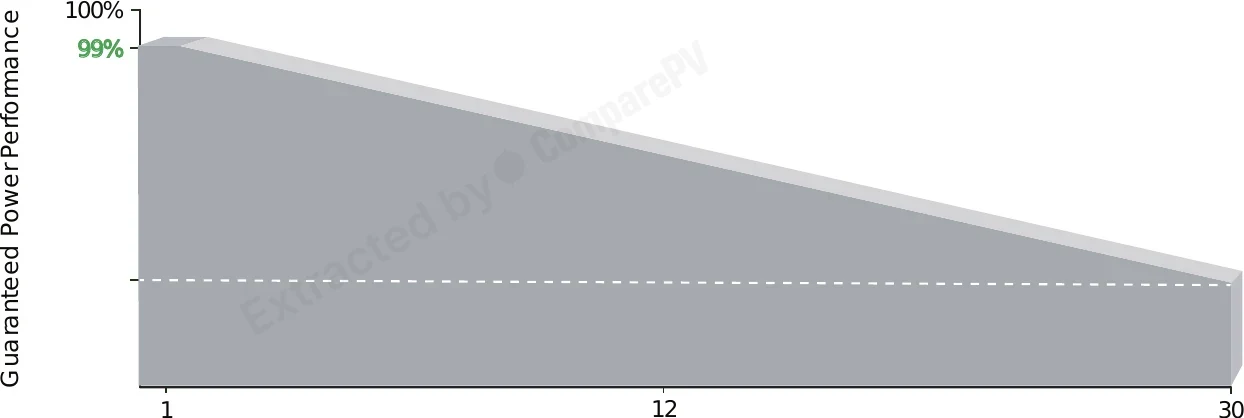
JinkoSolar guarantees ≤0.4%/year degradation and a minimum of 87.4% of nominal power output after 30 years of operation. While peer comparables (Risen RSM144-9, Hanersun Hitouch 5N) offer comparable terms, the 30-year horizon represents a premium standard versus the 25-year baseline still used by a portion of mid-tier manufacturers.
JinkoSolar is the sole manufacturer in the world to achieve a 100% bankability rating in BloombergNEF's 2024 PV Module Bankability Survey, maintaining Tier-1 status for over a decade (10th consecutive year as the most bankable brand). For investors relying on project finance or non-recourse debt, this directly streamlines technical due diligence and reduces lender risk assessment requirements.
Super Multi Busbar (SMBB) technology combined with M10 (182 mm) half-cut cells reduces resistive losses and mitigates microcracks. The peak power of 585 Wp and module efficiency of 22.65% place this series at the top of its peer group (Hanersun HN18-72H and Q-SUN Qrystal N8 match at 22.65%; Risen RSM144-9 reaches 22.6%). Mechanical ratings: snow load 5400 Pa, wind load 2400 Pa.
The 72HL4-(V) series is strictly monofacial (is_bifacial = false). The direct JinkoSolar counterpart, the Tiger Neo 72HL4-BDV (bifacial, dual-glass), captures an additional 5-15% of energy from rear-side reflected irradiance depending on ground albedo. For ground-mount and utility-scale projects - the primary target market for this series - forgoing bifaciality is a concrete constraint when optimizing LCOE.
The declared product warranty is 12 years, which is the market-standard for large commercial modules; however, select premium Tier-1 manufacturers (e.g., Trina Solar Vertex N) now offer 15-year product warranties. In the context of a 30-year investment horizon, this gap may affect insurance underwriting terms and risk scoring by project finance lenders.
- Efficiency of 22.1% matches the N-type 550-600W median
- Power density of 220.7 W/m² is 3.8 W/m² below N-type 550-600W median (224.5 W/m²) - needs more roof space
- At -0.29%/°C, hot weather performance is typical for N-type 550-600W panels
- 28.0 kg weight - 2.3 kg lighter than N-type 550-600W median (30.3 kg), reducing installation effort
- #6199 for efficiency, #2220 for temperature performance out of 14129 panels
Specifications
Datasheet charts
Measured curves published by Jinko Solar in this model's datasheet. A chart carrying a wattage was measured on that variant alone - only the ones that describe 570 Wp appear here. The rest cover the whole series.
Simulations
Degradation from this panel's own datasheet figures. No inverter, soiling or shading losses.





Found 2327 panels of the same or similar size to this one, within ±10 mm. See them here Found 2369 panels of the same or similar size to this one, within ±25 mm. See them here Found 2383 panels of the same or similar size to this one, within ±50 mm. See them here Found 2548 panels of the same or similar size to this one, within ±100 mm. See them here
About the Tiger Neo N-type 72HL4-(V) series
These answers cover the whole series. Where a figure differs, the specification above is this module's own.