Jinko Solar JKM550-570M-72HL4-(V)-F5-EN / JKM550M-72HL4 / JKM550M-72HL4-V

550 Wp PERC
ComparePV verdict

Light for its output, short guarantee

Rank 8,057 of 14,129
Compare panels Datasheet PDF
Power (Wp)
550
Weak · bottom 15%
Efficiency (%)
21.29
Typical · median 21.29%
Density (Wp/m²)
212.9
Typical · median 212.9
Temp (%/°C)
-0.350
Typical · median -0.350
Weight (kg)
27.0
Strong · 3.8 kg below median
Warranty (yrs)
25
Weak · bottom 24%

The Jinko Solar Tiger Pro 72HC (MBB HC Technology) series was designed for reliable energy production in locations where the predictability of energy yields and resilience to typical operational issues are crucial. The application of heterojunction (HC) technology improves the module's performance under partial shading-power drops are less severe, which is significant on roofs with chimneys, window wells, or installations near trees. The construction also employs Multi Busbar (MBB), or multi-string current collection-this translates to better light capture, lower resistive losses, and higher reliability over time. An additional distinguishing feature is Tiling Ribbon (TR), which minimizes gaps between cells, supporting efficient use of the module's surface area.

In practice, this series helps mitigate the risk of hot-spots and energy yield losses in challenging operating conditions, which is appreciated by installers in C&I projects and investors in PV farms. It is an excellent choice for installations where low energy costs and stable operation over years are a priority.

Ranking

589 panels in the segment PERC 550-600 W
Metric This panel Median Position in segment Overall rank
Module efficiency 21.29% 21.29% Typical 8,776
Power density 212.9 212.9 Typical 8,563
Temperature coefficient -0.350 -0.350 Typical 10,489
Weight per kWp 49.1 52.7 Strong · top 13% 2,727
Performance warranty 25 yrs 27 yrs Weak · bottom 24% 9,912
Colour key Strong - top 25% Typical - middle 50% Weak - bottom 25%

Signals from the data

6 positive · 4 caution
Best for

Commercial, utility-scale and shaded-installations.

Not ideal for

Owners who want a long output guarantee.

Strengths
49.1 kg per kWp

Top 13% of the PERC 550-600 W segment, against a median of 52.7.

Watch-outs
25 year performance warranty

Bottom 24% of the PERC 550-600 W segment, against a median of 27 yrs.

What owners get
MBB + Half-Cut (HC) Technology

The combination of Multi Busbar (MBB) and 144 half-cut cells reduces series resistance and resistive losses, lowers hot-spot risk, and improves module behavior under partial shading compared to conventional 72-cell full-cell designs, resulting in higher annual energy yield.

Top-Tier Efficiency for Mono-PERC 72HC

Module efficiency of 21.29-22.07% places this series in the upper quartile of mono-PERC products in the 550-570 Wp power class. For reference, the peer-comparable Silfab Commercial NTC reaches a maximum of 22.1% at the same peak power.

#1 BNEF Bankability Ranking

JinkoSolar achieved a 100% bankability rating in the BloombergNEF 2024 PV Module Bankability Survey - the only manufacturer to do so - maintaining this position for over 10 consecutive years. This ensures full lender acceptance for C&I and utility-scale project financing.

High Mechanical Load Resistance

Datasheet confirms resistance to 5,400 Pa front-side and 2,400 Pa rear-side loads, combined with high salt mist and ammonia resistance, making these modules suitable for harsh environments such as coastal zones and agricultural installations.

Reliable Warranty Coverage

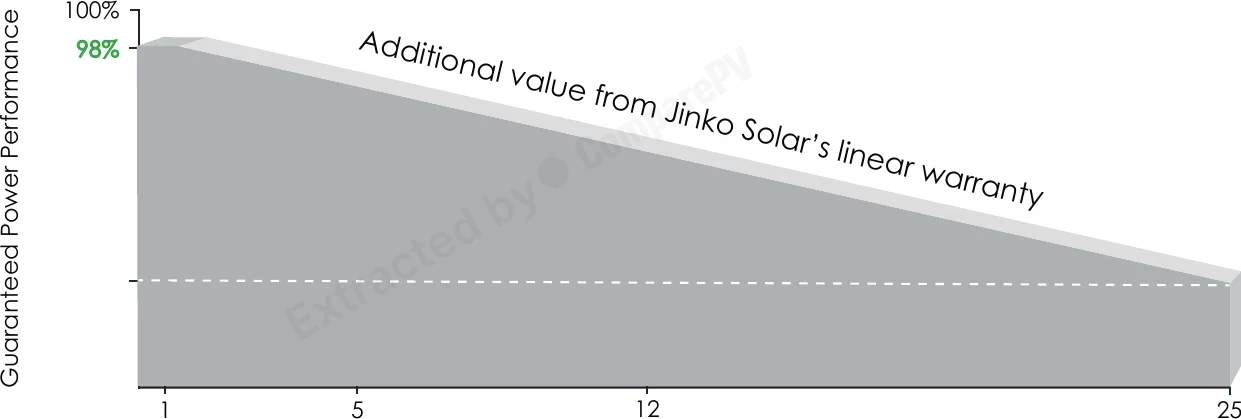
25-year linear power warranty guaranteeing ≥84.8% of rated power at year 25, backed by a manufacturer with a documented global warranty service network and European regional support infrastructure.

Trade-offs
Discontinued Series (2024)

The Tiger Pro 72HC line was discontinued approximately in 2024 and superseded by the Tiger Neo TOPCon N-type lineup. New orders are fulfilled exclusively from remaining warehouse stock, creating a risk of limited module availability for system expansions or replacement of damaged units.

PERC vs. TOPCon: Higher Annual Degradation

P-type PERC technology results in LID-related first-year degradation of ~2% and ~0.55%/yr thereafter, guaranteeing ≥84.8% power after 25 years. Newer TOPCon modules (e.g., Jinko Tiger Neo 3.0) declare ~1% year-1 degradation and ~0.40%/yr subsequently, translating to approximately 5-6 percentage points more remaining power at end-of-warranty - a meaningful lifetime LCOE difference.

Efficiency Below Peer Leaders

The maximum module efficiency of 22.07% falls short of the listed peer comparables: Horay Solar HS 191R-132 TC-D Basin and HS 191R-132 TC Basin, both rated at 570 Wp and 23.0% efficiency. The ~0.93 pp gap translates to greater roof area required to achieve the same installed capacity.

Notes from the database
  • Efficiency of 21.3% matches the PERC 550-600W median
  • At 212.9 W/m² power density, roof space requirements are typical for PERC 550-600W panels
  • At -0.35%/°C, hot weather performance is typical for PERC 550-600W panels
  • At 27.0 kg, this panel is 3.8 kg lighter than PERC 550-600W median (30.8 kg) - easier handling during installation
  • In the top 62% for efficiency among all PERC panels

Specifications

Open datasheet PDF
Nominal power (Pmax) 550 Wp Nameplate at 1000 W/m², 25 °C
Module efficiency 21.29 % Typical Segment median 21.29%
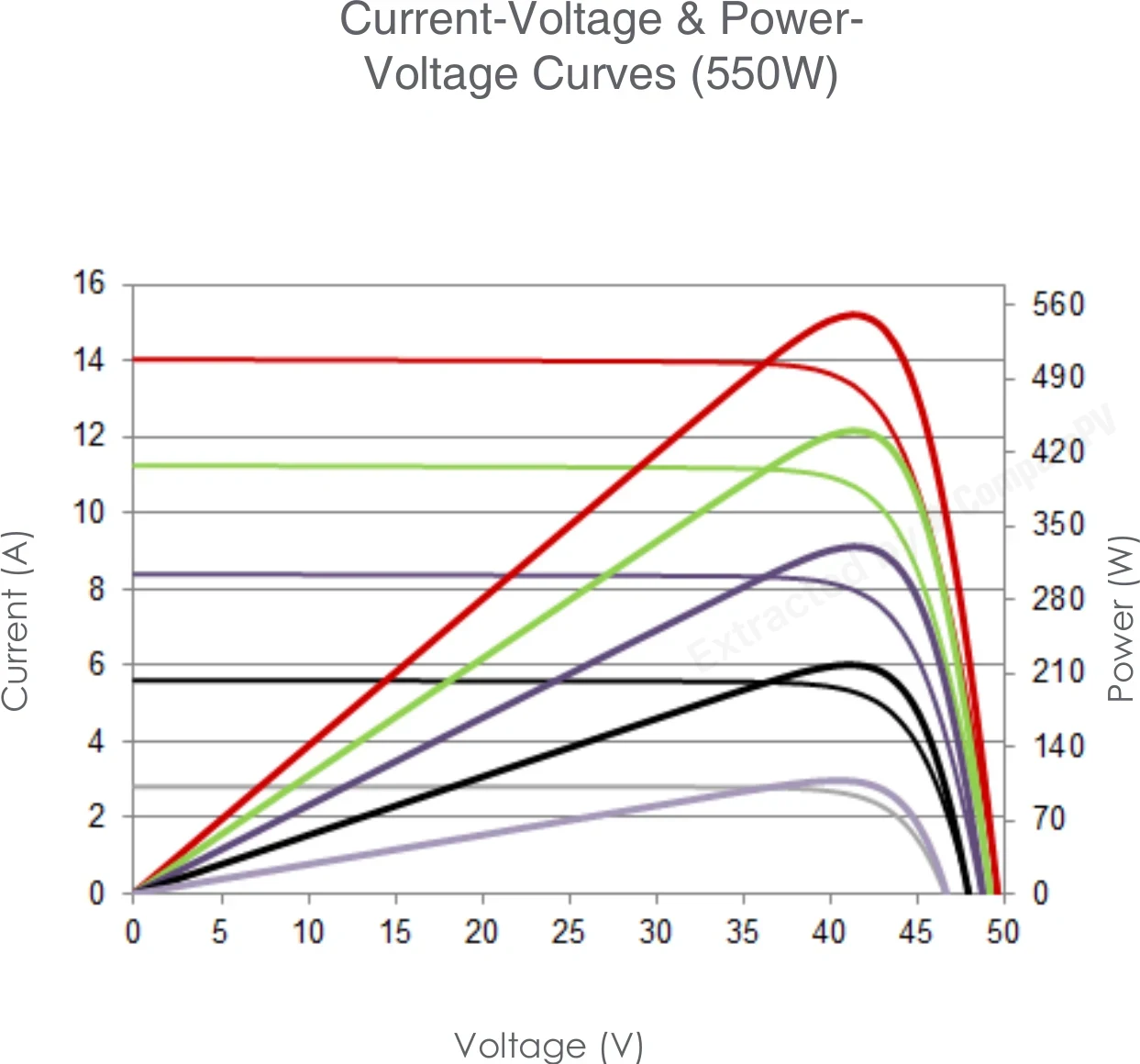
Vmpp · Impp 40.90 V · 13.45 A Operating point at max power
Voc · Isc 49.62 V · 14.03 A Sizes the string length
Max system voltage 1500 V Longer strings than 1000 V modules
Dimensions 2278×1134×30 mm · 2.58 m² of roof
Weight 27.0 kg Strong Strong · 3.8 kg below median
Cells 144 · PERC Monocrystalline
Coefficient Pmax -0.350 %/°C Typical median -0.350 of its segment
Coefficient Voc · Isc -0.280 · 0.048 %/°C
NOCT 45 °C At 800 W/m², 20 °C ambient
Product warranty 12 years Hardware defects only
Performance warranty 25 years Weak bottom 24% · median 27 yrs
End-of-warranty output 84.8 % Equals 457 W guaranteed
Degradation 0.55 % Per year after the first

Datasheet charts

Open datasheet PDF

Measured curves published by Jinko Solar in this model's datasheet. A chart carrying a wattage was measured on that variant alone - only the ones that describe 550 Wp appear here. The rest cover the whole series.
Simulations

Live - change any input
Lifetime output & value
30 years at 1200 kWh/kWp/year and €0.50 per kWh
Power in year 30
-
Lifetime energy
-
Energy value
-

Degradation from this panel's own datasheet figures. No inverter, soiling or shading losses.

Heat losses
-0.350 %/°C against a segment median of -0.350
-
Filter these
Size
Panel Power Eff. Temp. Weight Difference
Jinko Solar JKM550-570M-72HL4-(V)-F5-EN / JKM550M-72HL4 / JKM550M-72HL4-V 550 W 21.29% -0.350 27.0 kg You are here
LR7-54HJD-510M 510 W 25.00% -0.240 23.5 kg Cooler, +3.7 pp, +5 yr warranty
LR7-60HVH-560M 560 W 24.80% -0.260 25.0 kg Cooler, +3.5 pp, +5 yr warranty
LR7-54HJD-505M 505 W 24.70% -0.240 23.5 kg Cooler, +3.4 pp, +5 yr warranty
WST-505BKX54-A2 505 W 24.70% -0.260 25.0 kg Cooler, +3.4 pp, +5 yr warranty
LR7-60HVH-555M 555 W 24.60% -0.260 25.0 kg Cooler, +3.3 pp, +5 yr warranty
LR7-54HJD-500M 500 W 24.50% -0.240 23.5 kg -50 W, cooler, +3.2 pp
JKM525M-72HL4-TV 525 W 20.36% -0.350 28.9 kg -25 W, -0.9 pp, +5 yr warranty
JS182MHC144-525 525 W 20.31% -0.350 26.5 kg -25 W, -1.0 pp
JKM530M-72HL4-TV 530 W 20.55% -0.350 28.9 kg -20 W, -0.7 pp, +5 yr warranty
JS182MHC144-530 530 W 20.51% -0.350 26.5 kg -20 W, -0.8 pp
JKM535M-72HL4-(V)-F3-EN 535 W 20.71% -0.350 28.0 kg -15 W, heavier, -0.6 pp
JKM535M-72HL4-BDVP 535 W 20.75% -0.350 34.3 kg Heavier, -0.5 pp, +5 yr warranty
AIKO-A650-MAE72Mw 650 W 25.20% -0.260 27.0 kg +100 W, cooler, +3.9 pp
AIKO-A645-MAE72Mw 645 W 25.00% -0.260 27.0 kg +95 W, cooler, +3.7 pp
AIKO-A640-MAE72Mw 640 W 24.80% -0.260 27.0 kg +90 W, cooler, +3.5 pp
AIKO-A635-MAE72Mw 635 W 24.60% -0.260 27.0 kg +85 W, cooler, +3.3 pp

Found 2327 panels of the same or similar size to this one, within ±10 mm. See them here Found 2369 panels of the same or similar size to this one, within ±25 mm. See them here Found 2383 panels of the same or similar size to this one, within ±50 mm. See them here Found 2548 panels of the same or similar size to this one, within ±100 mm. See them here

About the Tiger Pro 72HC (MBB HC Technology) series

6 answered

These answers cover the whole series. Where a figure differs, the specification above is this module's own.

Is the Jinko Solar Tiger Pro 72HC series still available for purchase?
The Tiger Pro 72HC (MBB HC Technology) series has been discontinued and is no longer actively distributed by Jinko Solar. If you need modules of the same class, consider newer Jinko series such as Tiger Neo, which offer higher efficiency and updated cell technology. Residual stock may still be available through some distributors.
What warranty does the Jinko Solar Tiger Pro 72HC come with?
Jinko Solar provides a 12-year product warranty covering manufacturing defects and materials, along with a 25-year linear power output warranty. Over those 25 years, the module is guaranteed to maintain power above the specified threshold - typically with an annual degradation rate of around 0.45% after the first year. Warranty claims are handled by Jinko Solar as a Tier 1 manufacturer.
How does half-cut (HC) cell technology improve performance under partial shading?
Half-cut technology splits each PERC cell into two halves, reducing power losses when part of the module is shaded by a chimney, dormer, or nearby trees. The upper and lower halves of an HC module operate electrically independent, meaning shading one half does not block the entire string. In practice, this results in higher annual energy yield on complex rooftops compared to full-cell modules.
Are the Tiger Pro 72HC panels rated at 570 Wp suitable for a residential sloped roof?
The 72-cell modules in this series measure approximately 2278×1134 mm and weigh around 27 kg, making them larger than typical residential panels. Installation on a sloped roof is possible but requires a robust racking structure and an experienced crew. The series was designed for commercial and utility-scale PV installations where the larger format lowers the cost per watt. For residential applications, a more compact 60-cell format is generally preferred.
What is Multi Busbar (MBB) technology and does it actually improve module performance?
Multi Busbar replaces the traditional 3-5 thick busbars with 9-12 thinner ones. More busbars shorten the current path within the cell, reducing resistive losses and improving the capture of internally reflected light. The real-world result is higher power output for the same module footprint and better long-term reliability - damage to a single busbar has a smaller impact on overall cell performance compared to conventional designs.
How do Jinko Solar Tiger Pro 72HC panels perform in cold temperatures and overcast conditions?
The temperature coefficient of Pmax for this series is approximately -0.35%/°C. This means that as temperature drops below 25°C (STC), module output increases - cold, sunny winter days can therefore boost energy yield. Under diffuse light on overcast days, PERC modules with MBB and half-cut technology outperform older cell technologies, although like any monocrystalline panel they perform best under direct irradiance.
Add to compare