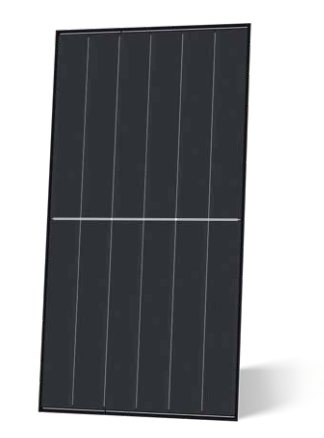
Jinko Solar JKM495-520N-51QL6-BDV-F2-EU (520W)

JKM495-520N-51QL6-BDV-F2-EU (520W)

520 Wp TOPCon Bifacial 85%
ComparePV verdict

Efficiency leader, no clear weak spot

Rank 4,053 of 14,005
Compare panels Datasheet PDF
Power (Wp)
520
Typical for its class
Efficiency (%)
24.06
Strong · top 1%
Density (Wp/m²)
240.6
Strong · top 1%
Temp (%/°C)
-0.260
Strong · top 2%
Weight (kg)
26.3
Typical · median 27.0 kg
Warranty (yrs)
30
Typical · median 30 yrs

Jinko Solar's Tiger Neo III 51QL6-BDV series are modules designed for maximum yield from the same surface area - especially where every square meter of roof or row in a solar farm counts. What sets them apart is the N-type TOPCon cell technology, engineered for more stable long-term operation and superior energy conversion in conditions where conventional modules lose their edge. In practice, this means higher yields not just under full sun but also during challenging daylight hours.

A key feature is bifaciality - the panels can harvest energy from both sides, effectively boosting energy production on ground-mounted systems, light-colored roofs, and any surface that reflects sunlight well. The glass-glass (double glass) construction enhances resistance to environmental factors and ensures durability in demanding locations. Furthermore, their low high-temperature sensitivity means they sag less during hot summer months.

This is an excellent choice for homes with limited space, companies seeking a lower LCOE, and commercial projects where predictable energy yields and long-term reliability are crucial.

Ranking

432 panels in the segment TOPCon 500-550 W
Metric This panel Median Position in segment Overall rank
Module efficiency 24.06% 22.73% Strong · top 1% 268
Power density 240.6 227.4 Strong · top 1% 290
Temperature coefficient -0.260 -0.290 Strong · top 2% 511
Weight per kWp 50.6 52.4 Typical 3,985
Performance warranty 30 yrs 30 yrs Typical 21
Colour key Strong - top 25% Typical - middle 50% Weak - bottom 25%

Signals from the data

8 positive · 1 caution
Best for

Residential, commercial and hot-climate.

Strengths
24.06% module efficiency

Top 1% of the TOPCon 500-550 W segment, against a median of 22.73%. Ranked 268th in the whole database.

240.6 watts per square metre

Top 1% of the TOPCon 500-550 W segment, against a median of 227.4. Ranked 290th in the whole database.

-0.260 %/°C temperature coefficient

Top 2% of the TOPCon 500-550 W segment, against a median of -0.290. Ranked 511th in the whole database.

What owners get
Efficiency leader among peers

Peak efficiency of 24.06% outperforms direct comparables: HT-SAAE HT54-18X(N) at 23.8%, TCL Zhonghuan HSM-BD60-LA at 23.5%, and DAH Solar DHN-60R20/DG at 23.0%. For space-constrained installations, this translates into higher energy yield without increasing the module count.

Temperature coefficient of -0.26%/°C

The Pmax temperature coefficient of -0.26%/°C is approximately 35–40% better than typical PERC modules (-0.40 to -0.45%/°C) and 10–13% better than standard TOPCon (-0.29 to -0.30%/°C). At summer module temperatures of 55–60°C, this delivers roughly 4.5% higher output than a PERC module with the same STC nameplate rating.

Low N-type degradation, no LID

N-type TOPCon cell technology eliminates LID and minimizes LeTID. The manufacturer guarantees degradation of ≤1% in Year 1, then ≤0.4%/year linear, retaining ≥87.4% of rated power after 30 years — compared to ≤0.45%/year and ≥84.8% at 25 years for standard P-type PERC modules.

30-year linear power warranty

A 30-year linear performance warranty with a ≥87.4% floor exceeds the 25-year standard offered by the peer comparables. For a commercial 500 kWp project, the extended warranty horizon lowers LCOE and simplifies long-term project finance structuring.

BNEF #1 bankability + bifacial glass-glass

JinkoSolar is the only PV module manufacturer recognized as bankable by 100% of respondents in the Bloomberg NEF bankability survey for 10 consecutive years (2025 report), significantly easing project financing. A bifacial factor up to 85% adds 5–25% rear-side energy gain, and the dual-glass (2+2 mm) structure enhances resistance to PID, moisture ingress, and microcracks.

Trade-offs
26.3 kg heavier than glass-backsheet

The dual-glass construction results in a module weight of 26.3 kg, compared to 21–23 kg for typical glass-backsheet TOPCon panels of similar wattage. On rooftop installations of older buildings, this may require a structural load assessment, adding to project engineering costs.

Notes from the database
  • At 24.1% efficiency, this panel is 1.3pp above typical TOPCon 500-550W modules (median: 22.7%)
  • At 240.6 W/m² power density, this panel generates 13.2 W/m² more per unit area than TOPCon 500-550W median (227.4 W/m²)
  • Temperature coefficient of -0.26%/°C vs median -0.29%/°C means ~1% less power loss at 65°C
  • 85% bifaciality enables rear-side power generation, boosting yield by 4-13% on reflective surfaces
  • #268 for efficiency, #511 for temperature performance out of 14005 panels

Specifications

Open datasheet PDF
Nominal power (Pmax) 520 Wp Nameplate at 1000 W/m², 25 °C
Module efficiency 24.06 % Strong Segment median 22.73%
Vmpp · Impp 33.57 V · 15.49 A Operating point at max power
Voc · Isc 39.60 V · 16.01 A Sizes the string length
Max system voltage 1500 V Longer strings than 1000 V modules
Dimensions 1906×1134×30 mm · 2.16 m² of roof
Weight 26.3 kg Typical Typical · median 27.0 kg
Cells 204 · TOPCon Monocrystalline
Bifaciality 85 % Rear output as a share of front
Coefficient Pmax -0.260 %/°C Strong top 2% of its segment
Coefficient Voc · Isc -0.240 · 0.046 %/°C
Product warranty 15 years Hardware defects only
Performance warranty 30 years Typical median 30 yrs · median 30 yrs
End-of-warranty output 88.8 % Equals 462 W guaranteed
Degradation 1.00 → 0.35 % First year, then annual

Simulations

Live - change any input
Lifetime output & value
30 years at 1200 kWh/kWp/year and €0.50 per kWh
Power in year 30
-
Lifetime energy
-
Energy value
-
With bifacial gain
-

Degradation from this panel's own datasheet figures. No inverter, soiling or shading losses.

Heat losses
-0.260 %/°C against a segment median of -0.290
-
Bifacial gain
Rear gain over light concrete: -
-

Model: bifaciality × albedo × 0.6 view factor. A first-order estimate, not a yield simulation.

Filter these
Size
Panel Power Eff. Temp. Weight Difference
Jinko Solar JKM495-520N-51QL6-BDV-F2-EU (520W) 520 W 24.06% -0.260 26.3 kg You are here
LR7-54HJD-510M 510 W 25.00% -0.240 23.5 kg Cooler, lighter, +0.9 pp
AIKO-A495-MCE54Mw 495 W 24.80% -0.260 21.0 kg -25 W, lighter, +0.7 pp
LR7-60HVH-560M 560 W 24.80% -0.260 25.0 kg +40 W, lighter, +0.7 pp
LR7-54HJD-505M 505 W 24.70% -0.240 23.5 kg Cooler, lighter, +0.6 pp
LR7-60HVH-555M 555 W 24.60% -0.260 25.0 kg +35 W, lighter, +0.5 pp
AIKO-A490-MCE54Mw 490 W 24.50% -0.260 21.0 kg -30 W, lighter, +0.4 pp
LR7-54HJD-500M 500 W 24.50% -0.240 23.5 kg Cooler, lighter, +0.4 pp
JKM440M-60HL4 440 W 20.39% -0.350 24.2 kg -80 W, hotter, -3.7 pp
JKM445M-60HL4 445 W 20.62% -0.350 24.2 kg -75 W, hotter, -3.4 pp
JKM450M-60HL4-V 450 W 20.85% -0.350 24.2 kg -70 W, hotter, -3.2 pp
JS182MHC120-450 450 W 20.79% -0.340 23.0 kg -70 W, hotter, -3.3 pp
JKM455M-60HL4 455 W 21.08% -0.350 24.2 kg -65 W, hotter, -3.0 pp
JS182MHC120-455 455 W 21.02% -0.340 23.0 kg -65 W, hotter, -3.0 pp
LR7-60HVHL-550M 550 W 24.40% -0.260 16.3 kg +30 W, lighter, +0.3 pp
JAT60S40-540/LR 540 W 24.40% -0.260 23.5 kg +20 W, lighter, +0.3 pp
GK-5-60HG-540M 540 W 24.40% -0.260 23.3 kg +20 W, lighter, +0.3 pp

Found 739 panels of the same or similar size to this one, within ±10 mm. See them here Found 755 panels of the same or similar size to this one, within ±25 mm. See them here Found 910 panels of the same or similar size to this one, within ±50 mm. See them here Found 1499 panels of the same or similar size to this one, within ±100 mm. See them here

Common questions

6 answered
What warranty does the Jinko Solar Tiger Neo III 51QL6-BDV series come with?
The Tiger Neo III 51QL6-BDV series carries a 15-year product warranty covering material and workmanship defects, along with a 30-year linear power output warranty. The power warranty guarantees that the module will maintain a precisely defined minimum output level over three decades. The 30-year performance warranty is especially relevant when calculating LCOE for commercial projects and utility-scale PV plants.
Does the bifacial design of the Tiger Neo III 51QL6-BDV actually increase energy yield?
Yes, though the gain depends heavily on installation conditions. Bifacial modules harvest light from both the front and rear sides, which on ground-mounted systems with gravel or grass surfaces can add several percent to annual energy yield. The largest gains come from highly reflective ground surfaces and sufficient module clearance height. On a shaded or dark roof, the bifacial contribution will be minimal.
How does TOPCon technology in the Tiger Neo III 51QL6-BDV differ from standard PERC cells?
TOPCon (Tunnel Oxide Passivated Contact) uses an N-type silicon base with lower annual degradation rates and better low-light and diffuse-light conversion compared to P-type PERC. In practice, this means higher energy output in the morning, evening, and on overcast days. The result is a better overall performance ratio (PR) for the system, which is particularly valuable in climates with significant cloud cover.
Are the Jinko Solar Tiger Neo III 51QL6-BDV panels suitable for a residential rooftop installation?
Yes. With a maximum output of 520 Wp per module, fewer panels are needed to cover a typical household's energy demand, which is a clear advantage on roofs with limited usable area. However, larger 500+ Wp modules require a structural assessment of the roof's load-bearing capacity and a compatible inverter with appropriate MPPT voltage input ranges.
How does the glass-glass construction of the Tiger Neo III 51QL6-BDV affect module durability?
Dual-glass construction replaces the traditional polymer backsheet with a second glass layer, significantly improving resistance to moisture ingress, UV degradation, and cell micro-cracking. Glass-glass modules show lower susceptibility to potential-induced degradation (PID) and better withstand harsh environmental conditions. This directly supports the 30-year power warranty, as enclosure durability is fundamental to long-term field performance.
Do the Tiger Neo III 51QL6-BDV panels suffer significant power loss in summer heat?
N-type TOPCon technology delivers a more favorable temperature coefficient than standard PERC modules. This means each degree Celsius of cell temperature rise above STC results in a proportionally smaller power loss. In summer, when modules on rooftops reach 60-70°C, this advantage over older technologies becomes measurable and contributes to meaningfully higher annual energy yield from the system.
Add to compare