JKM450-475N-48HL4M-DV (465W class)

465 Wp TOPCon
ComparePV verdict

Space saver, no clear weak spot

Rank 6,892 of 14,005
Compare panels Datasheet PDF
Power (Wp)
465
Typical for its class
Efficiency (%)
23.27
Strong · top 12%
Density (Wp/m²)
232.7
Strong · top 10%
Temp (%/°C)
-0.290
Typical · median -0.290
Weight (kg)
24.0
Typical · median 24.0 kg
Warranty (yrs)
30
Typical · median 30 yrs

Jinko Solar's Tiger Neo 48HL4M-DV (dual glass, mono-facial) modules are designed for maximum yield on limited rooftop surfaces. The use of N-type TOPCon cells translates to lower susceptibility to degradation over time and more stable performance under varying real-world conditions, where sunlight fluctuates. In practice, this means a more predictable annual energy production-particularly important for prosumers and companies billed based on self-consumption.

The dual glass (glass-glass) construction reinforces the module and provides better protection against moisture and micro-cracks, which investors seeking equipment for decades, not just a few seasons, highly value. Additionally, SMBB improves current collection and minimizes losses during partial shading, while HOT 3.0 supports long-term reliability.

This is an excellent choice for residential and commercial installations, especially on roofs with higher humidity, in areas with stronger winds, or where high durability and peace of mind over the years are key.

Ranking

1,089 panels in the segment TOPCon 450-500 W
Metric This panel Median Position in segment Overall rank
Module efficiency 23.27% 22.52% Strong · top 12% 1,202
Power density 232.7 225.2 Strong · top 10% 1,115
Temperature coefficient -0.290 -0.290 Typical 2,165
Weight per kWp 51.6 52.2 Typical 4,981
Performance warranty 30 yrs 30 yrs Typical 21
Colour key Strong - top 25% Typical - middle 50% Weak - bottom 25%

Signals from the data

7 positive · 2 caution
Best for

Residential, commercial and shaded-installations.

Strengths
232.7 watts per square metre

Top 10% of the TOPCon 450-500 W segment, against a median of 225.2.

23.27% module efficiency

Top 12% of the TOPCon 450-500 W segment, against a median of 22.52%.

What owners get
Low LID/LeTID degradation rate

N-type TOPCon cells demonstrate LID degradation of just 0.26% versus 1.92% for PERC modules, as validated by TÜV Nord testing. Annual degradation is ~0.40%/yr vs. ~0.55% for P-type, translating into meaningfully higher cumulative energy yield over the 30-year warranty period.

30-year linear power warranty

Jinko Solar guarantees linear power output for 30 years with a 15-year product warranty. Peer comparables (JA Solar JAM54D40 LB, Astronergy ASTRO N7s 2.0) offer a comparable warranty structure; however, Jinko's 100% BNEF bankability score for 10 consecutive years significantly strengthens the credibility of this long-term commitment.

Dual glass – IP68 and mechanical resilience

The 2.0+2.0 mm glass-glass construction provides IP68 protection, salt mist resistance (IEC 61701), and ammonia resistance (IEC 62716). The module withstands 6,000 Pa front-side static load (snow) and 4,000 Pa rear-side load (wind), making it well-suited for coastal, high-humidity, and high-wind-zone installations.

#1 BNEF bankability – Tier-1 manufacturer

JinkoSolar ranked #1 in the BloombergNEF PV Module Bankability Survey 2024 as the only manufacturer to achieve a 100% bankability score, maintaining Tier-1 status for over a decade. With 86.8 GW shipped in 2025, the company demonstrates supply chain stability and long-term serviceability.

SMBB + HOT 3.0 – reduced partial-shading losses

Super Multi-Busbar (SMBB) technology shortens current paths between cells, lowering series resistance and reducing losses under partial shading. HOT 3.0 (High-performance Overlapping cell Technology) enhances long-term reliability of cell interconnections within the glass-glass laminate structure.

Trade-offs
Fire class C – mounting restrictions

The EU datasheet (JKM450-475N-48HL4M-DV-Z2-EU) lists fire classification Class C per IEC 61730:2023. In markets where building codes mandate Class A for modules installed near adjacent structures or in BIPV applications, this series requires compliance verification. Peer comparable Astronergy ASTRO N7s 2.0 (DG) declares Class A in its BH variant.

Higher weight – 24 kg (dual glass)

The glass-glass construction results in ~24 kg per module versus ~20–21 kg for a typical aluminum-framed module at comparable wattage. On older roof structures, this requires a structural load assessment and may increase BoS costs due to additional handling equipment and extended installation time.

Notes from the database
  • 23.3% module efficiency - 0.8pp better than the TOPCon 450-500W median of 22.5%
  • At 232.7 W/m² power density, this panel generates 7.5 W/m² more per unit area than TOPCon 450-500W median (225.2 W/m²)
  • At -0.29%/°C, hot weather performance is typical for TOPCon 450-500W panels
  • In the top 9% for efficiency among all TOPCon panels

Specifications

Open datasheet PDF
Nominal power (Pmax) 465 Wp Nameplate at 1000 W/m², 25 °C
Module efficiency 23.27 % Strong Segment median 22.52%
Vmpp · Impp 30.94 V · 15.03 A Operating point at max power
Voc · Isc 36.55 V · 15.96 A Sizes the string length
Max system voltage 1500 V Longer strings than 1000 V modules
Dimensions 1762×1134×30 mm · 2.00 m² of roof
Weight 24.0 kg Typical Typical · median 24.0 kg
Cells 96 · TOPCon Monocrystalline
Coefficient Pmax -0.290 %/°C Typical median -0.290 of its segment
Coefficient Voc · Isc -0.250 · 0.045 %/°C
Product warranty 15 years Hardware defects only
Performance warranty 30 years Typical median 30 yrs · median 30 yrs
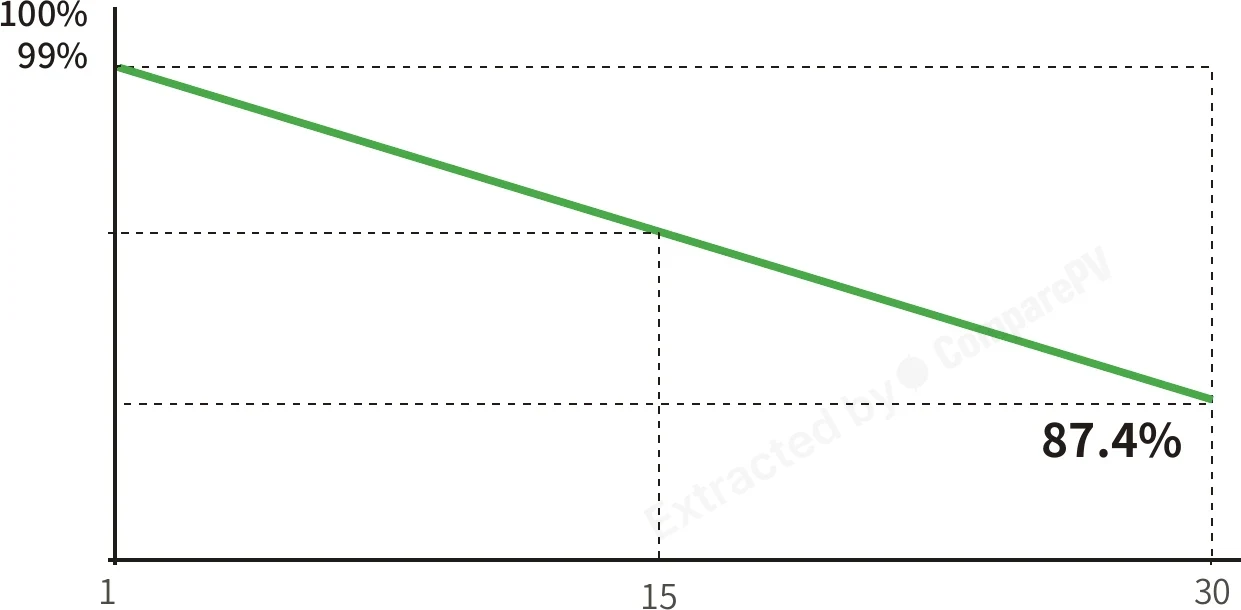
End-of-warranty output 87.4 % Equals 406 W guaranteed
Degradation 1.00 → 0.40 % First year, then annual

Datasheet charts

Open datasheet PDF

Measured curves published by Jinko Solar in this model's datasheet. A chart carrying a wattage was measured on that variant alone - only the ones that describe 465 Wp appear here. The rest cover the whole series.
Simulations

Live - change any input
Lifetime output & value
30 years at 1200 kWh/kWp/year and €0.50 per kWh
Power in year 30
-
Lifetime energy
-
Energy value
-

Degradation from this panel's own datasheet figures. No inverter, soiling or shading losses.

Heat losses
-0.290 %/°C against a segment median of -0.290
-
Filter these
Size
Panel Power Eff. Temp. Weight Difference
Jinko Solar JKM450-475N-48HL4M-DV (465W class) 465 W 23.27% -0.290 24.0 kg You are here
LR7-54HJD-510M 510 W 25.00% -0.240 23.5 kg +45 W, cooler, +1.7 pp
AIKO-A495-MCE54Mw 495 W 24.80% -0.260 21.0 kg +30 W, lighter, +1.5 pp
LR7-54HJD-505M 505 W 24.70% -0.240 23.5 kg +40 W, cooler, +1.4 pp
AIKO-A490-MCE54Mw 490 W 24.50% -0.260 21.0 kg Cooler, lighter, +1.2 pp
LR7-54HJD-500M 500 W 24.50% -0.240 23.5 kg +35 W, cooler, +1.2 pp
CIPRO-TN9C54M-500W 500 W 24.50% -0.260 21.4 kg +35 W, cooler, +1.2 pp
JKM420N-54HL4R-BDV 420 W 21.02% -0.290 22.0 kg -45 W, lighter, -2.2 pp
EU-JKM425-450N-54HL4R-BDB-G4 (425W class) 425 W 21.27% -0.290 24.5 kg -40 W, -2.0 pp
JKM430-455N-54HL4R-B-F8-EN (430W) 430 W 21.52% -0.290 21.0 kg -35 W, lighter, -1.8 pp

Found 1395 panels of the same or similar size to this one, within ±10 mm. See them here Found 1425 panels of the same or similar size to this one, within ±25 mm. See them here Found 3614 panels of the same or similar size to this one, within ±50 mm. See them here Found 3962 panels of the same or similar size to this one, within ±100 mm. See them here

Common questions

6 answered
What is the product and power warranty for the Jinko Solar Tiger Neo 48HL4M-DV series?
The Tiger Neo 48HL4M-DV series comes with a 15-year product warranty covering materials and workmanship, and a 30-year linear power warranty. After 30 years, the module should retain at least 87.4% of its rated output. This is one of the longer power warranties available on the market and a key consideration when calculating the return on investment over multiple decades.
Are the Jinko Tiger Neo 48HL4M-DV panels suitable for coastal installations or high-humidity environments?
Yes, the 48HL4M-DV series is well suited for those conditions. The dual glass construction provides significantly better moisture protection than standard backsheet modules. The panels are certified for salt mist and ammonia resistance, making them a solid choice for coastal rooftop installations as well as agricultural facilities with elevated ammonia levels in the air.
What is TOPCon technology and why are the N-type cells in the 48HL4M-DV better than older PERC modules?
N-type TOPCon cells have a lower annual degradation rate than older P-type PERC cells, meaning less power loss over the years and better output under diffuse light on overcast days. Jinko Solar's HOT 3.0 technology further reduces LID (Light Induced Degradation) during the first months of operation, resulting in more predictable energy yields throughout the module's entire service life.
How much does the Jinko Tiger Neo 48HL4M-DV module weigh and will a standard roof structure support it?
The module weighs approximately 24 kg with dimensions of 1762 × 1134 × 30 mm. This is standard for panels in this power class, and most typical aluminum or steel racking systems require no structural reinforcement. For larger arrays or older roof structures, it is advisable to verify the load-bearing capacity with your installer or a structural engineer.
Why is the Jinko 48HL4M-DV monofacial and does that matter for a rooftop installation?
The 48HL4M-DV is a monofacial module that collects energy only from the front surface. The bifacial variant (48HL4M-BDV) can additionally harvest light reflected from the ground, but on typical pitched roofs the gain is only around 2-5% because roofing materials reflect very little light. For most residential and commercial rooftop applications, monofacial is entirely sufficient and often a more cost-effective choice.
What is the peak power output of the Jinko Solar Tiger Neo 48HL4M-DV and how many panels does a typical home need?
The top variant of this series delivers a peak power of 475 Wp at an efficiency of up to 23.27%. A typical household consuming around 3,500-4,500 kWh per year generally needs between 8 and 12 modules, depending on location, roof pitch, and self-consumption profile. An installer should calculate the exact number based on a proper energy audit.
Add to compare