JKM450-475N-48HL4M-DV

475 Wp TOPCon
ComparePV verdict

Space saver, no clear weak spot

Rank 5,895 of 14,005
Compare panels Datasheet PDF
Power (Wp)
475
Typical for its class
Efficiency (%)
23.77
Strong · top 4%
Density (Wp/m²)
237.7
Strong · top 3%
Temp (%/°C)
-0.290
Typical · median -0.290
Weight (kg)
24.0
Typical · median 24.0 kg
Warranty (yrs)
30
Typical · median 30 yrs

The Jinko Solar Tiger Neo 48HL4M-DV series features monofacial glass-glass modules designed for maximum operational stability over the long term. The use of N-type TOPCon cells helps minimize typical degradation-related losses over time and maintains high energy output even under suboptimal irradiance conditions. Thanks to the HOT 3.0 technology, the module is optimized for enhanced reliability, which is crucial where predictable yield and reduced claim risks are important. The module is also distinguished by SMBB (multi busbar), supporting better current collection and resistance to microcracks. The dual-glass construction and enhanced component protection increase durability in challenging conditions, including humid environments and elevated salinity and ammonia presence, making it an excellent choice for coastal roofs, agricultural facilities, and industrial sites. This series is ideal for residential and commercial installations where high environmental durability and long-term reliability are priorities.

Ranking

1,089 panels in the segment TOPCon 450-500 W
Metric This panel Median Position in segment Overall rank
Module efficiency 23.77% 22.52% Strong · top 4% 499
Power density 237.7 225.2 Strong · top 3% 467
Temperature coefficient -0.290 -0.290 Typical 2,165
Weight per kWp 50.5 52.2 Typical 3,892
Performance warranty 30 yrs 30 yrs Typical 21
Colour key Strong - top 25% Typical - middle 50% Weak - bottom 25%

Signals from the data

7 positive · 2 caution
Best for

Residential and commercial.

Strengths
237.7 watts per square metre

Top 3% of the TOPCon 450-500 W segment, against a median of 225.2. Ranked 467th in the whole database.

23.77% module efficiency

Top 4% of the TOPCon 450-500 W segment, against a median of 22.52%. Ranked 499th in the whole database.

What owners get
23.77% efficiency – top of the 48-cell segment

The module delivers 23.77% efficiency, placing it neck-and-neck with the peer segment leaders: JA Solar JAM54D40 LB and Astronergy ASTRO N7s 2.0 (both at 23.8%, a 0.03 pp gap). Longi Hi-MO X10 Explorer trails at 23.3%; the 0.47 pp advantage over Longi translates to roughly 47 kWh more annual output on a typical 10 kWp rooftop system.

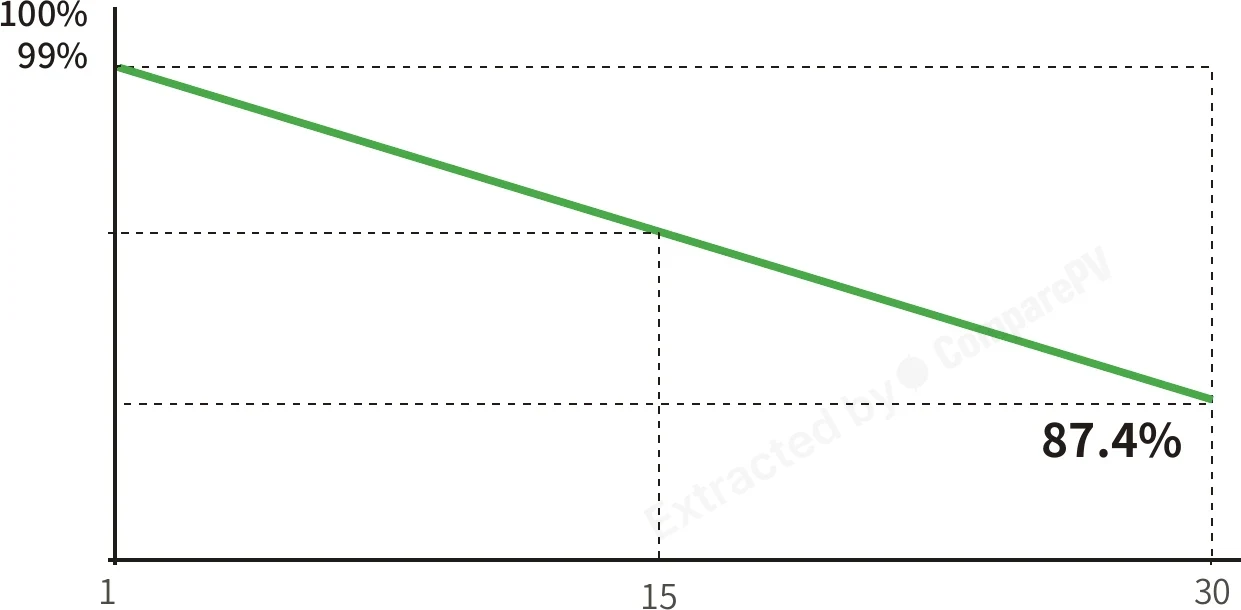
TOPCon degradation 0.40%/yr – ≥87.4% at year 30

N-type TOPCon cells exhibit significantly lower LID and LeTID than legacy PERC technology. The manufacturer guarantees linear degradation ≤0.40%/yr over 30 years and a minimum of 87.4% of rated power at end of life — one of the lowest degradation rates available in the 475 Wp class.

HOT 3.0 + 20-busbar SMBB – micro-crack risk −30%

The HOT 3.0 platform combined with a 20-busbar SMBB grid reduces micro-crack risk by ~30% vs. conventional 5-busbar designs (JinkoSolar, 2025). Shorter current pathways lower series resistance and improve fill factor, boosting yield under diffuse irradiance and partial shading conditions.

Dual glass: 6,000 Pa, IEC-certified salt mist & ammonia

The dual-glass construction (2.0 mm front + 2.0 mm rear) provides 6,000 Pa front and 4,000 Pa rear static load ratings, complying with IEC 61701 (salt mist) and IEC 62716 (ammonia) standards. Eliminating backsheet degradation makes this module the optimal choice for coastal, agricultural, and industrial rooftop installations.

#1 BNEF bankability – the only 100% rating in the market

JinkoSolar is the only PV module manufacturer with a 100% bankability rating in Bloomberg NEF's 2024/2025 survey, maintaining Tier-1 BNEF status for more than 10 consecutive quarters. This ensures smooth project financing and lease structuring — critical for commercial and institutional-scale deployments.

Trade-offs
15-year product warranty – below Tier-1 standard

Per the specifications for this variant, the product warranty (manufacturing defects) covers only 15 years, versus the 25-year standard offered by Tier-1 dual-glass manufacturers such as JA Solar, Astronergy, and Longi as of 2024. The 10-year gap may be a concern for bank-financed or leased installations requiring full product coverage throughout the loan repayment period.

Monofacial + dual glass: no bifacial gain

Despite the heavier and costlier dual-glass construction, the module lacks active rear-side cells (is_bifacial: false). On installations with high-albedo surfaces (white TPO membrane, light concrete, snow-covered ground), the 5–15% bifacial gain achievable with bifacial modules at the same power class is entirely foregone.

Notes from the database
  • Efficiency of 23.8% is 1.2pp above the TOPCon 450-500W median (22.5%)
  • 237.7 W/m² power density - 12.5 W/m² more than TOPCon 450-500W median (225.2 W/m²), more power per roof area
  • At -0.29%/°C, hot weather performance is typical for TOPCon 450-500W panels
  • #499 for efficiency, #2165 for temperature performance out of 14005 panels

Specifications

Open datasheet PDF
Nominal power (Pmax) 475 Wp Nameplate at 1000 W/m², 25 °C
Module efficiency 23.77 % Strong Segment median 22.52%
Vmpp · Impp 31.40 V · 15.13 A Operating point at max power
Voc · Isc 36.89 V · 16.06 A Sizes the string length
Max system voltage 1500 V Longer strings than 1000 V modules
Dimensions 1762×1134×30 mm · 2.00 m² of roof
Weight 24.0 kg Typical Typical · median 24.0 kg
Cells 96 · TOPCon Monocrystalline
Coefficient Pmax -0.290 %/°C Typical median -0.290 of its segment
Coefficient Voc · Isc -0.250 · 0.045 %/°C
Product warranty 15 years Hardware defects only
Performance warranty 30 years Typical median 30 yrs · median 30 yrs
End-of-warranty output 87.4 % Equals 415 W guaranteed
Degradation 1.00 → 0.40 % First year, then annual

Datasheet charts

Open datasheet PDF

Measured curves published by Jinko Solar in this model's datasheet. A chart carrying a wattage was measured on that variant alone - only the ones that describe 475 Wp appear here. The rest cover the whole series.
Simulations

Live - change any input
Lifetime output & value
30 years at 1200 kWh/kWp/year and €0.50 per kWh
Power in year 30
-
Lifetime energy
-
Energy value
-

Degradation from this panel's own datasheet figures. No inverter, soiling or shading losses.

Heat losses
-0.290 %/°C against a segment median of -0.290
-
Filter these
Size
Panel Power Eff. Temp. Weight Difference
Jinko Solar JKM450-475N-48HL4M-DV 475 W 23.77% -0.290 24.0 kg You are here
LR7-54HJD-510M 510 W 25.00% -0.240 23.5 kg +35 W, cooler, +1.2 pp
AIKO-A495-MCE54Mw 495 W 24.80% -0.260 21.0 kg Cooler, lighter, +1.0 pp
LR7-54HJD-505M 505 W 24.70% -0.240 23.5 kg +30 W, cooler, +0.9 pp
AIKO-A490-MCE54Mw 490 W 24.50% -0.260 21.0 kg Cooler, lighter, +0.7 pp
LR7-54HJD-500M 500 W 24.50% -0.240 23.5 kg +25 W, cooler, +0.7 pp
CIPRO-TN9C54M-500W 500 W 24.50% -0.260 21.4 kg Cooler, lighter, +0.7 pp
JKM420N-54HL4R-BDV 420 W 21.02% -0.290 22.0 kg -55 W, lighter, -2.8 pp
EU-JKM425-450N-54HL4R-BDB-G4 (425W class) 425 W 21.27% -0.290 24.5 kg -50 W, -2.5 pp
JKM430-455N-54HL4R-B-F8-EN (430W) 430 W 21.52% -0.290 21.0 kg -45 W, lighter, -2.2 pp

Found 1395 panels of the same or similar size to this one, within ±10 mm. See them here Found 1425 panels of the same or similar size to this one, within ±25 mm. See them here Found 3614 panels of the same or similar size to this one, within ±50 mm. See them here Found 3962 panels of the same or similar size to this one, within ±100 mm. See them here

Common questions

6 answered
What warranty comes with the Jinko Solar Tiger Neo 48HL4M-DV series?
The Tiger Neo 48HL4M-DV carries a 15-year product warranty covering material and workmanship defects, along with a 30-year power output warranty. After 30 years, Jinko guarantees at least 87.4% of nominal power, with annual degradation capped at 0.4% after year one. This is among the most competitive warranty packages currently available for monofacial modules on the market.
Are Jinko Tiger Neo 48HL4M-DV panels suitable for coastal rooftops or livestock farming environments?
Yes, this series is particularly well-suited for those conditions. The glass-glass construction with tempered glass on both sides, combined with certified salt mist and ammonia resistance, ensures stable performance in chemically aggressive environments. Eliminating the backsheet also reduces the risk of edge corrosion commonly seen in coastal installations and farm buildings with intensive animal husbandry.
What is HOT 3.0 technology in the Jinko Tiger Neo 48HL4M-DV modules?
HOT 3.0 is Jinko Solar's proprietary reliability-focused technology. It combines enhanced lamination methods, optimized SMBB (multi busbar) interconnection, and advanced protection against LID and LeTID degradation typical of older P-type cells. In practice, this results in lower microcrack risk, more stable long-term output, and a predictable energy yield backed by the 30-year power warranty.
How does the Jinko Tiger Neo 48HL4M-DV perform in overcast conditions or low winter temperatures?
N-type TOPCon cells deliver a temperature coefficient of Pmax of -0.29%/°C, which is noticeably better than standard PERC modules at -0.35% to -0.38%/°C. This means smaller power losses on hot days and more stable output in cool, diffuse light. The series is well-matched to climates with a high proportion of cloudy days, making it a solid choice for Central European installations.
What are the dimensions and weight of the 475 Wp Jinko Solar Tiger Neo 48HL4M-DV module?
The 475 Wp module measures 1762 × 1134 × 30 mm and weighs approximately 21.5 kg. The dual-glass frameless construction is slightly heavier than backsheet-and-frame equivalents, which should be factored into racking system selection. With efficiency reaching up to 23.77%, the module delivers more power per square meter of roof space compared to older PERC panels.
How does the Tiger Neo 48HL4M-DV differ from the bifacial versions of the Tiger Neo series?
The DV (Dual glass, monofacial) variant uses two glass panes, but only the front surface is active — the rear is opaque. Bifacial Tiger Neo versions can additionally harvest light reflected off the ground, generating 5–25% extra energy under favorable conditions (light-colored ground, open spaces). The DV variant is chosen where the mechanical and environmental durability of glass-glass construction matters more than the bifacial gain — for example, on dark-membrane rooftops or in dense urban installations.
Add to compare