Middle of its segment, heavy for its output
The JA Solar JS 120M6 HJT DG solar panel series consists of technologically advanced modules utilizing heterojunction technology (HJT), which effectively combines the advantages of crystalline and thin-film silicon. This solution allows for significantly higher efficiency compared to traditional cells, translating into maximized energy production from limited roof space. A key feature of the series is the use of N-type cells, which are completely resistant to light-induced degradation (LID), guaranteeing stable power and exceptional longevity of the installation over decades of use. The bifacial double glass construction enables active energy harvesting from both sides of the panel by utilizing light reflected from the surface, which is especially effective on light-colored roof coverings or ground-mounted structures. These modules solve the problem of performance drops on hot days thanks to a very low temperature coefficient, maintaining high efficiency even in extreme sunlight. This product is dedicated to premium investors and commercial solar farms where the priority is the lowest levelized cost of energy (LCOE). They stand out from the competition due to their excellent performance in low-light conditions and above-average mechanical strength, making them an ideal choice for the demanding weather conditions found in Poland.
Ranking
Signals from the data
Weight-limited structures.
Bottom 15% of the HJT 400-450 W segment, against a median of 52.4.
The highest-power variant of the series reaches 21.96% efficiency, outperforming peer comparables: MWG Mono (19.32%) by ~+13.7% and DMEGC GH400M10T (15.48%) by over +41%. The result is competitive even against the Meyer Burger White (21.7%), Europe's premium benchmark. This directly translates into higher annual energy yield from limited roof area.
N-type HJT cells completely eliminate Light-Induced Degradation (LID), and the temperature coefficient is approximately –0.24%/°C vs. –0.35%/°C for PERC technology. On a roof heated to 65°C in summer, the difference equates to ~4 percentage points of retained power versus PERC — a meaningful LCOE improvement in Polish climate conditions where cell temperatures regularly exceed STC.
The bifacial double-glass construction harvests irradiance reflected from the ground surface (albedo effect). On light-colored substrates or white roofing membranes, the real-world energy gain reaches 10–20% compared to a monofacial module, with no additional capital cost.
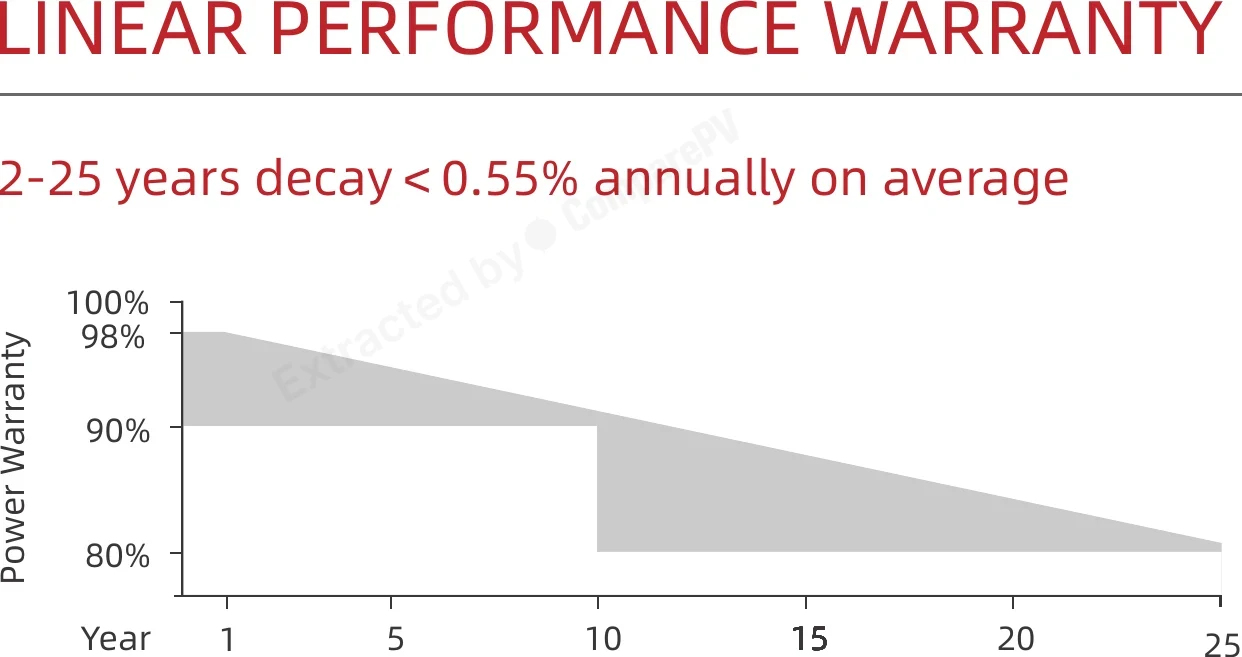
The manufacturer guarantees 30 years on both the product (physical integrity) and power output (linear degradation ≥87.4% after 30 years). The Tier-1 industry standard is typically 12–15 years product warranty and 25 years power warranty — this series exceeds it by 5 years on the power guarantee and doubles it on the product warranty.
JA Solar appears on the official BNEF Tier 1 list in Q1 2026 and manufactures over 100 GW annually, ensuring module and service availability throughout the full 30-year warranty period. Tier-1 bankable status streamlines non-recourse project financing for commercial and utility-scale PV installations.
HJT modules command a 20–30% price premium over comparable-power TOPCon panels and approximately 10–15% over PERC, based on 2025–2026 market data. For a typical 10 kWp residential system, this can translate to an additional €500–1,000 in upfront cost. Under Polish irradiation conditions (~1,100 kWh/kWp/year), gains from the superior temperature coefficient and bifacial yield may not compress the ROI proportionally to the price premium.
The series uses M6 (166 mm) wafers, while the market has shifted to M10 (182 mm) and G12 (210 mm) formats enabling 500–700 Wp per module. The 400 Wp ceiling increases the number of modules required in commercial installations, raising BoS costs (cabling, racking, MPPT strings) and installation labor compared to modern large-format panels.
- At 22.0% efficiency, this panel is on par with typical HJT 400-450W modules
- At 219.6 W/m² power density, roof space requirements are typical for HJT 400-450W panels
- Temperature coefficient of -0.24%/°C matches the HJT 400-450W median
- Bifaciality factor of 85% can add 4-13% extra yield with reflective mounting surface
- #6741 for efficiency, #13 for temperature performance out of 14005 panels
Specifications
Datasheet charts
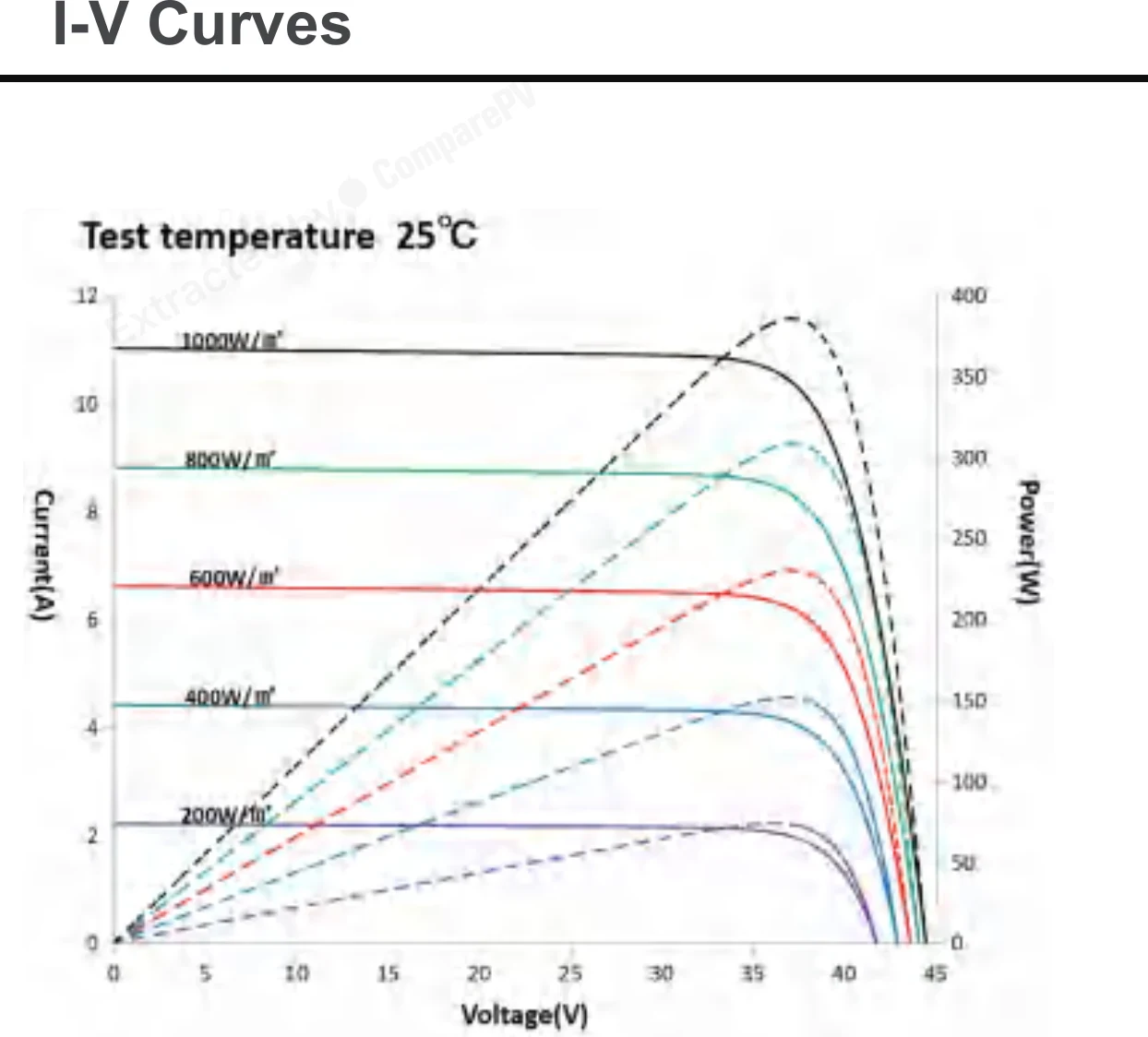
Measured curves published by JA Solar in this model's datasheet. A chart carrying a wattage was measured on that variant alone - only the ones that describe 400 Wp appear here. The rest cover the whole series.
Simulations
Degradation from this panel's own datasheet figures. No inverter, soiling or shading losses.
Model: bifaciality × albedo × 0.6 view factor. A first-order estimate, not a yield simulation.






Found 210 panels of the same or similar size to this one, within ±10 mm. See them here Found 271 panels of the same or similar size to this one, within ±25 mm. See them here Found 332 panels of the same or similar size to this one, within ±50 mm. See them here Found 4151 panels of the same or similar size to this one, within ±100 mm. See them here