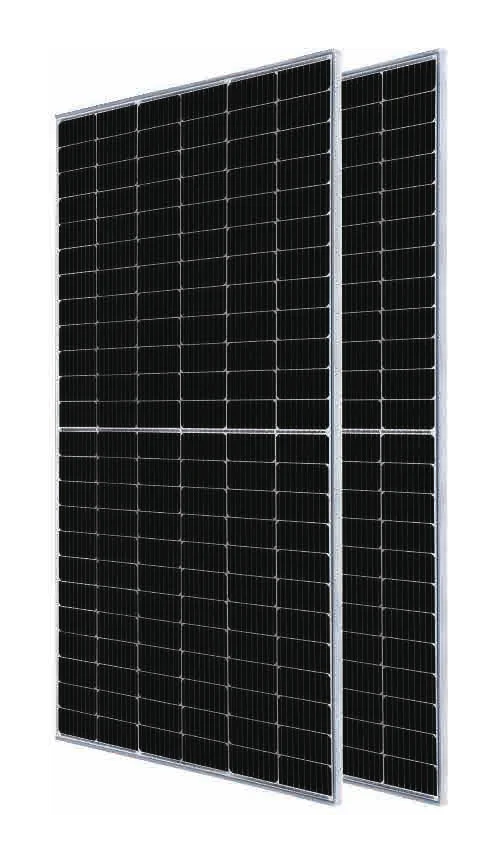
Middle of its segment, needs the roof space
JAM72S20 445-470/MR series modules are based on an innovative architecture using PERC half-cut cells, which directly translates to higher energy efficiency while simultaneously lowering the operating temperature of individual cells. The Multi-Busbar (MBB) technology used in this series shortens the electron flow path, effectively minimizing resistive losses and significantly increasing the module's resistance to micro-cracks during many years of operation in varying weather conditions. This series effectively solves the problem of drastic power drops resulting from partial shading of the module surface, offering investors reduced sensitivity to shading thanks to the completely independent operation of the panel's upper and lower sections. It is a solution dedicated primarily to large-scale commercial projects and ground-mounted photovoltaic farms, where a quick return on investment and maximum power density from the available area are of key importance. What distinguishes this product line from standard market solutions is its increased mechanical strength against snow and wind loads as well as exceptional resistance to potential-induced degradation (PID). This guarantees stable electricity production even in extreme environmental conditions. The robust design combined with an optimized temperature coefficient makes these panels work much more efficiently on hot days than competing products of similar power.
Ranking
Signals from the data
Commercial and shaded-installations.
Roofs where every square metre has to count and tight roof space.
Bottom 19% of the PERC 450-500 W segment, against a median of 208.5.
Bottom 20% of the PERC 450-500 W segment, against a median of 20.82%.
JA Solar (founded 2005) has maintained consistent BNEF Tier 1 bankable status and exceeds 80 GW of annual module production. Tier 1 classification directly facilitates non-recourse project financing for commercial and utility-scale ground-mount assets, reducing the weighted cost of capital.
Multi-Busbar architecture shortens electron travel paths, cutting resistive losses. Splitting into 144 half-cut cells halves internal current, reducing thermal stress, hot-spot risk, and improving partial-shading tolerance versus conventional 72-cell full-cell modules.
A Pmax temperature coefficient (γPmax) of -0.35%/°C places this module in the top quartile of the PERC class (typical segment range: -0.36% to -0.40%/°C), delivering measurably higher annual yield in continental climates compared to PERC peers with inferior temperature response.
The series carries IEC 61215 (durability) and IEC 61730 (safety) certifications and declared PID resistance. PID immunity is a critical requirement for long DC strings used in commercial and utility ground-mount systems operating above 1000 V.
Direct peers at the same power class — Recom Lynx 470 Wp and Sunlike Solar SKT470 — achieve 23.52% module efficiency, outperforming this series by 2.3–3.5 percentage points. On a fixed footprint, this gap translates to roughly 11–17% more power output, materially worsening LCOE in space-constrained projects.
2025 PVEL data and industry benchmarks indicate PERC cells degrade at approximately 0.5–0.8%/year versus ~0.25–0.4%/year for TOPCon N-type. The 84.8% linear power warranty after 25 years is the PERC-class standard but trails modern N-type TOPCon offerings, which now account for ~65% of global module production.
The series is non-bifacial despite being positioned for utility-scale ground-mount installations where bifacial modules typically deliver 5–15% additional annual energy yield from albedo reflection, reducing this series' competitiveness against newer products in the same watt-class.
- Efficiency of 20.5% matches the PERC 450-500W median
- Power density of 204.8 W/m² is 3.7 W/m² below PERC 450-500W median (208.5 W/m²) - needs more roof space
- Temperature coefficient of -0.35%/°C matches the PERC 450-500W median
- #11308 for efficiency, #10419 for temperature performance out of 14005 panels
Specifications
Simulations
Degradation from this panel's own datasheet figures. No inverter, soiling or shading losses.






Found 76 panels of the same or similar size to this one, within ±10 mm. See them here Found 345 panels of the same or similar size to this one, within ±25 mm. See them here Found 345 panels of the same or similar size to this one, within ±50 mm. See them here Found 959 panels of the same or similar size to this one, within ±100 mm. See them here