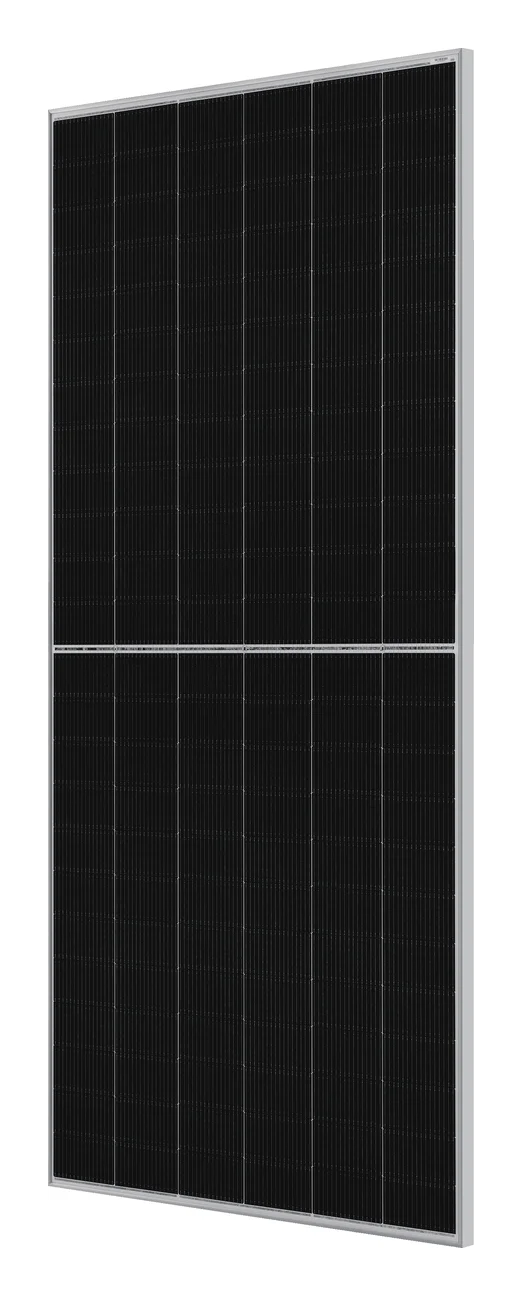
Middle of its segment, weak in heat
JA Solar DEEP BLUE 4.0 series photovoltaic panels introduce a new level of quality thanks to the use of advanced n-type cells in Bycium+ technology. This innovation directly translates into significantly higher efficiency and excellent operational stability in difficult lighting conditions. This series was designed to maximize investor profits through a reduced LCOE, making it one of the most cost-effective solutions on the market. A key advantage over older technologies is minimal light-induced degradation, thanks to which the modules maintain high performance over decades of use. This solves the problem of long-term yield loss, offering full certainty of return on investment. Thanks to a low temperature coefficient, these panels generate more energy during hot days compared to standard p-type modules. It is an ideal choice for both large-scale industrial farms and modern home installations, where every watt of power obtained from limited roof space counts. High mechanical resistance and a sealed construction make Deep Blue 4.0 stand out from the competition with exceptional durability and reliability in the variable Polish climate. This is a solution for those seeking the technological optimum between price and innovation.
Ranking
Signals from the data
Residential, commercial and utility-scale.
Hot climates and weight-limited structures.
Bottom 17% of the N-type 550-600 W segment, against a median of -0.290.
Bottom 19% of the N-type 550-600 W segment, against a median of 52.5.
Bycium+ n-type cells achieve up to 25.3% cell efficiency in mass production and deliver ~3.9% higher annual energy yield compared to standard p-type PERC modules. Minimal light-induced degradation (LID) and a low temperature coefficient of -0.30%/°C translate into measurably higher output on hot, high-irradiance days.
The 21.5-22.5% module efficiency range places this series at the very top of its peer group: Emmvee Titanium Duo/Clear tops out at 22.45% and ZNShine ZXM7-UHLD144 at 22.44%. DEEP BLUE 4.0 matches its closest competitors with no meaningful efficiency gap, while benefiting from JA Solar's global supply chain scale.
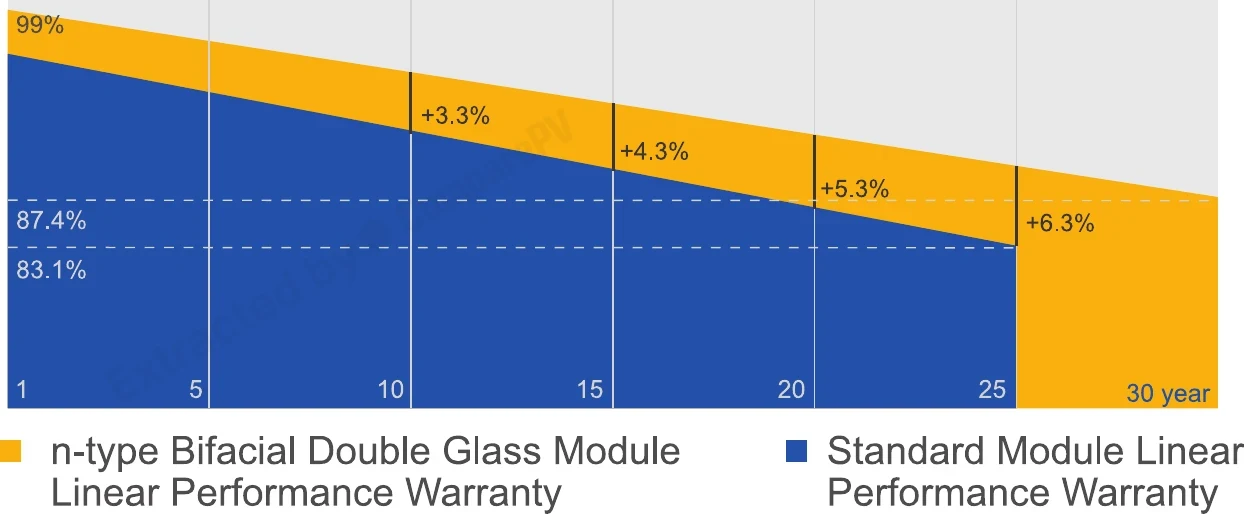
JA Solar guarantees first-year degradation ≤1% and annual degradation ≤0.40%/year thereafter, with a minimum of 87.4% rated power after 30 years. This long-term performance commitment is a key driver of LCOE reduction for both residential prosumers and utility-scale projects.
The bifacial module construction harvests reflected irradiance from the rear surface (roofing material, gravel, snow). With typical albedo values of 10-25%, bifacial gain ranges from 5% to 15% over equivalent monofacial modules in the same power class, at no additional BoS cost.
JA Solar (founded 2005) has maintained a continuous presence on BloombergNEF's quarterly Tier-1 list and ranks among the five largest PV module manufacturers globally (annual nameplate capacity >30 GW). Tier-1 bankable status reduces non-recourse financing risk and ensures long-term service and spare-parts availability.
JA Solar's 12-year workmanship warranty is the shortest among leading Tier-1 manufacturers: REC Solar offers 20 years, Qcells and Panasonic both offer 25 years, and the market median for the premium segment is approximately 25 years. For commercial projects with extended financing horizons, this gap may increase perceived counterparty risk during due diligence.
- Efficiency of 22.3% matches the N-type 550-600W median
- At 222.6 W/m² power density, roof space requirements are typical for N-type 550-600W panels
- At -0.30%/°C, hot weather performance is typical for N-type 550-600W panels
- Weight of 31.8 kg is 1.5 kg above N-type 550-600W median (30.3 kg) - verify structural support
- Bifacial design (80% factor) captures reflected light - adds 4-12% yield on ground-mount or white roof
Specifications
Datasheet charts
Measured curves published by JA Solar in this model's datasheet. A chart carrying a wattage was measured on that variant alone - only the ones that describe 575 Wp appear here. The rest cover the whole series.
Simulations
Degradation from this panel's own datasheet figures. No inverter, soiling or shading losses.
Model: bifaciality × albedo × 0.6 view factor. A first-order estimate, not a yield simulation.





Found 2327 panels of the same or similar size to this one, within ±10 mm. See them here Found 2369 panels of the same or similar size to this one, within ±25 mm. See them here Found 2383 panels of the same or similar size to this one, within ±50 mm. See them here Found 2548 panels of the same or similar size to this one, within ±100 mm. See them here
About the DEEP BLUE 4.0 series
These answers cover the whole series. Where a figure differs, the specification above is this module's own.