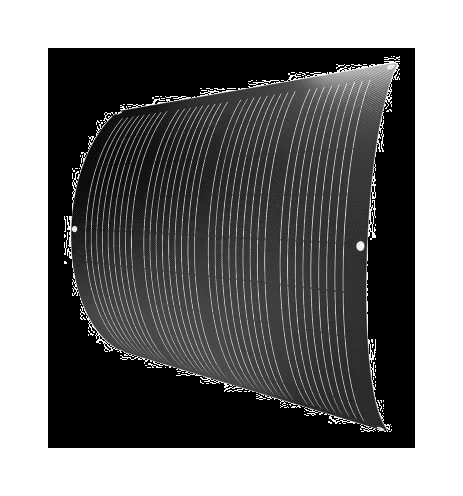
Light for its output, weak in heat
Isola New Energy flexible panels are an advanced solution based on monocrystalline cell technology that redefines the possibilities of photovoltaic installation on unusual surfaces. Thanks to the use of durable ETFE laminate and an innovative design, these modules are characterized by exceptional resistance to harsh weather conditions, including direct exposure to sea salt and intense UV radiation. The main advantage of the series is its above-average flexibility, allowing for a perfect fit of the panels to the curved roofs of campers, yachts, or caravans without the risk of damaging the silicon structure. This solves the problem of excessive load on supporting structures and unfavorable air resistance, which is key in the broadly understood mobile sector. Unlike traditional, heavy modules in aluminum frames, Isola focuses on extremely low weight and maximum installation discretion using technical adhesives. The use of modern shingled technology in selected models allows for the elimination of classic busbars, which significantly increases the active surface area of the cells and minimizes energy losses. This is a product dedicated to users for whom high mechanical resistance and aesthetics are a priority when building independent power systems in demanding off-grid locations. Thanks to their design, these panels effectively eliminate the problem of fatigue cracks, placing them at the forefront of solutions designed for operation in continuous motion.
Ranking
Price offers
| Shop | Country | Price | Per kWp | Stock | Offer updated | Link to shop |
|---|---|---|---|---|---|---|
| AID Solar | Poland | 499 zł incl. VAT | 2 495 zł/kWp | In stock | 19h ago | Visit shop |
Signals from the data
Off-grid.
Hot climates.
Top 2% of the 100-300 W band, against a median of 67.9. Ranked 65th in the whole database.
Top 11% of the 100-300 W band, against a median of 166.0.
Top 12% of the 100-300 W band, against a median of 16.60%.
Bottom 20% of the 100-300 W band, against a median of -0.370.
The flexible construction allows fitting to curved rooftops of RVs, yachts, and camper trailers without risk of silicon fatigue cracking. This solves the key problem in mobile applications where rigid aluminum-framed panels are technically impossible to mount.
ETFE transmits up to 95% of solar radiation (vs. 90–93% for the cheaper PET alternative) and has a service life of up to 15 years vs. 5 years for PET. This translates to more stable energy yield throughout the product lifecycle and better UV resistance in marine environments.
Flexible modules weigh approximately 8–11 kg/m², representing a ~70–75% mass saving over rigid aluminum-framed panels (35–40 kg/m² for typical 450 Wp modules). Critical for the mobile sector where every kilogram of structural load directly affects fuel consumption or payload capacity.
The absence of an aluminum frame eliminates the primary site of galvanic corrosion in salt-spray marine environments. Unlike standard framed modules, Isola Flexible panels require no electrical isolation from metal boat decks or special anti-corrosion sealing.
Elimination of conventional busbars in shingled models increases active cell area and reduces partial-shading sensitivity by 15–30% compared to standard 5-busbar modules. Particularly relevant in mobile applications where shade from masts, chimneys, and antennas is unavoidable.
The series peaks at 20.92% module efficiency, while comparable wattage (450 Wp) peers — SunKean/Sunket SKT430~450M10-108D5 — reach 23.04% and Sunova Tangra S Pro HD hits 22.5%. The ~2.1 pp gap translates to roughly 10% more required active area for the same rated power output, which is meaningful in the limited deck or rooftop space of boats and RVs.
The product warranty covers only 5 years, while Tier-1 manufacturers (LONGi, JA Solar, Trina) standardly offer 10–15 years. In off-grid marine and RV installations — where servicing is logistically difficult — this short coverage window represents a material risk for the end user.
Flexible panels structurally degrade at 0.8–1.0%/year vs. ~0.5%/year for rigid monocrystalline modules. Although the manufacturer provides a 25-year power warranty, real-world output after 25 years may fall 10–15 pp short compared to an equivalent rigid module carrying an identical warranty declaration.
- Efficiency of 19.8% is 1.1pp above the Flexible 0-400W median (18.8%)
- 196.7 W/m² power density - 7.0 W/m² more than Flexible 0-400W median (189.7 W/m²), more power per roof area
- Temperature coefficient of -0.40%/°C is 0.05pp worse than Flexible 0-400W median (-0.35%/°C) - higher losses in summer heat
- Ranked #12416 out of 14005 panels for efficiency in the database
Specifications
Simulations
Degradation from this panel's own datasheet figures. No inverter, soiling or shading losses.








Found 1 panel of the same or similar size to this one, within ±10 mm. See them here Found 3 panels of the same or similar size to this one, within ±25 mm. See them here Found 3 panels of the same or similar size to this one, within ±50 mm. See them here Found 22 panels of the same or similar size to this one, within ±100 mm. See them here