Light for its output, no clear weak spot
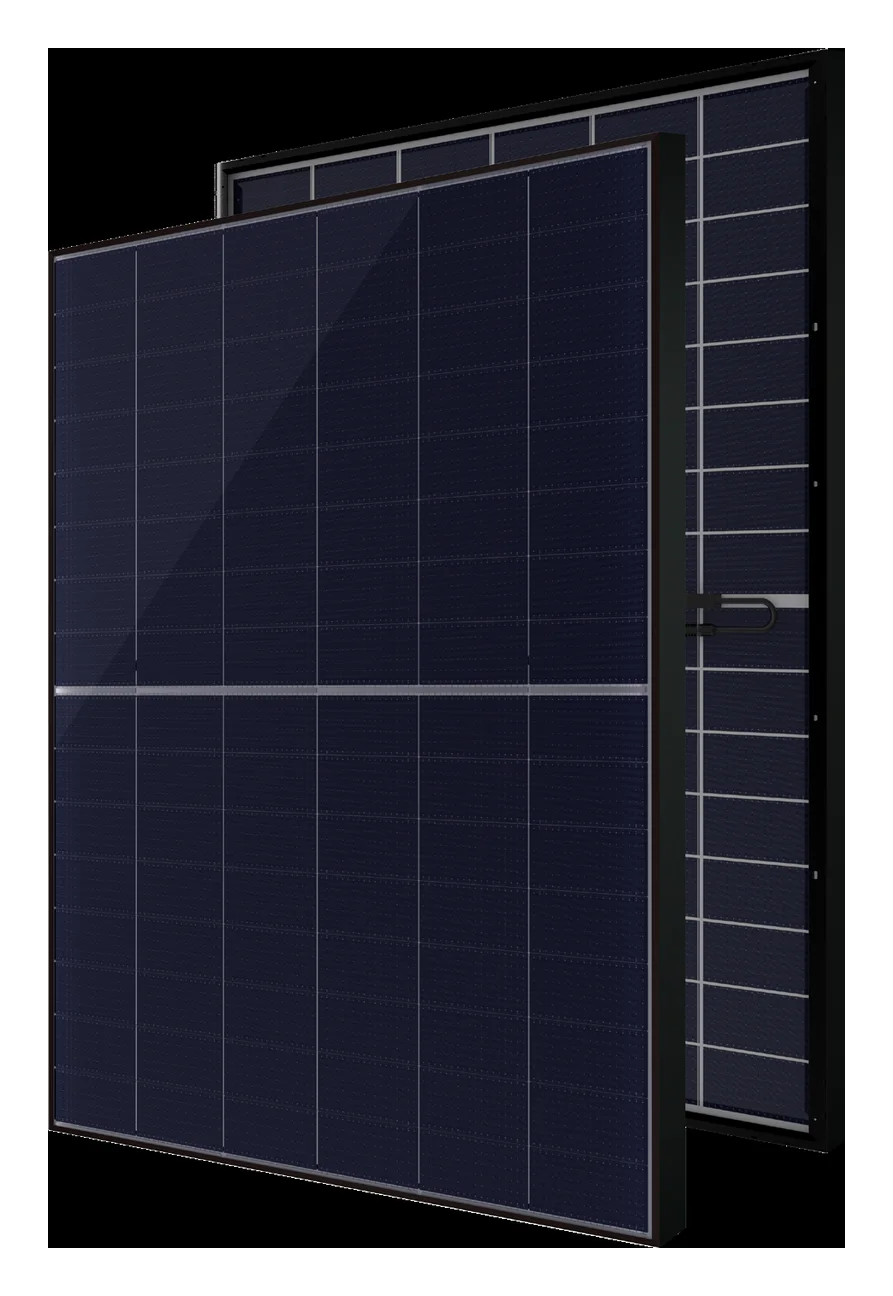
Hyundai HeteroMax panels from the CE-BF series are an advanced solution based on HJT heterojunction cell technology, setting new standards for efficiency in difficult lighting conditions. Thanks to the unique combination of monocrystalline silicon with a thin amorphous layer, these modules almost completely eliminate the negative effects of LID and PID degradation, which directly translates into the longevity of the installation. Their bifacial glass-glass construction allows for additional energy recovery from reflected light, making them an ideal choice for modern ground-mounted and rooftop systems with light-colored roofing. The HeteroMax series stands out with its minimal temperature coefficient, ensuring the panels operate stably even in extreme sun, offering significantly higher annual yields than standard PERC-type modules. The use of SMBB technology increases resistance to micro-cracks and optimizes electron flow, which is crucial for trouble-free operation for decades. This is a premium solution for investors who demand maximum power density and uncompromising reliability, expecting a product that outclasses the competition in terms of efficiency in real-world, variable weather conditions typical of the Polish climate.
Ranking
Signals from the data
Residential, commercial and hot-climate.
Top 16% of the HJT 450-500 W segment, against a median of 49.3.
The CE-BF HJT cells achieve a Pmax temperature coefficient of -0.24%/°C, compared to approximately -0.35%/°C for PERC and -0.30%/°C for TOPCon modules. Under typical summer conditions with a module temperature of 65°C, this translates to a 2–3% higher daily yield versus a same-wattage PERC module.
The symmetric HJT cell structure delivers bifaciality up to 90%, versus 70–75% for bifacial PERC and 75–80% for TOPCon bifacial modules. On ground-mount systems with light-colored albedo surfaces or white roofing, this yields an additional 4–8% energy harvest from the rear side compared to a typical TOPCon bifacial module.
Hyundai provides a 30-year product warranty and a 30-year linear power warranty, guaranteeing ≥90.3% of nominal power after 30 years at 0.3%/year annual degradation (after year 1). Peer comparable Risen RSM96-11 offers only a 25-year product warranty with a separate 30-year power warranty — the CE-BF series provides full 30-year product coverage.
The HJT structure with amorphous silicon passivation eliminates LID (Light Induced Degradation) inherent in P-type PERC cells. Combined with a dual-glass construction and SMBB metallization that reduces micro-crack risk, the CE-BF series achieves the lowest real-world degradation rates in the 440–460 Wp module class.
The 22–23% efficiency range places the series well above the Zonergy ZPM MH3-72 (21.16%) at the same 460 Wp peak power, reducing required roof or ground area for a given system size. The result is on par with Risen RSM96-11 (23%) and SunKean SKT440~460M12-96D4 (23.02%) — positioning the CE-BF firmly in the top tier of 96-cell 460 Wp modules.
HJT module manufacturing cost runs approximately $0.14–0.16/W versus $0.11–0.13/W for TOPCon, resulting in a 20–30% higher retail price compared to equivalent TOPCon modules such as the Risen RSM96-11 (identical 23% efficiency). For a typical 10 kWp residential system in Poland, the cost delta can reach €350–600, extending simple payback by 6–10 months under local irradiance conditions.
- At 23.0% efficiency, this panel is on par with typical HJT 450-500W modules
- At 230.2 W/m² power density, roof space requirements are typical for HJT 450-500W panels
- At -0.24%/°C, hot weather performance is typical for HJT 450-500W panels
- Weight of 21.8 kg (1.2 kg below HJT 450-500W median of 23.0 kg) allows easier transport and roof mounting
- 90% bifaciality enables rear-side power generation, boosting yield by 4-14% on reflective surfaces
Specifications
Datasheet charts
Measured curves published by Hyundai in this model's datasheet. A chart carrying a wattage was measured on that variant alone - only the ones that describe 460 Wp appear here. The rest cover the whole series.

Simulations
Degradation from this panel's own datasheet figures. No inverter, soiling or shading losses.
Model: bifaciality × albedo × 0.6 view factor. A first-order estimate, not a yield simulation.




Found 1395 panels of the same or similar size to this one, within ±10 mm. See them here Found 1425 panels of the same or similar size to this one, within ±25 mm. See them here Found 3614 panels of the same or similar size to this one, within ±50 mm. See them here Found 3962 panels of the same or similar size to this one, within ±100 mm. See them here