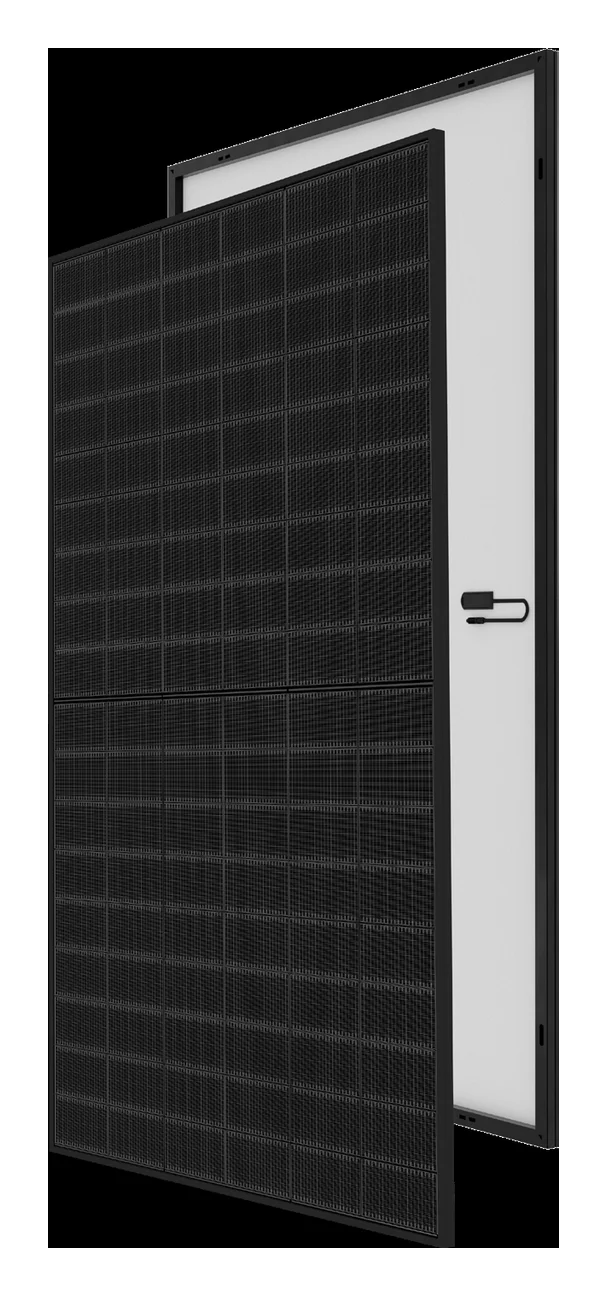
Hyundai HiT-H440LE-FB(ZB)

HiT-H440LE-FB(ZB)

440 Wp HJT Bifacial
ComparePV verdict

Light for its output, no clear weak spot

Rank 5,958 of 14,005
Compare panels Datasheet PDF
Power (Wp)
440
Typical for its class
Efficiency (%)
22.00
Typical · median 22.20%
Density (Wp/m²)
220.2
Typical · median 221.6
Temp (%/°C)
-0.240
Typical · median -0.240
Weight (kg)
21.6
Strong · 1.4 kg below median
Warranty (yrs)
30
Typical · median 30 yrs

The Hyundai HeteroMax (LE-FB(ZB) Series) has been designed to maximize energy yield from every meter of roof area, even under less-than-ideal conditions. The use of N-type HJT cells ensures stable operation and excellent energy production even with lower sunlight levels, which is particularly important in the Polish climate, especially in autumn and winter. The modules utilize a dual glass construction, which enhances resistance to environmental factors and helps maintain performance over the long term. Another key feature is the full black aesthetic, which makes the series ideal for modern roofs where a consistent and aesthetically pleasing appearance is important.

The LE-FB(ZB) series is a good choice for investors who want to combine high efficiency with durability, whether in residential prosumer installations or in projects where consistent quality is essential. Thanks to improved performance at high temperatures and a refined cell connection technology, this series effectively reduces typical losses and helps extract more energy from the same surface area.

Ranking

113 panels in the segment HJT 400-450 W
Metric This panel Median Position in segment Overall rank
Module efficiency 22.00% 22.20% Typical 6,517
Power density 220.2 221.6 Typical 6,328
Temperature coefficient -0.240 -0.240 Typical 13
Weight per kWp 49.1 52.4 Strong · top 16% 2,739
Performance warranty 30 yrs 30 yrs Typical 21
Colour key Strong - top 25% Typical - middle 50% Weak - bottom 25%

Signals from the data

6 positive · 1 caution
Best for

Residential, commercial and hot-climate.

Strengths
49.1 kg per kWp

Top 16% of the HJT 400-450 W segment, against a median of 52.4.

What owners get
HJT N-type Zero Busbar – lowest temperature coefficient

Temperature coefficient of Pmax is -0.24%/°C — among the lowest in the 440-460 W module segment (PERC: approx. -0.35%/°C, TOPCon: approx. -0.28-0.30%/°C). N-type cell architecture fully eliminates LID (Light-Induced Degradation) and ensures zero PID sensitivity, delivering more stable energy yield across the full 30-year operating lifetime.

Bifaciality up to 90% – outperforms PERC and TOPCon

The symmetrical HJT cell structure enables a bifaciality factor of up to 90%, compared to ~70-75% for PERC and ~80-85% for TOPCon modules. At a typical ground albedo of 20% (light roofing or gravel), this translates to a 5-9% real-world power gain above the front-side STC rating, directly improving system LCOE.

30-year product and power warranty (90.3% after 30 years)

Hyundai guarantees 90.3% of nominal power after 30 years alongside a 30-year product warranty. The industry standard for peer comparables (Risen RSM96-11, Zonergy ZPM MH3-72, SunKean SKT440-460M12) is a 25-year power warranty. The extended coverage significantly reduces investment risk in bank-financed projects.

Dual glass full black – durability and premium aesthetics

The dual-glass construction (1.6 mm front and rear glass) eliminates UV-induced backsheet degradation and substantially reduces moisture ingress — critical in Central European climates with high diurnal temperature swings. The full-black finish provides a uniform appearance on modern pitched roofs with no visible contrast between cells and frame.

22-23% efficiency – top-tier among peer comparables

Top variants in the series reach 23% efficiency, matching Risen RSM96-11-440-460BNDG (23%) and SunKean SKT440-460M12-96D4 (23.02%), while exceeding Zonergy ZPM MH3-72 (21.16%) by nearly 1.84 percentage points. In terms of power per square meter, this translates to meaningfully higher output from the same roof area.

Trade-offs
HJT price premium over TOPCon peers

HJT modules are priced at approximately $0.38-0.50/W wholesale versus $0.28-0.35/W for TOPCon equivalents — a 15-40% premium. Peer comparables Risen RSM96-11 and SunKean SKT440-460M12, both TOPCon-based, achieve equal or marginally higher efficiency (23-23.02%) at a lower per-watt cost, which may favor the alternative in typical residential prosumer installations where minimizing BoS cost takes priority over maximizing power density.

Notes from the database
  • At 22.0% efficiency, this panel is on par with typical HJT 400-450W modules
  • Power density of 220.2 W/m² matches the HJT 400-450W median
  • Temperature coefficient of -0.24%/°C matches the HJT 400-450W median
  • 21.6 kg weight - 1.4 kg lighter than HJT 400-450W median (23.0 kg), reducing installation effort
  • Ranked #6517 out of 14005 panels for efficiency in the database

Specifications

Open datasheet PDF
Nominal power (Pmax) 440 Wp Nameplate at 1000 W/m², 25 °C
Module efficiency 22.00 % Typical Segment median 22.20%
Vmpp · Impp 30.61 V · 14.38 A Operating point at max power
Voc · Isc 36.52 V · 15.31 A Sizes the string length
Max system voltage 1500 V Longer strings than 1000 V modules
Dimensions 1762×1134×30 mm · 2.00 m² of roof
Weight 21.6 kg Strong Strong · 1.4 kg below median
Cells 96 · HJT Monocrystalline
Coefficient Pmax -0.240 %/°C Typical median -0.240 of its segment
Coefficient Voc · Isc -0.220 · 0.040 %/°C
NOCT 44 °C At 800 W/m², 20 °C ambient
Product warranty 30 years Hardware defects only
Performance warranty 30 years Typical median 30 yrs · median 30 yrs
End-of-warranty output 90.3 % Equals 397 W guaranteed
Degradation 1.00 → 0.30 % First year, then annual

Datasheet charts

Open datasheet PDF

Measured curves published by Hyundai in this model's datasheet. A chart carrying a wattage was measured on that variant alone - only the ones that describe 440 Wp appear here. The rest cover the whole series.

Simulations

Live - change any input
Lifetime output & value
30 years at 1200 kWh/kWp/year and €0.50 per kWh
Power in year 30
-
Lifetime energy
-
Energy value
-

Degradation from this panel's own datasheet figures. No inverter, soiling or shading losses.

Heat losses
-0.240 %/°C against a segment median of -0.240
-
Filter these
Size
Panel Power Eff. Temp. Weight Difference
Hyundai HiT-H440LE-FB(ZB) 440 W 22.00% -0.240 21.6 kg You are here
AIKO-A490-MCE54Mw 490 W 24.50% -0.260 21.0 kg +50 W, hotter, +2.5 pp
STP-NT11/48QGSF-490 490 W 24.50% -0.260 21.5 kg +50 W, hotter, +2.5 pp
JAT54S40-485/LR 485 W 24.30% -0.260 19.3 kg +45 W, lighter, +2.3 pp
AIKO-A485-MCE54Mw 485 W 24.30% -0.260 21.0 kg +45 W, hotter, +2.3 pp
AIKO-A485-MAH54Mw 485 W 24.30% -0.260 21.5 kg +45 W, hotter, +2.3 pp
GK-5-54HG-485M 485 W 24.30% -0.260 21.0 kg +45 W, hotter, +2.3 pp
ZEUS 3.0+ 108 485WP 485 W 24.30% -0.260 24.2 kg +45 W, heavier, +2.3 pp
HiT-H435LE-FB 435 W 21.80% -0.240 21.8 kg Very close match
HiT-H445LE-FB(ZB) 445 W 22.30% -0.240 21.6 kg +0.3 pp
HiT-H450LE-FB(ZB) 450 W 22.50% -0.240 21.6 kg +10 W, +0.5 pp
LR7-54HJD-510M 510 W 25.00% -0.240 23.5 kg +70 W, heavier, +3.0 pp
AIKO-A495-MCE54Mw 495 W 24.80% -0.260 21.0 kg +55 W, hotter, +2.8 pp
LR7-54HJD-505M 505 W 24.70% -0.240 23.5 kg +65 W, heavier, +2.7 pp
LR7-54HJD-500M 500 W 24.50% -0.240 23.5 kg +60 W, heavier, +2.5 pp
CIPRO-TN9C54M-500W 500 W 24.50% -0.260 21.4 kg +60 W, hotter, +2.5 pp

Found 1395 panels of the same or similar size to this one, within ±10 mm. See them here Found 1425 panels of the same or similar size to this one, within ±25 mm. See them here Found 3614 panels of the same or similar size to this one, within ±50 mm. See them here Found 3962 panels of the same or similar size to this one, within ±100 mm. See them here

Common questions

6 answered
What makes the HJT cell technology in Hyundai HeteroMax LE-FB(ZB) modules stand out compared to PERC and TOPCon?
N-type HJT cells combine amorphous and crystalline silicon layers, delivering approximately 23% module efficiency and an exceptionally low temperature coefficient of -0.24%/°C. That means the LE-FB(ZB) series loses significantly less power on hot summer days when module temperatures exceed 50°C than PERC or TOPCon alternatives. The advantage is real across the entire year, not just under ideal test conditions.
What warranty does the Hyundai HeteroMax LE-FB(ZB) series carry and what does it cover?
The HeteroMax LE-FB(ZB) series comes with a 30-year product warranty covering materials and workmanship, plus a 30-year power output warranty. Degradation is capped at 1% in year one and no more than 0.3% per year thereafter. After 30 years the module should retain over 87% of its rated power — one of the strongest warranty packages currently available in the residential PV market.
Are Hyundai HeteroMax LE-FB(ZB) 460 W panels a good fit for a residential rooftop installation?
Yes, the LE-FB(ZB) series with up to 460 W peak output is designed primarily for prosumer rooftop systems. The roughly 23% module efficiency yields more energy from the same roof area compared to standard PERC modules. The full black aesthetics and dual glass construction also make these modules an excellent visual match for modern pitched and flat roofs.
Is the LE-FB(ZB) series bifacial, and does bifaciality deliver real benefits on a rooftop?
Yes, the LE-FB(ZB) modules use bifacial half-cut HJT cells that harvest energy from both the front and rear surfaces. Rooftop bifacial gains are smaller than in ground-mounted systems, but light reflected off bright roofing membranes or light-colored tiles can add several percent of extra energy yield. The dual glass back sheet also protects the rear cells and slows degradation throughout the 30-year power warranty period.
How does the Hyundai HeteroMax LE-FB(ZB) series perform under low-irradiance conditions in autumn and winter?
HJT cells are particularly responsive to diffuse radiation, which dominates during overcast Central European autumn and winter days. Combined with the low -0.24%/°C temperature coefficient — which boosts output on cold, sunny days — the LE-FB(ZB) series consistently outproduces comparable PERC modules of the same nominal wattage during low-irradiance months.
Why do LE-FB(ZB) modules use dual glass instead of a standard backsheet, and what does it mean for long-term system reliability?
Dual glass construction replaces the polymer backsheet with a second glass layer, significantly improving resistance to moisture ingress, ammonia exposure, and mechanical stress. This slows long-term degradation, reduces the risk of delamination and micro-cracking after years of operation, and results in more stable power output across the full 30-year product warranty offered by Hyundai.
Add to compare