Middle of its segment, weak in heat
Hyundai HeteroMax MF SERIES panels are an advanced solution based on innovative heterojunction (HJT) technology, which effectively combines the advantages of crystalline and thin-film silicon. Thanks to the use of N-type cells and a bifacial design, this series enables energy generation from both sides of the module, which significantly increases total yields, especially when installed on bright surfaces. This solves the problem of limited installation space, offering power density that goes beyond market standards. A key advantage over the competition is an exceptionally low temperature coefficient, guaranteeing stability of parameters in extreme heat, and almost total resistance to degradation caused by PID and LID phenomena. The MF series was designed for demanding residential and business investors who seek the highest durability and minimal power drops over many years. High performance in low sunlight makes these panels a perfect fit for the specifics of the Polish climate, ensuring stable power production even on cloudy days. By choosing these modules, the user gains confidence in trouble-free operation and excellent mechanical resistance, which directly translates into the safety and profitability of the entire energy system for decades.
Ranking
Signals from the data
Residential, commercial and hot-climate.
Hot climates.
Bottom 23% of the HJT 400-450 W segment, against a median of -0.240.
HJT cells deliver a Pmax temperature coefficient of -0.26%/°C, versus -0.31%/°C for TOPCon and -0.35%/°C for PERC. Under typical summer conditions (35°C ambient, NOCT 44°C), this translates to a real-world annual yield advantage of 3–5% over PERC modules of equivalent nameplate power.
Peak module efficiency of 22.79% leads the peer group: Q-Cells Q.TRON BLACK tops out at 22.3%, Solitek SOLRIF D Satin at 22.06%, and SunEvo SE6-46SC at only 21.4%. Higher power density directly reduces roof area requirements and BoS costs per installed kWp.
HJT's inherently symmetric heterojunction structure yields a bifaciality factor above 90%, compared to 70–80% for bifacial PERC and 80–85% for TOPCon bifacial. This delivers an additional 2–4% rear-side energy contribution when installed over reflective surfaces such as white TPO membranes, gravel, or concrete.
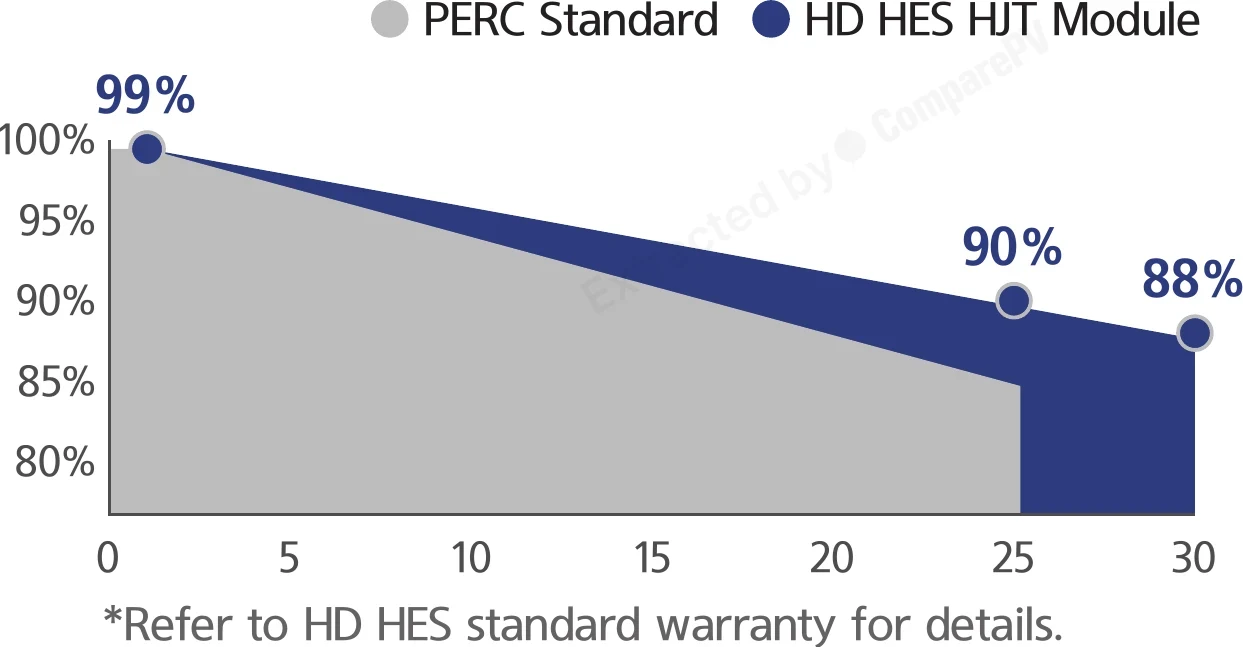
HD Hyundai guarantees a maximum first-year degradation of 1%, followed by 0.375%/year, ensuring ≥88% of nameplate power at year 30 — covered by both a product warranty and a performance warranty. Competing series such as Q-Cells Q.TRON BLACK and Solitek SOLRIF D Satin carry standard 25-year power warranties; the 5-year gap is financially material across a residential LCOE horizon.
N-type HJT cells are inherently free of Light-Induced Degradation (LID) and Potential-Induced Degradation (PID) — failure modes common in P-type PERC that can reduce output by 1–3% within the first weeks of operation. Combined with HD Hyundai Energy Solutions' BNEF Tier-1 bankable status (South Korea, est. 2004), this makes the series favorable for bank-financed commercial installations.
The low-temperature HJT manufacturing process keeps wholesale prices at approximately $0.38–0.50/Wp FOB (Q1 2026 data), compared to $0.28–0.35/Wp for equivalent TOPCon modules — a 15–40% gap. For a typical 10 kWp residential system, this premium may extend the simple payback period (SPP) by 1–2 years relative to alternatives such as Q-Cells Q.TRON BLACK, which offers comparable efficiency (22.3%) at a lower per-watt cost.
- Efficiency of 22.0% matches the HJT 400-450W median
- At 220.2 W/m² power density, roof space requirements are typical for HJT 400-450W panels
- -0.26%/°C temperature coefficient - 0.02pp worse than HJT 400-450W median (-0.24%/°C), expect higher hot weather losses
- Weight of 22.0 kg is typical for HJT 400-450W panels
- In the top 45% for efficiency among all HJT panels
Specifications
Datasheet charts
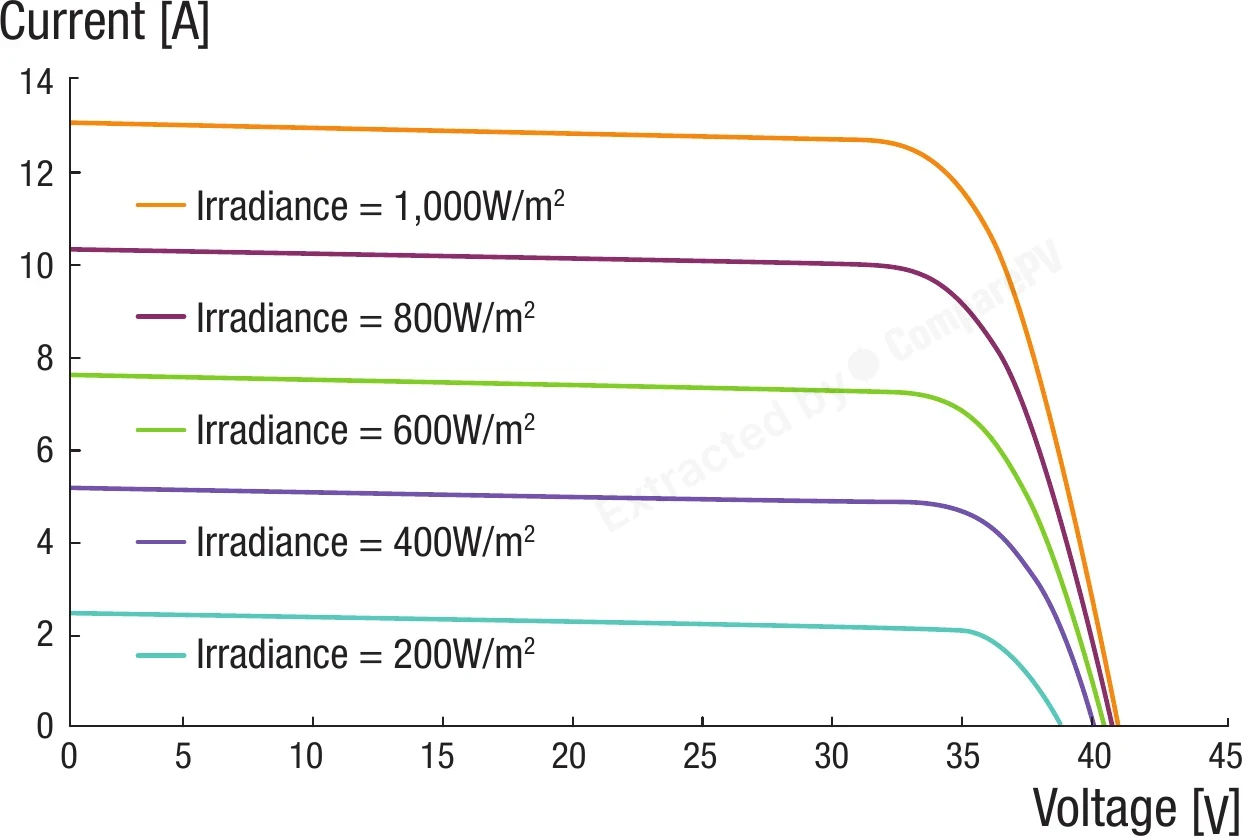
Measured curves published by Hyundai in this model's datasheet. A chart carrying a wattage was measured on that variant alone - only the ones that describe 430 Wp appear here. The rest cover the whole series.
Simulations
Degradation from this panel's own datasheet figures. No inverter, soiling or shading losses.






Found 1783 panels of the same or similar size to this one, within ±10 mm. See them here Found 1914 panels of the same or similar size to this one, within ±25 mm. See them here Found 3392 panels of the same or similar size to this one, within ±50 mm. See them here Found 3970 panels of the same or similar size to this one, within ±100 mm. See them here