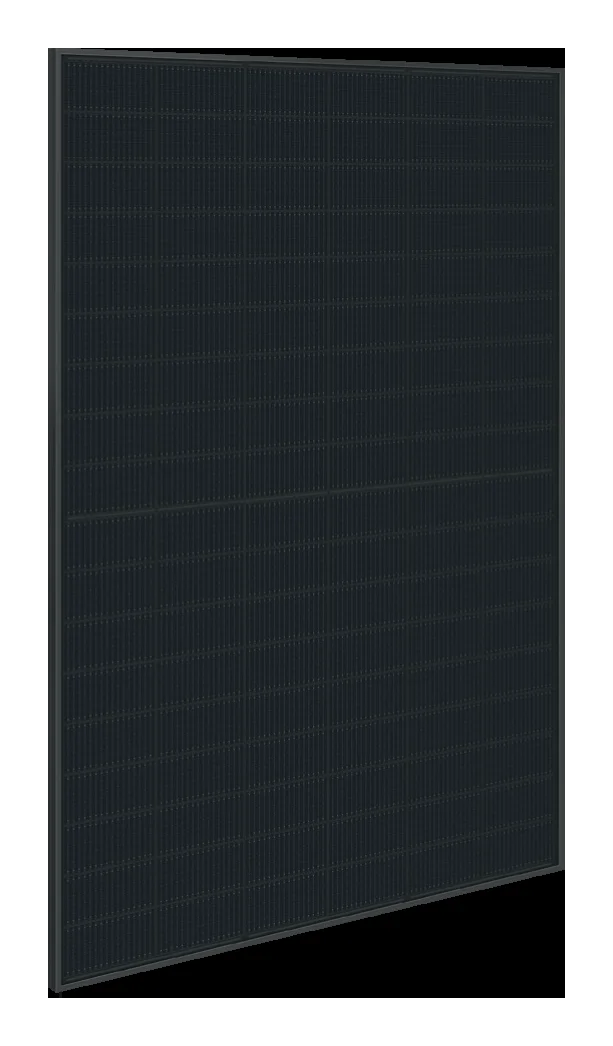
Middle of its segment, heavy for its output
Hyundai photovoltaic panels from the NF(BK) series are based on innovative shingled technology, which redefines the standards of durability and aesthetics in modern solar energy. By eliminating traditional busbars and replacing them with overlapping cells, these modules offer a significantly larger active surface area and minimize the risk of micro-cracks under mechanical loads. This series is characterized by exceptional Full Black aesthetics, making it the first choice for demanding residential users who wish to harmoniously blend the installation with dark roofing. The use of shingled technology allows for maximum efficiency in shaded conditions and better performance in low sunlight, which directly translates into higher energy yields in the Polish climate. NF(BK) modules solve the problem of limited installation space, delivering more power from the same area than standard panels. The security of the investment is highlighted by a 25-year product warranty, which covers both workmanship and linear power output. This is an uncompromising solution for those seeking a combination of modern design and industrial reliability, standing out from the competition with a longer lifespan and higher resistance to degradation caused by atmospheric factors.
Ranking
Signals from the data
Residential and shaded-installations.
Weight-limited structures.
Bottom 14% of the TOPCon 400-450 W segment, against a median of 51.4.
N-type TOPCon technology eliminates the LID (Light-Induced Degradation) effect characteristic of PERC cells, resulting in a lower annual degradation rate (~0.40%/yr vs ~0.55%/yr for PERC). Combined with 16 busbars (16BB) and half-cut cell design, the module reduces series resistance and partial-shading losses — a meaningful advantage under Poland's frequently overcast conditions.
The Hyundai NF(BK) series carries a 25-year materials and workmanship warranty, while a direct peer — the Luxor ECO LINE N-TYPE TOPCon NON-REFLECT 440W — offers only 15 years of product warranty. The 10-year gap represents substantially lower investment risk for residential prosumers and stronger protection across the full system lifecycle.
Hyundai guarantees ≥87.4% of rated output after 30 years of operation. The peer Luxor ECO LINE NON-REFLECT 440W guarantees 87.5% of rated output, but only after 25 years — Hyundai covers an additional 5-year horizon at a comparable retention level, directly improving LCOE economics for installations designed to operate beyond 25 years.
Semi-tempered 2.0 mm glass on both sides provides a mechanical load rating of 5,400 Pa front and rear. This exceeds the requirements of typical Polish residential rooftop installations (normative 2,400 Pa per PN-EN 1991-1-3), making the module well-suited for high-snowfall or high-wind regions such as the Sudetes or Tatra mountains.
A temperature coefficient of -0.30%/°C is significantly better than standard PERC cells (-0.35% to -0.40%/°C) and matches leading peers (Luxor -0.30%/°C, Seraphim Nebula). At a typical summer module temperature of ~60°C (25°C above STC), power losses amount to only 10.5% vs ~12.25% for a typical PERC module — a measurable real-world gain during Polish summer heat.
The series' maximum efficiency (22.53%) trails a direct peer — the Luxor ECO LINE N-TYPE TOPCon NON-REFLECT 440W (22.86%) — by 0.33 percentage points. On a constrained roof area (e.g., 20 m²), this gap translates to ~14 Wp less per module; for a typical 10 kWp system on a very small roof, it could necessitate 1–2 additional modules to meet the same power target.
The NF(BK) Full Black variant specifically targets aesthetically dark rooftiles — yet dark roof surfaces carry an albedo of only 10–20%, capping practical rear-side energy gain at 3–5% of rated output. By contrast, light-colored substrates (white membrane, bright gravel) with 40–70% albedo deliver 10–20% bifacial gain. Buyers prioritizing maximum bifacial yield should factor this trade-off into system design.
- At 22.0% efficiency, this panel is on par with typical TOPCon 400-450W modules
- Power density of 220.2 W/m² matches the TOPCon 400-450W median
- At -0.30%/°C, hot weather performance is typical for TOPCon 400-450W panels
- At 24.5 kg (2.5 kg above TOPCon 400-450W median of 22.0 kg), requires checking roof load capacity
- 80% bifaciality enables rear-side power generation, boosting yield by 4-12% on reflective surfaces
Specifications
Datasheet charts
Measured curves published by Hyundai in this model's datasheet. A chart carrying a wattage was measured on that variant alone - only the ones that describe 430 Wp appear here. The rest cover the whole series.

Simulations
Degradation from this panel's own datasheet figures. No inverter, soiling or shading losses.
Model: bifaciality × albedo × 0.6 view factor. A first-order estimate, not a yield simulation.






Found 1783 panels of the same or similar size to this one, within ±10 mm. See them here Found 1914 panels of the same or similar size to this one, within ±25 mm. See them here Found 3392 panels of the same or similar size to this one, within ±50 mm. See them here Found 3970 panels of the same or similar size to this one, within ±100 mm. See them here