Middle of its segment, modest efficiency
The HT-SAAE HT48-18X(ND)-F series are modern N-type TOPCon modules designed for stable, long-term operation with minimal degradation. The application of half-cut technology enhances performance in real-world conditions by reducing heat-related losses and optimizing output when the installation is partially shaded or operating under scattered light. A key advantage of this series is its double glass construction, which increases resistance to moisture, temperature fluctuations, and micro-cracking - particularly important for roofs exposed to harsh weather conditions. Additionally, thanks to bifacial capability, the modules can utilize reflected light from the ground surface, helping boost energy yield in well-maintained installations (bright roof, gravel, membranes). This is an excellent choice for premium residential installations and demanding rooftop projects where durability, aesthetics, and predictable inverter performance in varying conditions are essential.
Ranking
Signals from the data
Residential and shaded-installations.
Tight roof space, roofs where every square metre has to count and weight-limited structures.
Bottom 12% of the TOPCon 350-400 W segment, against a median of 18.20%.
Bottom 13% of the TOPCon 350-400 W segment, against a median of 181.8.
Bottom 22% of the TOPCon 350-400 W segment, against a median of 68.9.
N-type TOPCon cells degrade at approximately 0.4%/year compared to 0.7-0.8% for P-type PERC. Near-zero Light-Induced Degradation (LID) means the module does not lose several percent of its rated power in the first weeks of operation, as is commonly observed with PERC modules.
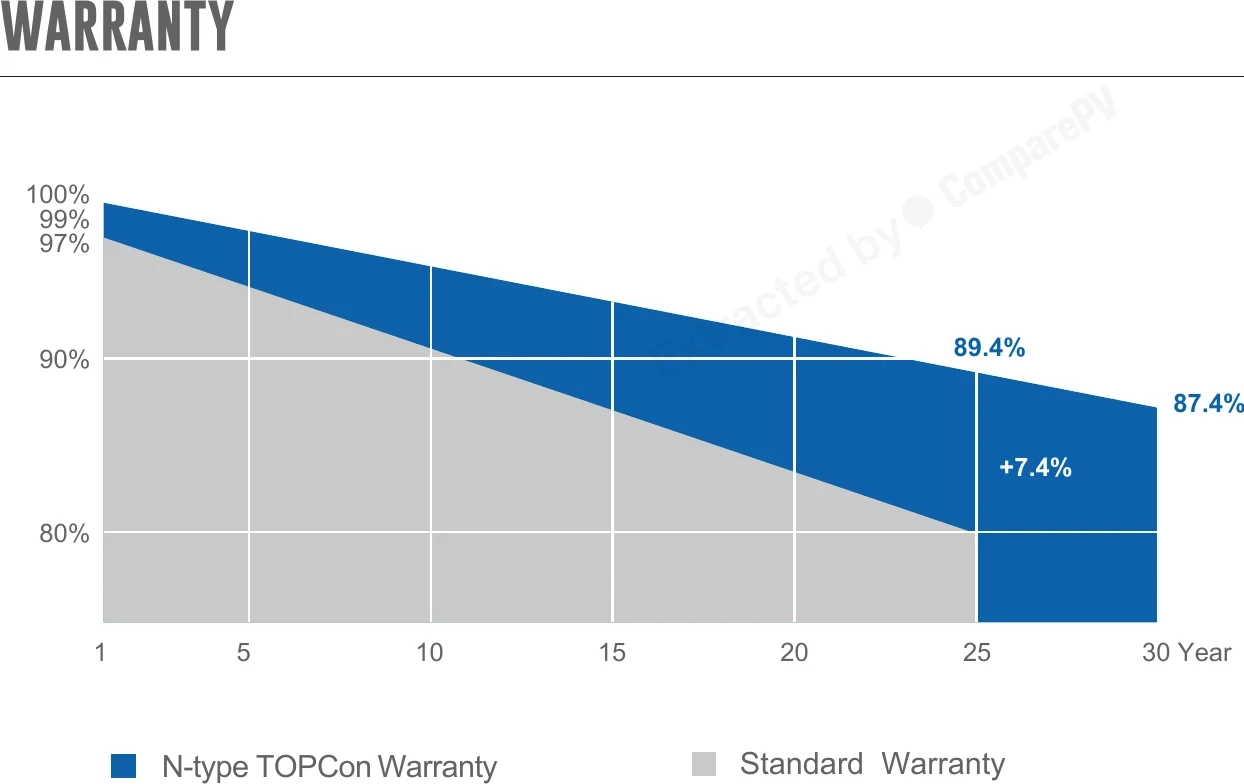
The manufacturer guarantees ≥87% of rated power after 30 years-an above-standard commitment compared to most P-type modules (Trina, JA Solar), which offer 25 years with a floor of 84.8%. The 30-year product warranty also covers workmanship defects, which is uncommon in this market segment.
A rear glass pane in place of a polymer backsheet eliminates the risk of delamination, provides a lower water vapor transmission rate (WVTR), and improves resistance to cell microcracks. This is particularly relevant for rooftop installations subjected to freeze-thaw cycles and high wind loads.
The bifacial architecture enables an additional 5-15% energy yield from light reflected off high-albedo surfaces such as roofing membranes and gravel ballast. Half-cut cells reduce resistive losses and improve tolerance to partial shading-mismatch losses are confined to one half of the module rather than propagating across the entire string.
HT-SAAE has maintained Tier 1 status according to BloombergNEF (BNEF) for many years and is a subsidiary controlled by China Aerospace and Science Technology Corporation (CASC). Bankable status enables project financing through institutional lenders and provides a substantive basis for enforcing the 30-year warranty.
Module efficiency of 14.5-15.3% is significantly below what current TOPCon technology can deliver and well behind peer comparables: the Waaree EDO PRO reaches 19.83% and the Meyer Burger Black achieves 21.5%. A 10 kWp system using this series requires approximately 65-67 m² of roof area, whereas modules rated at ~20% efficiency would occupy roughly 50 m²-a meaningful difference where available roof space is constrained.
- Efficiency of 14.7% is 1.3pp below the TOPCon 0-400W median (16.0%)
- 147.1 W/m² power density is 12.7 W/m² below TOPCon 0-400W median (159.8 W/m²) - requires larger installation area
- Temperature coefficient of -0.31%/°C is 0.02pp worse than TOPCon 0-400W median (-0.29%/°C) - higher losses in summer heat
- Weight of 32.5 kg is 9.0 kg above TOPCon 0-400W median (23.5 kg) - verify structural support
- 75% bifaciality enables rear-side power generation, boosting yield by 4-11% on reflective surfaces
Specifications
Datasheet charts
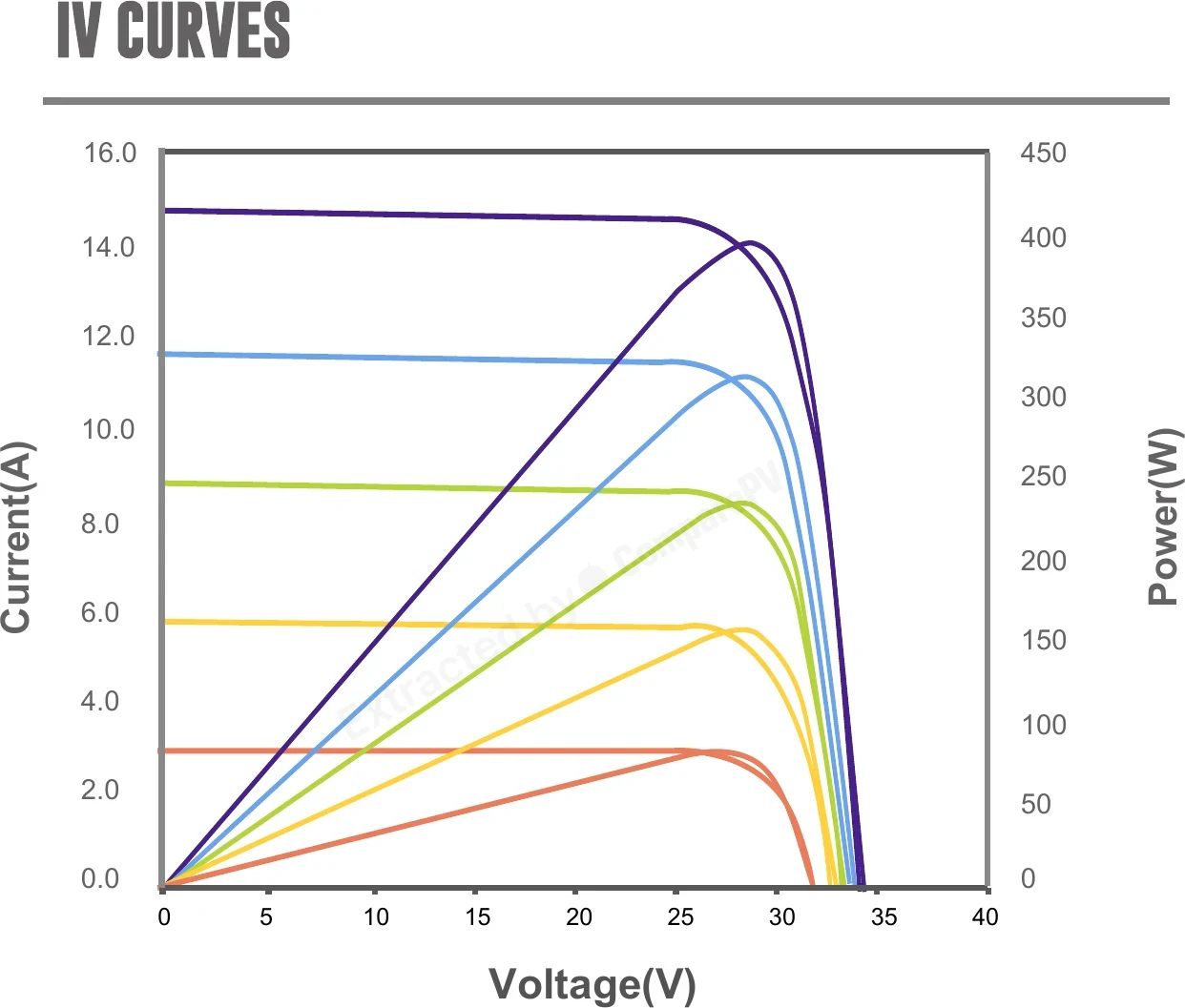
Measured curves published by HT-SAAE in this model's datasheet. A chart carrying a wattage was measured on that variant alone - only the ones that describe 380 Wp appear here. The rest cover the whole series.
Simulations
Degradation from this panel's own datasheet figures. No inverter, soiling or shading losses.
Model: bifaciality × albedo × 0.6 view factor. A first-order estimate, not a yield simulation.
Alternatives



Found 2327 panels of the same or similar size to this one, within ±10 mm. See them here Found 2369 panels of the same or similar size to this one, within ±25 mm. See them here Found 2383 panels of the same or similar size to this one, within ±50 mm. See them here Found 2548 panels of the same or similar size to this one, within ±100 mm. See them here
About the HT48-18X(ND)-F series
These answers cover the whole series. Where a figure differs, the specification above is this module's own.