DMEGC GH395M10RT-G48HSW-LC

GH395M10RT-G48HSW-LC

395 Wp N-type
ComparePV verdict

Strong in heat, no clear weak spot

Rank 10,927 of 14,005
Compare panels Datasheet PDF
Power (Wp)
395
Strong · top 4%
Efficiency (%)
21.11
Strong · top 15%
Density (Wp/m²)
211.1
Strong · top 19%
Temp (%/°C)
-0.290
Strong · top 11%
Weight (kg)
19.4
Strong · 2.6 kg below median
Warranty (yrs)
30
Strong · top 19%

The DMEGC Greenhouse series is a specialized solution in the field of agrivoltaics that redefines the way modern agriculture is combined with green energy production. The key distinguishing feature of these modules is their unique construction transparency, which allows for the free flow of sunlight necessary for proper plant growth. The use of advanced N-type TOPCon bifacial cell technology ensures the panels generate electricity from both sides, maximizing yields even in specific mounting conditions above crops. They solve the land deficit problem, enabling efficient dual use of the surface for crops and renewable energy installations simultaneously. Unlike traditional modules, the Greenhouse series provides optimal lighting for crops and protects them from severe weather events such as hail or heavy rain. Thanks to the glass-glass structure, the product is characterized by extreme resistance to ammonia and moisture, making it reliable in aggressive agricultural environments. The innovative approach to construction allows for easy installation on various types of support systems used in horticulture. It is an ideal choice for farms seeking energy independence without reducing production acreage. The applied technology eliminates the risk of hot-spots and guarantees stable operation for decades, setting these panels apart from standard market solutions.

Ranking

51 panels in the segment N-type 350-400 W
Metric This panel Median Position in segment Overall rank
Module efficiency 21.11% 20.00% Strong · top 15% 9,271
Power density 211.1 200.4 Strong · top 19% 9,286
Temperature coefficient -0.290 -0.320 Strong · top 11% 2,165
Weight per kWp 49.1 62.0 Strong · top 25% 2,753
Performance warranty 30 yrs 25 yrs Strong · top 19% 21
Colour key Strong - top 25% Typical - middle 50% Weak - bottom 25%

Signals from the data

8 positive · 2 caution
Best for

Agrivoltaic.

Strengths
-0.290 %/°C temperature coefficient

Top 11% of the N-type 350-400 W segment, against a median of -0.320.

21.11% module efficiency

Top 15% of the N-type 350-400 W segment, against a median of 20.00%.

211.1 watts per square metre

Top 19% of the N-type 350-400 W segment, against a median of 200.4.

What owners get
Adjustable Light Transmittance 2–50%

The Greenhouse series (evolved toward the G12RT) offers a light transmittance spectrum from 2% to 50%, enabling precise module selection to match the requirements of a specific crop and climate. None of the listed peer comparables (Jinko Tiger Neo, Q-Cells Q.TRON BLACK, Astronergy ASTRO N7s) feature this capability — it is a unique characteristic exclusive to DMEGC's agrivoltaic series.

N-type TOPCon + Glass-Glass Construction

N-type TOPCon cells exhibit lower LID degradation rates and a superior temperature coefficient compared to PERC technology (typically -0.29%/°C vs. -0.35%/°C). The glass-glass laminate provides exceptional resistance to moisture and ammonia — critical in greenhouse and livestock environments where standard backsheets undergo accelerated degradation.

30-Year Power Output Warranty

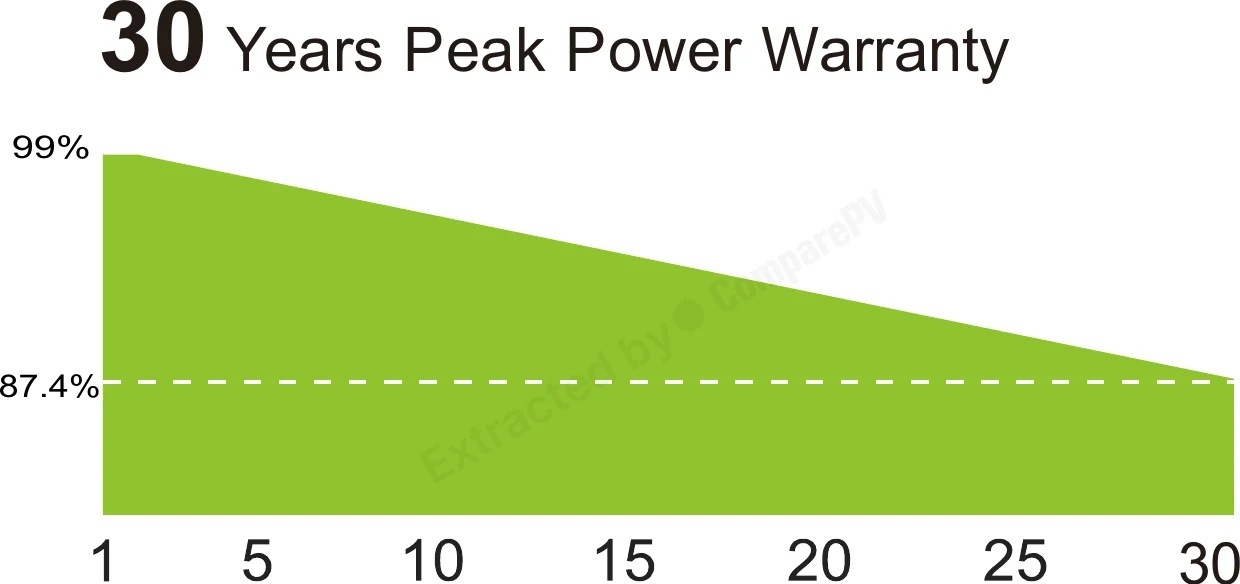
DMEGC guarantees ≥99% power output after year 1 and ≥85% after 30 years, corresponding to a slower degradation curve than the standard 25-year warranties offered by many competing series. For agrivoltaic projects with a typical investment horizon of 25–30 years, this has a direct impact on project bankability.

Bloomberg NEF Tier 1 — Confirmed Q3 2025

DMEGC Solar has maintained BloombergNEF Tier 1 status continuously through at least Q3 2025 (annual production capacity: 21 GW). This status is required by the majority of renewable energy project lenders for non-recourse financing, directly reducing the cost of capital for agrivoltaic farm developments.

Manufacturer with 45 Years of Production Experience

DMEGC has been in operation since 1980, which — in the context of a 30-year power warranty — is a significant credibility argument. Manufacturer insolvency risk is lower than with newer market entrants, a factor that banks and project insurers typically price as reduced risk premiums for renewable energy projects.

Trade-offs
Non-Bifacial Design in an Agrivoltaic Application

The Greenhouse series has is_bifacial = false, whereas agrivoltaic installations are among the use cases where bifacial technology delivers the greatest benefits — light reflected from the ground surface and crops can increase energy yield by 5–30% (Oxford Clean Energy, 2024). The direct peer, Astronergy ASTRO N7s, is a bifacial series with 22.3% efficiency, which in above-crop mounting configurations may translate into a measurably higher annual energy yield.

Peak Efficiency (21.91%) Below Segment Leaders

The series' maximum efficiency of 21.91% falls short of all three listed peer comparables, which achieve 22.27–22.3% (Jinko Tiger Neo, Q-Cells Q.TRON BLACK, Astronergy ASTRO N7s). The ~0.4 percentage point gap translates to approximately 2% more module area required for the same power target — a meaningful constraint in installations with limited greenhouse floor space.

Notes from the database
  • At 21.1% efficiency, this panel is 1.6pp above typical N-type 0-400W modules (median: 19.5%)
  • Power density of 211.1 W/m² packs 16.2 W/m² more into the same footprint vs N-type 0-400W median (194.9 W/m²)
  • Temperature coefficient of -0.29%/°C vs median -0.32%/°C means ~1% less power loss at 65°C
  • At 19.4 kg, this panel is 2.6 kg lighter than N-type 0-400W median (22.0 kg) - easier handling during installation
  • Ranked #9271 out of 14005 panels for efficiency in the database

Specifications

Open datasheet PDF
Nominal power (Pmax) 395 Wp Nameplate at 1000 W/m², 25 °C
Module efficiency 21.11 % Strong Segment median 20.00%
Vmpp · Impp 29.40 V · 13.46 A Operating point at max power
Voc · Isc 35.24 V · 13.97 A Sizes the string length
Max system voltage 1500 V Longer strings than 1000 V modules
Dimensions 1650×1134×25 mm · 1.87 m² of roof
Weight 19.4 kg Strong Strong · 2.6 kg below median
Cells 96 · N-type Monocrystalline
Coefficient Pmax -0.290 %/°C Strong top 11% of its segment
Coefficient Voc · Isc -0.250 · 0.048 %/°C
NOCT 42 °C At 800 W/m², 20 °C ambient
Product warranty 15 years Hardware defects only
Performance warranty 30 years Strong top 19% · median 25 yrs
End-of-warranty output 87.4 % Equals 345 W guaranteed
Degradation 1.00 → 0.40 % First year, then annual

Datasheet charts

Open datasheet PDF

Measured curves published by DMEGC in this model's datasheet. A chart carrying a wattage was measured on that variant alone - only the ones that describe 395 Wp appear here. The rest cover the whole series.
Simulations

Live - change any input
Lifetime output & value
30 years at 1200 kWh/kWp/year and €0.50 per kWh
Power in year 30
-
Lifetime energy
-
Energy value
-

Degradation from this panel's own datasheet figures. No inverter, soiling or shading losses.

Heat losses
-0.290 %/°C against a segment median of -0.320
-
Filter these
Size
Panel Power Eff. Temp. Weight Difference
DMEGC GH395M10RT-G48HSW-LC 395 W 21.11% -0.290 19.4 kg You are here
LX-440M/182-108+GG 440 W 23.07% -0.240 23.6 kg +45 W, cooler, +2.0 pp
GKA210M360W 360 W 23.00% - 16.2 kg -35 W, lighter, +1.9 pp
GKA210M380W (1/4*4*38) 380 W 23.00% - 17.1 kg -15 W, lighter, +1.9 pp
GKA210M400W (1/2*4*20) 400 W 23.00% - 18.0 kg Lighter, +1.9 pp
GKA210M400W (1/4*4*40) 400 W 23.00% - 18.0 kg Lighter, +1.9 pp
GKA210M380W (1/2*4*19) 380 W 23.00% - 17.1 kg -15 W, lighter, +1.9 pp
JT440SYK(B) 440 W 22.90% -0.240 23.0 kg +45 W, cooler, +1.8 pp
LX-440M/182-108+ 440 W 22.86% -0.300 21.5 kg +45 W, +1.8 pp, -5 yr warranty
GH400M10RT-G48HSW-LC 400 W 21.38% -0.290 19.4 kg +0.3 pp
GH405M10RT-G48HSW-LC 405 W 21.65% -0.290 19.4 kg +10 W, +0.5 pp
GH410M10RT-G48HSW-LC 410 W 21.91% -0.290 19.4 kg +15 W, +0.8 pp
JST-EDMH-(445-465)W-TD (465W class) 465 W 23.81% -0.300 20.5 kg +70 W, heavier, +2.7 pp
AIKO-A460-MAH54Mb 460 W 23.60% -0.290 20.5 kg +65 W, heavier, +2.5 pp
JST-EDMH-(445-465)W-TD (460W class) 460 W 23.56% -0.300 20.5 kg +65 W, heavier, +2.4 pp
PS-MNB108(HCBF)-460W 460 W 23.53% -0.290 20.5 kg +65 W, heavier, +2.4 pp
AIKO-455-MAH54Db 455 W 23.30% -0.260 24.0 kg +60 W, heavier, +2.2 pp

Found 12 panels of the same or similar size to this one, within ±10 mm. See them here Found 12 panels of the same or similar size to this one, within ±25 mm. See them here Found 25 panels of the same or similar size to this one, within ±50 mm. See them here Found 1997 panels of the same or similar size to this one, within ±100 mm. See them here

Common questions

6 answered
How much light do DMEGC Greenhouse panels transmit, and will plants grow well beneath them?
The DMEGC Greenhouse series offers adjustable light transmittance ranging from 2% to as much as 50%, allowing growers to select the appropriate variant for a specific crop species. The transparent module construction permits free passage of the solar radiation required for photosynthesis while simultaneously protecting plants from severe weather events such as hail and heavy rainfall.
What warranty does the manufacturer provide on DMEGC Greenhouse panels?
DMEGC provides a 15-year product warranty on the Greenhouse series, covering material and manufacturing defects. The power output warranty extends to 30 years, meaning the manufacturer guarantees a defined minimum energy yield level over three decades of operation. These are standard warranty terms for glass-glass modules intended for long-term agrivoltaic installations.
How do DMEGC Greenhouse panels differ from conventional photovoltaic panels used in agriculture?
Unlike standard modules, the Greenhouse series was designed specifically for agrivoltaic applications: it features a transparent glass-glass structure that transmits light to the crops beneath, employs N-type TOPCon cells that generate current from both sides of the module, and exhibits exceptional resistance to ammonia and moisture. Conventional agricultural panels block light access and degrade rapidly in livestock housing or greenhouse environments.
Can DMEGC Greenhouse panels be installed on an existing greenhouse or polytunnel structure?
Yes, the Greenhouse series is engineered for compatibility with the typical mounting systems used in horticulture and greenhouse construction, including Y-frame and ECG structures. However, the load-bearing capacity of the existing structure should be verified with an installer prior to mounting, as glass-glass modules are heavier than standard EVA-backsheet panels.
What is the maximum power output of DMEGC Greenhouse panels, and does N-type TOPCon technology make a difference here?
Greenhouse series panels achieve a peak power output of up to 445 Wp. N-type TOPCon cell technology is critical to this result: it delivers higher conversion efficiency and lower temperature-induced degradation than older PERC cells, and its surface passivation minimizes the risk of hot-spot formation — an important advantage under the partial shading conditions typical of installations over crops.
Are DMEGC Greenhouse panels suitable for use in the humid environment of a poultry house or livestock barn?
Yes, the Greenhouse series is particularly well suited for such applications. The glass-glass construction — glass on both sides in place of a conventional backsheet — provides exceptional resistance to moisture and to the ammonia released by animal waste and fertilizers. Traditional backsheet modules are prone to rapid delamination under such conditions, whereas Greenhouse modules maintain full integrity throughout their entire service life.
Add to compare