Heckert Solar ZEUS 3.0+ 108 485W FULL BLACK

ZEUS 3.0+ 108 485W FULL BLACK

485 Wp Back Contact Bifacial 42%
ComparePV verdict

Space saver, no clear weak spot

Rank 2,068 of 14,005
Compare panels Datasheet PDF
Power (Wp)
485
Strong · top 21%
Efficiency (%)
24.30
Strong · top 7%
Density (Wp/m²)
242.7
Strong · top 6%
Temp (%/°C)
-0.260
Typical · median -0.260
Weight (kg)
24.2
Typical · median 23.5 kg
Warranty (yrs)
30
Typical · median 30 yrs

The Zeus 3.0+ Full Black is a photovoltaic module built on Back-Contact (ABC) technology, where all electrical contacts are moved to the rear side of the cell. As a result, the front surface stays free of metallization grids and interconnect ribbons, delivering a uniform, deep black appearance with no visible streaks or busbars - an excellent fit for installations where roof aesthetics matter as much as performance. The series is based on N-type cells, which provide lower long-term degradation and better high-temperature stability than conventional P-type designs. The glass-glass construction with a 30 mm aluminum frame and bifacial technology allows the module to capture additional energy reflected from the ground, boosting the overall yield of the installation. The Zeus 3.0+ handles partial shading well thanks to an architecture that limits the impact of hot spots, making it a solid choice for roofs with irregular exposure. It's designed for residential and commercial investors who expect a modern, minimalist look, high mechanical durability, and a long-term warranty backing up low power degradation over years of operation.

Ranking

156 panels in the segment Back Contact 450-500 W
Metric This panel Median Position in segment Overall rank
Module efficiency 24.30% 23.50% Strong · top 7% 131
Power density 242.7 235.2 Strong · top 6% 140
Temperature coefficient -0.260 -0.260 Typical 511
Weight per kWp 49.9 48.0 Typical 3,275
Performance warranty 30 yrs 30 yrs Typical 21
Colour key Strong - top 25% Typical - middle 50% Weak - bottom 25%

Signals from the data

7 positive · 2 caution
Best for

Residential, commercial, BIPV and shaded-installations.

Strengths
242.7 watts per square metre

Top 6% of the Back Contact 450-500 W segment, against a median of 235.2. Ranked 140th in the whole database.

24.30% module efficiency

Top 7% of the Back Contact 450-500 W segment, against a median of 23.50%. Ranked 131st in the whole database.

What owners get
Efficiency up to 24.3%, top of the segment

Efficiency of 24-24.3% matches the best peer comparable (Gokin GK-5-54HG/GK-5-54HGb, 24.3%) and exceeds ZNShine ZXM7-UHLD120 (22.47%) by roughly 1.8pp at the same 485 Wp power class, meaning notably less roof area needed for the same output.

Back Contact (ABC) technology, no front busbars

All electrical contacts are moved to the rear side of the N-type cell, freeing the front surface from metallization grids and interconnect ribbons — this increases active cell area and improves partial-shading and high-temperature performance compared to conventional P-type PERC cells.

30-year product and power warranty

Heckert Solar offers a 30-year warranty on both product and power, a longer and more symmetric term than the market-typical 12-15 years on product and 25 years on power, meaningfully lowering long-term investor risk.

Bifacial glass-glass build with high bifaciality

The glass-glass version (2x2 mm) achieves bifaciality up to 43.6%, recovering additional energy reflected from the ground and boosting total system yield, especially on bright or highly reflective mounting surfaces.

German manufacturer with a 30-year track record

Heckert Solar has operated since 1992 and is headquartered in Germany, which combined with TÜV certification and a 30-year warranty establishes credibility as a Tier-1 supplier for residential and commercial installations.

Trade-offs
Lack of long-term field data

The Zeus 3.0+ series launched in 2026, so despite the 30-year warranty there is no independent, multi-year field degradation data for ABC cells yet, unlike mature PERC/TOPCon technologies that have years of track record.

Higher weight of glass-glass construction

The bifacial glass-glass variant is noticeably heavier than standard glass-backsheet modules, which for retrofit installations on older roof structures may require additional load-bearing verification before installation.

Notes from the database
  • At 24.3% efficiency, this panel is 0.8pp above typical Back Contact 450-500W modules (median: 23.5%)
  • At 242.7 W/m² power density, this panel generates 7.5 W/m² more per unit area than Back Contact 450-500W median (235.2 W/m²)
  • At -0.26%/°C, hot weather performance is typical for Back Contact 450-500W panels
  • Bifaciality factor of 42% can add 2-6% extra yield with reflective mounting surface
  • In the top 1% for efficiency among all Back Contact panels

Specifications

Open datasheet PDF
Nominal power (Pmax) 485 Wp Nameplate at 1000 W/m², 25 °C
Module efficiency 24.30 % Strong Segment median 23.50%
Vmpp · Impp 34.60 V · 14.02 A Operating point at max power
Voc · Isc 41.00 V · 14.84 A Sizes the string length
Max system voltage 1500 V Longer strings than 1000 V modules
Dimensions 1762×1134×30 mm · 2.00 m² of roof
Weight 24.2 kg Typical Typical · median 23.5 kg
Cells 108 · Back Contact Monocrystalline
Bifaciality 42 % Rear output as a share of front
Coefficient Pmax -0.260 %/°C Typical median -0.260 of its segment
Coefficient Voc · Isc -0.220 · 0.050 %/°C
NOCT 45 °C At 800 W/m², 20 °C ambient
Product warranty 30 years Hardware defects only
Performance warranty 30 years Typical median 30 yrs · median 30 yrs
End-of-warranty output 85.0 % Equals 412 W guaranteed
Degradation 2.00 → 0.45 % First year, then annual

Datasheet charts

Open datasheet PDF

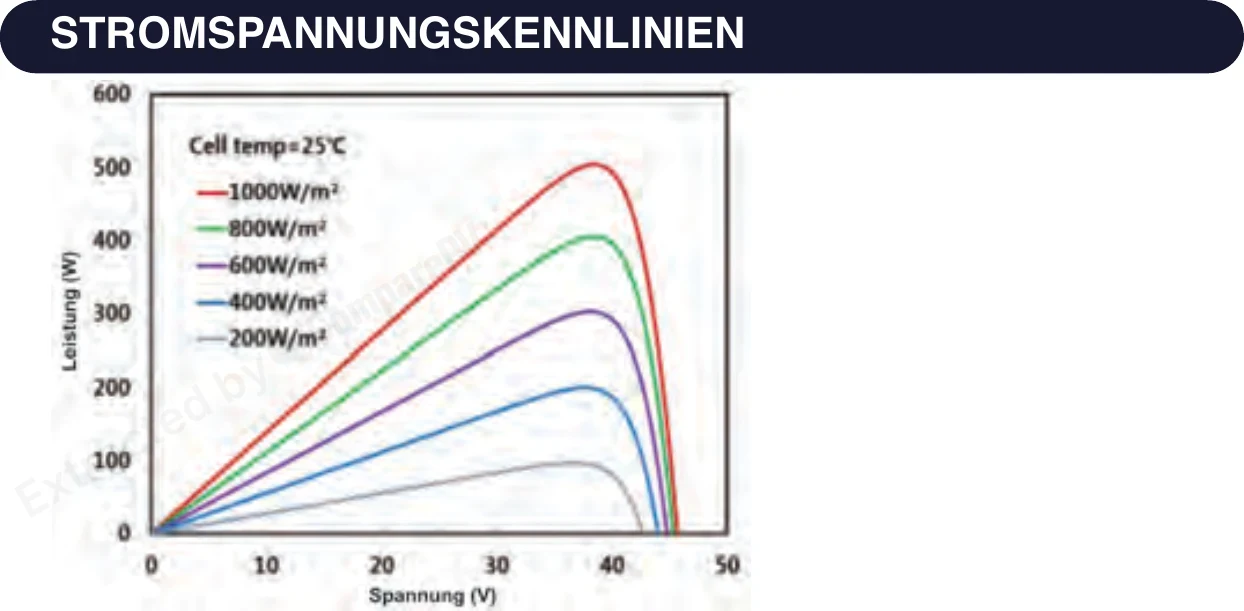
Measured curves published by Heckert Solar in this model's datasheet. A chart carrying a wattage was measured on that variant alone - only the ones that describe 485 Wp appear here. The rest cover the whole series.
Simulations

Live - change any input
Lifetime output & value
30 years at 1200 kWh/kWp/year and €0.50 per kWh
Power in year 30
-
Lifetime energy
-
Energy value
-
With bifacial gain
-

Degradation from this panel's own datasheet figures. No inverter, soiling or shading losses.

Heat losses
-0.260 %/°C against a segment median of -0.260
-
Bifacial gain
Rear gain over light concrete: -
-

Model: bifaciality × albedo × 0.6 view factor. A first-order estimate, not a yield simulation.

Filter these
Size
Panel Power Eff. Temp. Weight Difference
Heckert Solar ZEUS 3.0+ 108 485W FULL BLACK 485 W 24.30% -0.260 24.2 kg You are here
LR7-54HJD-510M 510 W 25.00% -0.240 23.5 kg +25 W, cooler, +0.7 pp
AIKO-A495-MCE54Mw 495 W 24.80% -0.260 21.0 kg +10 W, lighter, +0.5 pp
LR7-54HJD-505M 505 W 24.70% -0.240 23.5 kg +20 W, cooler, +0.4 pp
AIKO-A490-MCE54Mw 490 W 24.50% -0.260 21.0 kg Lighter
LR7-54HJD-500M 500 W 24.50% -0.240 23.5 kg +15 W, cooler
CIPRO-TN9C54M-500W 500 W 24.50% -0.260 21.4 kg +15 W, lighter
ZEUS 1.1 440WP Full Black 440 W 22.00% -0.280 20.9 kg -45 W, lighter, -2.3 pp
ZEUS 1.1 445W Black Frame 445 W 22.30% -0.280 20.9 kg -40 W, lighter, -2.0 pp

Found 1395 panels of the same or similar size to this one, within ±10 mm. See them here Found 1425 panels of the same or similar size to this one, within ±25 mm. See them here Found 3614 panels of the same or similar size to this one, within ±50 mm. See them here Found 3962 panels of the same or similar size to this one, within ±100 mm. See them here

Common questions

6 answered
What is Back-Contact (ABC) technology in Heckert Solar ZEUS 3.0+ panels and how does it differ from standard modules?
In Back-Contact technology, all electrical contacts of the cell are moved to its rear side, so the front of the panel is free of visible busbars and connecting ribbons. In practice this results in a uniform, deep black surface without metallization stripes and slightly higher efficiency, since the entire front side of the cell acts as active light-absorbing area, unshaded by conductive paths.
What is the maximum power and efficiency of the ZEUS 3.0+ Full Black module?
The panel reaches a maximum power of up to 485 Wp with module efficiency of approximately 24.3%, one of the highest results among commercially available panels. High efficiency allows more energy to be generated from a smaller roof area, which matters when installation space is limited.
Are ZEUS 3.0+ panels bifacial, and is it worth choosing this feature?
Yes, the ZEUS 3.0+ series uses a glass-glass construction with bifacial technology, allowing additional energy to be recovered from light reflected off the ground beneath the panel. This makes the most sense on light-colored roofing, gravel, or ground-mounted structures with adequate clearance, while on a standard dark roof tile installation the gain will be smaller, though still positive.
What warranty comes with Heckert Solar ZEUS 3.0+ panels?
The manufacturer provides a 30-year product warranty and a 30-year power performance warranty, placing it among the industry leaders. The N-type cells used in this series have lower annual degradation than conventional P-type cells, allowing the panel to maintain a high percentage of nominal power even after decades of operation.
Do ZEUS 3.0+ panels handle shading well, for example from a chimney or antenna?
The Back-Contact architecture limits the impact of hot spots, so partial shading of individual cells has less effect on the overall panel's output compared to conventional modules. This is a significant advantage for roofs with irregular exposure, chimneys, dormers, or receiving-equipment elements casting shadows.
Are ZEUS 3.0+ modules more durable than standard solar panels?
The glass-glass construction with a 30 mm aluminum frame and double-sided 2 mm glass layers provides greater mechanical rigidity and better resistance to snow and wind loads compared to modules with a rear polymer backsheet. The panels also operate in a system voltage rated up to 1500 V, making them suitable for both residential and larger commercial installations.
Add to compare