G-STAR GSD7S72T-600WT

GSD7S72T-600WT

600 Wp TOPCon Bifacial 80%
ComparePV verdict

Efficiency leader, weak in heat

Rank 2,392 of 14,005
Compare panels Datasheet PDF
Power (Wp)
600
Weak · bottom 5%
Efficiency (%)
23.23
Strong · top 20%
Density (Wp/m²)
232.3
Strong · top 21%
Temp (%/°C)
-0.300
Weak · bottom 19%
Weight (kg)
32.0
Typical · median 32.7 kg
Warranty (yrs)
30
Typical · median 30 yrs

The G-STAR GSD7S72T solar panel series represents a breakthrough in performance thanks to the use of N-type TOPCon cell technology, which minimizes energy losses and ensures excellent efficiency even in challenging lighting conditions. The use of a modern bifacial double glass design allows for the active capture of radiation reflected from the ground, which significantly increases the total energy yield from the installation compared to traditional single-sided modules. This solution perfectly addresses the needs of commercial investors and solar farm owners looking to maximize return on investment while limiting power degradation over a long-term horizon. Thanks to the complete elimination of the LID effect and improved resistance to high operating temperatures, these modules operate much more stably than standard competitor solutions, offering a longer warranty period for linear performance. Solid construction and a reinforced glass-glass structure make the GSD7S72T series exceptionally resistant to extreme mechanical loads and adverse weather conditions. Choosing this specific series is an investment in energy security and durability, dedicated to demanding large-scale projects where the priority is every watt of power generated per square meter of surface while maintaining the lowest possible LCOE.

Ranking

1,086 panels in the segment TOPCon 600-650 W
Metric This panel Median Position in segment Overall rank
Module efficiency 23.23% 22.80% Strong · top 20% 1,252
Power density 232.3 227.7 Strong · top 21% 1,252
Temperature coefficient -0.300 -0.290 Weak · bottom 19% 6,093
Weight per kWp 53.3 53.1 Typical 7,236
Performance warranty 30 yrs 30 yrs Typical 21
Colour key Strong - top 25% Typical - middle 50% Weak - bottom 25%

Signals from the data

7 positive · 2 caution
Best for

Commercial, utility-scale and shaded-installations.

Not ideal for

Hot climates.

Strengths
23.23% module efficiency

Top 20% of the TOPCon 600-650 W segment, against a median of 22.80%.

232.3 watts per square metre

Top 21% of the TOPCon 600-650 W segment, against a median of 227.7.

Watch-outs
-0.300 %/°C temperature coefficient

Bottom 19% of the TOPCon 600-650 W segment, against a median of -0.290.

What owners get
Premium-class efficiency – up to 23.03%

The top-tier variant GSD7S72T-595 achieves 23.03% module efficiency, matching direct competitors Solarspace Lumina II and Ulica Solar TOPCon (both 23.03%) and significantly outpacing the Sunova TS-BW78 (21.3%). This translates to approximately 8% more energy yield from the same footprint compared to the aforementioned Sunova module.

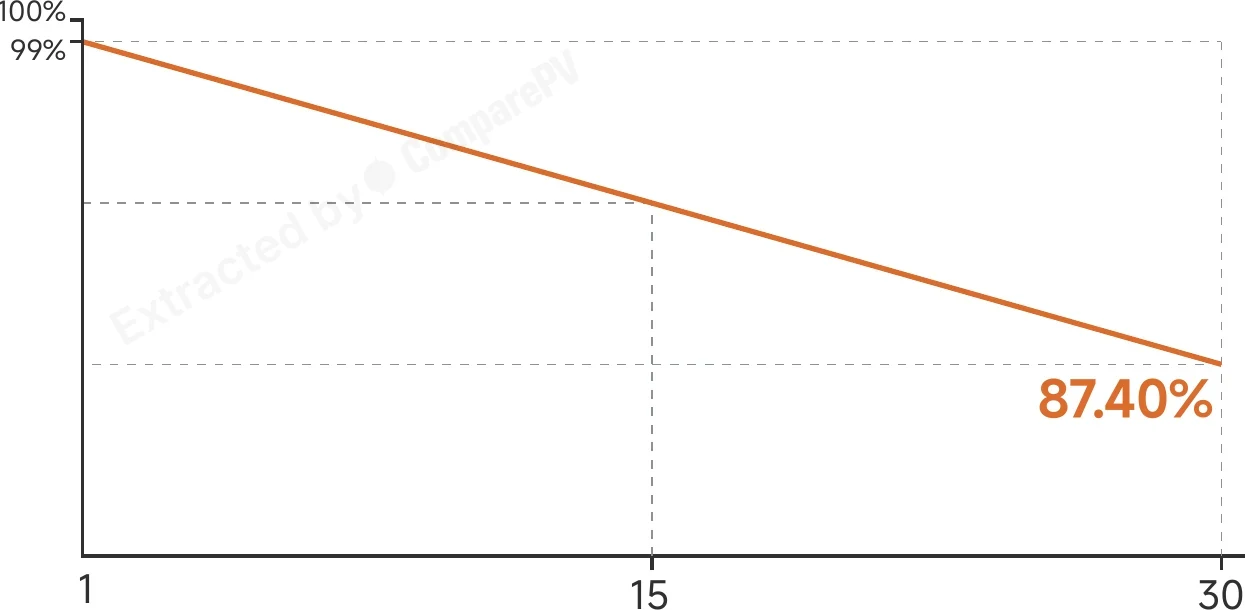
30-year linear power warranty, degradation ≤0.40%/year

The manufacturer guarantees a linear power warranty for 30 years with an annual degradation rate of ≤0.40%, retaining approximately 88% of nominal power output at year 30. Most Tier-1 modules (e.g., Jinko, Trina) offer 25-year warranties with end-of-life power retention of ~84.8%, making the GSD7S72T more attractive in long-term financial models and LCOE calculations.

N-type TOPCon – zero LID effect

N-type TOPCon technology completely eliminates Light-Induced Degradation (LID) inherent to P-type PERC cells. The temperature coefficient of –0.30%/°C means that at a module operating temperature of 65°C (typical summer conditions in Poland), power losses are approximately 7.5% versus ~9% for standard PERC cells (–0.35%/°C) — a tangible gain on hot days.

Bifacial dual-glass construction, rear-side gain 5–25%

The bifacial dual glass configuration harvests 5–25% additional energy from reflected irradiance (albedo), particularly effective over light-colored or snow-covered surfaces. The glass-glass laminate also extends mechanical service life and provides high resistance to wind and snow loads — typical rated values exceed 5,400 Pa (dynamic) and 2,400 Pa (static).

Wide power range: 565–595 Wp across 7 variants

Seven power variants within a single series simplify project optimization for a given module count and inverter specifications, eliminating wasted power headroom. The 30 Wp flexibility range is significant in EPC tenders and utility-scale array design, where precise string power directly influences the selection of string inverters.

Trade-offs
Manufacturer not on BNEF Tier-1 list

G-STAR does not appear on the BloombergNEF bankable Tier-1 list (confirmed by context: tier_1_bankable: false and absence from BNEF Q1 2026 reports). In projects financed on a non-recourse basis by banks or infrastructure funds, sourcing modules from a Tier-1 manufacturer is standard practice — the lack of this status may block financing or increase required insurance coverage for projects exceeding 1 MWp.

Notes from the database
  • Efficiency of 23.2% matches the TOPCon 600-650W median
  • At 232.3 W/m² power density, this panel generates 4.6 W/m² more per unit area than TOPCon 600-650W median (227.7 W/m²)
  • Temperature coefficient of -0.30%/°C matches the TOPCon 600-650W median
  • 80% bifaciality enables rear-side power generation, boosting yield by 4-12% on reflective surfaces
  • #1252 for efficiency, #6093 for temperature performance out of 14005 panels

Specifications

Open datasheet PDF
Nominal power (Pmax) 600 Wp Nameplate at 1000 W/m², 25 °C
Module efficiency 23.23 % Strong Segment median 22.80%
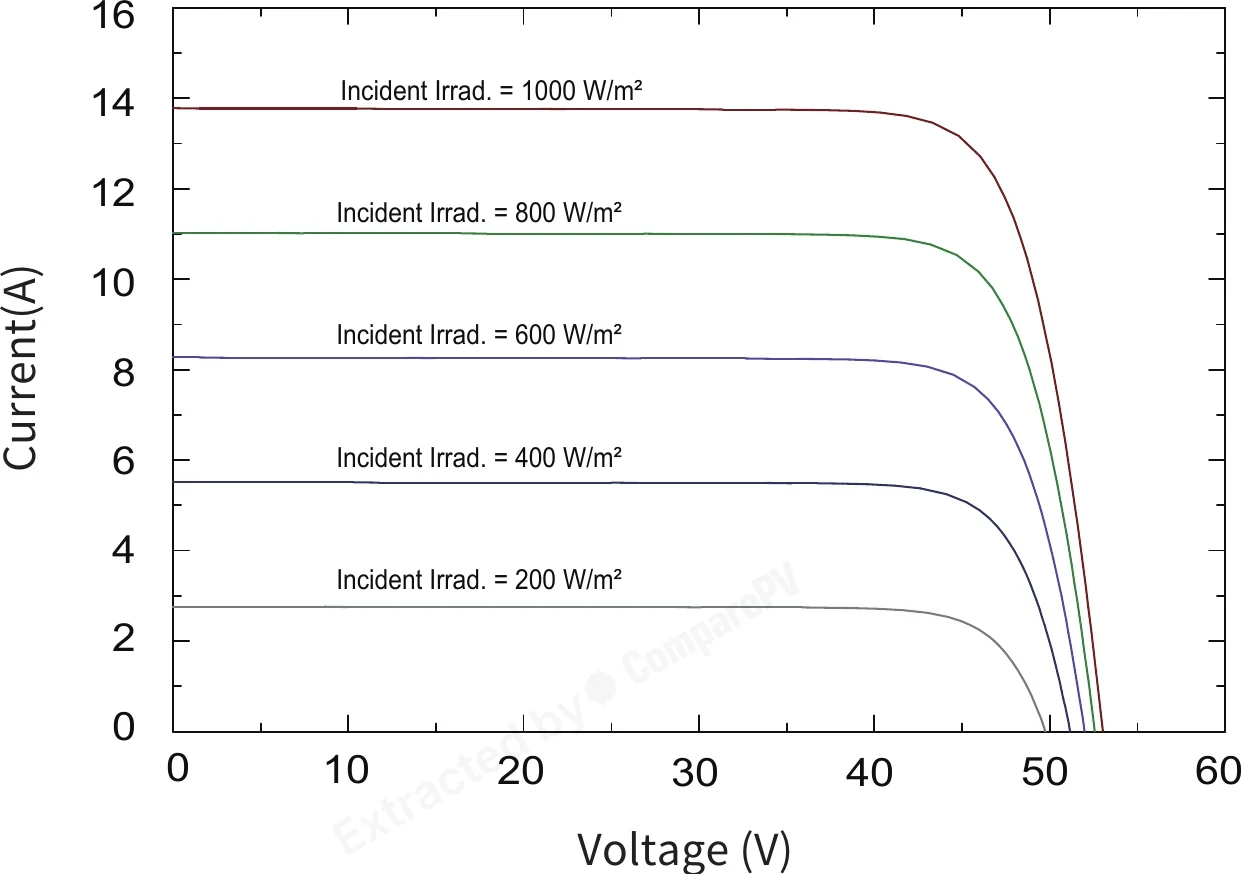
Vmpp · Impp 45.19 V · 13.28 A Operating point at max power
Voc · Isc 53.39 V · 13.90 A Sizes the string length
Max system voltage 1500 V Longer strings than 1000 V modules
Dimensions 2278×1134×30 mm · 2.58 m² of roof
Weight 32.0 kg Typical Typical · median 32.7 kg
Cells 144 · TOPCon Monocrystalline
Bifaciality 80 % Rear output as a share of front
Coefficient Pmax -0.300 %/°C Weak bottom 19% of its segment
Coefficient Voc · Isc -0.250 · 0.046 %/°C
NOCT 43 °C At 800 W/m², 20 °C ambient
Product warranty 15 years Hardware defects only
Performance warranty 30 years Typical median 30 yrs · median 30 yrs
End-of-warranty output 87.4 % Equals 524 W guaranteed
Degradation 1.00 → 0.40 % First year, then annual

Datasheet charts

Open datasheet PDF

Measured curves published by G-STAR in this model's datasheet. A chart carrying a wattage was measured on that variant alone - only the ones that describe 600 Wp appear here. The rest cover the whole series.
Simulations

Live - change any input
Lifetime output & value
30 years at 1200 kWh/kWp/year and €0.50 per kWh
Power in year 30
-
Lifetime energy
-
Energy value
-
With bifacial gain
-

Degradation from this panel's own datasheet figures. No inverter, soiling or shading losses.

Heat losses
-0.300 %/°C against a segment median of -0.290
-
Bifacial gain
Rear gain over light concrete: -
-

Model: bifaciality × albedo × 0.6 view factor. A first-order estimate, not a yield simulation.

Alternatives

All G-STAR panels
Filter these
Size
Panel Power Eff. Temp. Weight Difference
G-STAR GSD7S72T-600WT 600 W 23.23% -0.300 32.0 kg You are here
AIKO-A650-MAE72Mw 650 W 25.20% -0.260 27.0 kg +50 W, lighter, +2.0 pp
AIKO-A645-MAE72Mw 645 W 25.00% -0.260 27.0 kg +45 W, lighter, +1.8 pp
LR7-60HVH-560M 560 W 24.80% -0.260 25.0 kg -40 W, lighter, +1.6 pp
AIKO-A640-MAE72Mw 640 W 24.80% -0.260 27.0 kg +40 W, lighter, +1.6 pp
LR7-60HVH-555M 555 W 24.60% -0.260 25.0 kg -45 W, lighter, +1.4 pp
AIKO-A635-MAE72Mw 635 W 24.60% -0.260 27.0 kg Cooler, lighter, +1.4 pp
GSP7G72M(H)530WT 530 W 20.52% -0.350 28.0 kg -70 W, hotter, -2.7 pp
GSP7G72M(H)535WT 535 W 20.71% -0.350 28.0 kg -65 W, hotter, -2.5 pp
GSP7G72M(H)540WT 540 W 20.90% -0.350 28.0 kg -60 W, hotter, -2.3 pp
GSP7G72M(H)545WT 545 W 21.10% -0.350 28.0 kg -55 W, hotter, -2.1 pp
GSP7G72M(H)550WT 550 W 21.29% -0.350 28.0 kg -50 W, hotter, -1.9 pp
GSD7S72T-565WT 565 W 21.87% -0.300 32.0 kg -35 W, -1.4 pp
GSD7S72T-570WT 570 W 22.07% -0.300 32.0 kg -30 W, -1.2 pp
GSD7S72T-575WT 575 W 22.26% -0.300 32.0 kg -25 W, -1.0 pp
GSD7S72T-580WT 580 W 22.45% -0.300 32.0 kg -20 W, -0.8 pp
GSD7S72T-585WT 585 W 22.65% -0.300 32.0 kg -15 W, -0.6 pp
AIKO-A630-MAH72Dw 630 W 24.40% -0.260 32.5 kg +30 W, cooler, +1.2 pp

Found 2326 panels of the same or similar size to this one, within ±10 mm. See them here Found 2368 panels of the same or similar size to this one, within ±25 mm. See them here Found 2382 panels of the same or similar size to this one, within ±50 mm. See them here Found 2547 panels of the same or similar size to this one, within ±100 mm. See them here

Common questions

6 answered
What warranty is provided for the G-STAR GSD7S72T panels?
The G-STAR GSD7S72T series comes with a 25-year product warranty and a 30-year linear power output warranty. Thanks to N-type TOPCon cell technology, power degradation over time is significantly lower than in conventional P-type modules, resulting in genuinely higher energy yield throughout the entire operational lifetime of the installation.
What is TOPCon technology and why is it worth choosing?
TOPCon is an N-type cell technology in which an additional tunnel oxide passivation layer reduces charge carrier recombination. In practice, this translates to higher conversion efficiency, complete elimination of the LID (Light-Induced Degradation) effect, and better performance at elevated temperatures. In the GSD7S72T series, this results in more stable power output throughout the entire warranty period compared to older PERC modules.
Are the G-STAR GSD7S72T panels suitable for a residential rooftop, or are they primarily intended for utility-scale farms?
The GSD7S72T series, with a peak power of 595 Wp, consists of large-format modules designed primarily for commercial installations and utility-scale photovoltaic farms. For a typical pitched roof on a single-family home, smaller modules in the 400–430 Wp class would be a better fit. However, if you have a large roof section or a flat roof and your priority is maximizing yield per square meter, installing the GSD7S72T is technically feasible.
How does the bifacial double glass design work in the GSD7S72T panels, and when does it provide a real advantage?
The bifacial double glass construction means the module harvests energy from both the front side and from irradiance reflected onto the rear surface. The greatest gain is achieved with high-albedo ground surfaces (concrete, gravel, snow) or in vertical mounting configurations. In ground-mounted installations with adequate ground clearance, GSD7S72T panels can generate up to several percentage points more energy than an equivalent monofacial module, directly reducing the LCOE of the entire farm.
Do the G-STAR GSD7S72T modules perform well under overcast conditions and in low winter temperatures?
N-type TOPCon technology delivers a better temperature coefficient than P-type cells, meaning lower power losses during high-temperature periods. In winter, GSD7S72T panels operate efficiently even at low temperatures, and the tempered glass used in the glass-glass construction reduces the risk of microcracks under extreme frost conditions. Under diffuse irradiance, TOPCon panels outperform older mono PERC technologies, although the difference is less pronounced than under direct irradiance.
Is G-STAR a reputable photovoltaic manufacturer, and can I rely on warranty service?
G-STAR is not classified among Tier 1 manufacturers according to industry rankings (e.g., BloombergNEF), which implies lower brand recognition and a shorter bankability track record than market leaders. Before purchasing, it is advisable to verify that the distributor provides local warranty claims handling and that the manufacturer's insurance policy covers warranty claims in the event of financial difficulties on the part of the company.
Add to compare