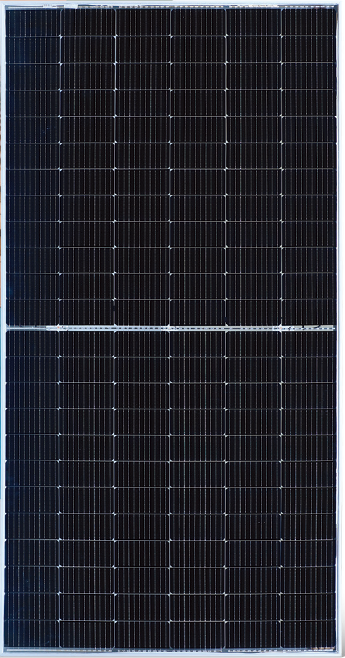
Solid all-round for its segment
The Emmvee SAPPHIRE series consists of bifacial glass-glass panels designed to effectively increase energy yield not only from the front, but also from the rear side. This solution is particularly effective in areas where the substrate reflects light (e.g., light gravel, membranes, light concrete) and in ground-mounted installations. The use of half-cut mono PERC solar cells helps to minimize losses and improve resistance to microcracks, which is important in Polish wind and snow load conditions. Additionally, the multi-busbar technology supports better current collection and more stable module operation in daily use. In practice, SAPPHIRE solves the common problem of reduced production under less intense sunlight - it maintains high efficiency even in low irradiance conditions. The series is designed for installers and investors who expect lower LCOE and faster return on investment without compromising durability, especially in commercial and utility-scale projects, as well as on demanding roofs.
Ranking
Signals from the data
Commercial, utility-scale and shaded-installations.
Emmvee is the only Indian manufacturer and one of only 9 companies worldwide to achieve Top Performer status across all seven Kiwa PVEL 2024 test sequences (PID, LID+LETID, Damp Heat, Thermal Cycling, Mechanical Stress, Hail Stress, and PAN Performance). This independent durability certification is a key factor in assessing long-term investment risk.
The SAPPHIRE series carries a 30-year linear power warranty — longer than the 25-year standard offered by most mid-range competitors. The manufacturer's warranty claim rate of 0.0002% of revenue confirms that this service commitment is backed by real-world reliability.
The module generates power from both faces — the rear glass replaces a conventional backsheet, eliminating delamination risk and improving long-term moisture resistance. In ground-mount installations or on high-albedo surfaces (TPO membranes, gravel), bifacial operation can deliver 10–30% additional net energy yield compared to standard monofacial modules.
The SAPPHIRE datasheet specifies a minimum of 95% of STC efficiency at 200 W/m² irradiance (25°C, AM1.5). In the Polish climate, where a significant share of solar hours occur under diffuse irradiance conditions (100–400 W/m²), this parameter has a direct and measurable impact on annual energy yield.
The half-cut cell format reduces the current in each cell half by 50%, lowering resistive losses and decreasing susceptibility to microcracks under mechanical loading from snow and wind. The 10-busbar multi-busbar configuration shortens the electron collection path, improving current harvest uniformity and sustaining module performance under partial shading conditions.
Emmvee does not appear on the BNEF Tier-1 Bankable Manufacturers list (confirmed in manufacturer data: tier_1_bankable: false). For utility-scale PV projects financed by commercial banks or infrastructure funds, Tier-1 status is often a hard prerequisite — the absence of this designation may restrict financing options or require additional technical insurance coverage.
The maximum module efficiency of the SAPPHIRE series is 21.29%, while the peer-comparable Gamko GKA182N132 (likely N-type TOPCon) reaches 23.16% — a ~1.87 percentage point gap that translates into measurable differences in yield per m². PERC cells also exhibit a higher annual degradation rate (~0.55%/year) compared to N-type TOPCon (~0.40%/year), resulting in a cumulative multi-percent power loss disadvantage over a 30-year project horizon.
- At 20.7% efficiency, this panel is on par with typical PERC 500-550W modules
- At 207.1 W/m² power density, roof space requirements are typical for PERC 500-550W panels
- At -0.35%/°C, hot weather performance is typical for PERC 500-550W panels
- At 30.0 kg (1.6 kg above PERC 500-550W median of 28.4 kg), requires checking roof load capacity
- 70% bifaciality enables rear-side power generation, boosting yield by 4-10% on reflective surfaces
Specifications
Simulations
Degradation from this panel's own datasheet figures. No inverter, soiling or shading losses.
Model: bifaciality × albedo × 0.6 view factor. A first-order estimate, not a yield simulation.
Alternatives



Found 2326 panels of the same or similar size to this one, within ±10 mm. See them here Found 2368 panels of the same or similar size to this one, within ±25 mm. See them here Found 2382 panels of the same or similar size to this one, within ±50 mm. See them here Found 2547 panels of the same or similar size to this one, within ±100 mm. See them here