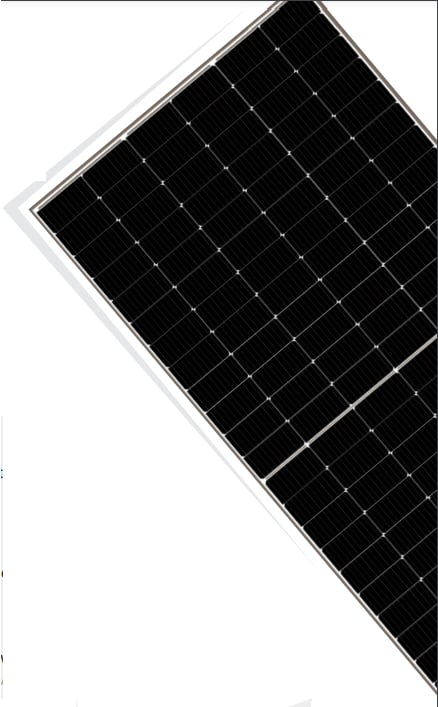
Middle of its segment, needs the roof space
The DAS Solar DAS-DH144NA series are bifacial modules featuring a double glass structure, designed for high energy production not only from the front side but also from the rear - where reflected light utilisation (bright roof, gravel, membrane, ground) plays a key role. The use of N-type cells helps limit performance degradation over time and stabilises the installation's operation in demanding conditions. The double glass construction and symmetrical layer arrangement increase resistance to typical operational issues, such as micro-prestresses and accelerated material aging, which is crucial for projects focused on a long return on investment horizon. These modules also stand out for their good performance under low-light conditions, making them better suited for cloudy days, common in Poland's climate. This is a sensible choice for PV farms, commercial installations, and large rooftops, where reliable yield, durability, and real competitive advantage over traditional single-sided panels are key.
Ranking
Signals from the data
Commercial and utility-scale.
Roofs where every square metre has to count, tight roof space and weight-limited structures.
Bottom 7% of the TOPCon 550-600 W segment, against a median of 224.4. Ranked 8,034th in the whole database.
Bottom 7% of the TOPCon 550-600 W segment, against a median of 22.44%. Ranked 7,958th in the whole database.
Bottom 16% of the TOPCon 550-600 W segment, against a median of 53.8.
A peak efficiency of 23.2% places the series on par with the Tongwei TWMND-72HD (23.2%) and just below the Powitt M10 MONO (23.23%), translating to meaningfully higher energy yield from the same rooftop or ground-mount footprint compared to PERC or older N-type modules.
N-type TOPCon cells deliver an annual degradation rate below 0.4% and a Pmax temperature coefficient of -0.32%/°C – outperforming typical PERC modules at -0.35%/°C. This results in higher yield on hot days and more stable production throughout the full 30-year system life.
With a bifaciality factor of ~80% and a double glass construction, the module can reach a peak output of approximately 679 W (under ground albedo and irradiance conditions specified in the manufacturer's datasheet). This is a significant advantage over conventional monofacial modules in agri-PV installations, and on white membranes, gravel, or light-colored concrete surfaces.
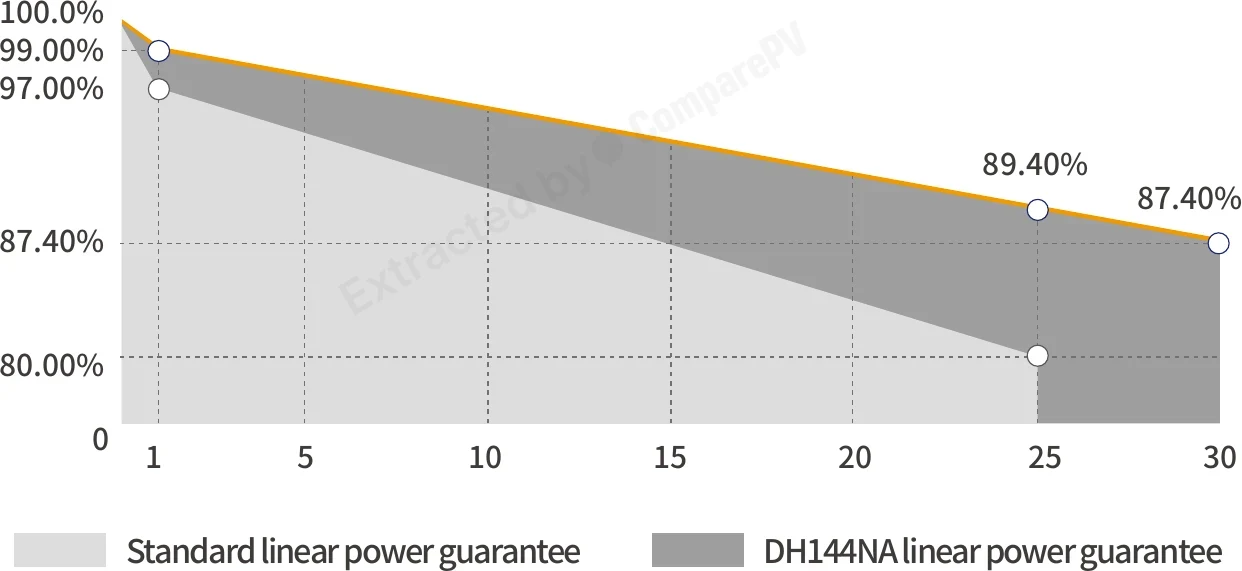
The manufacturer guarantees retention of at least 87.4% of nominal power after 30 years of operation. This is complemented by a 15-year product warranty covering material and workmanship defects – a standard aligned with leading Tier-1 manufacturers in the N-type double glass segment.
DAS Solar has maintained BNEF Tier-1 bankable status continuously for all four quarters of 2025 and ranks 8th globally in PV module shipments for H1 2024 (per InfoLink Consulting). This confirms bankability – non-recourse debt financing from independent banks is a realistic option for projects using these modules.
DAS Solar was founded in 2018, giving it only ~8 years of market history against a 30-year power warranty. Unlike Trina Solar (est. 1997) or JA Solar (est. 2005), the absence of a long-term track record can be raised as a risk factor by insurers or project finance banks underwriting large-scale PV projects – even with BNEF Tier-1 status.
- Efficiency of 21.5% is 0.9pp below the TOPCon 550-600W median (22.4%)
- Power density of 214.8 W/m² is 9.6 W/m² below TOPCon 550-600W median (224.4 W/m²) - needs more roof space
- At -0.30%/°C, hot weather performance is typical for TOPCon 550-600W panels
- 80% bifaciality enables rear-side power generation, boosting yield by 4-12% on reflective surfaces
- #7958 for efficiency, #6093 for temperature performance out of 14005 panels
Specifications
Datasheet charts
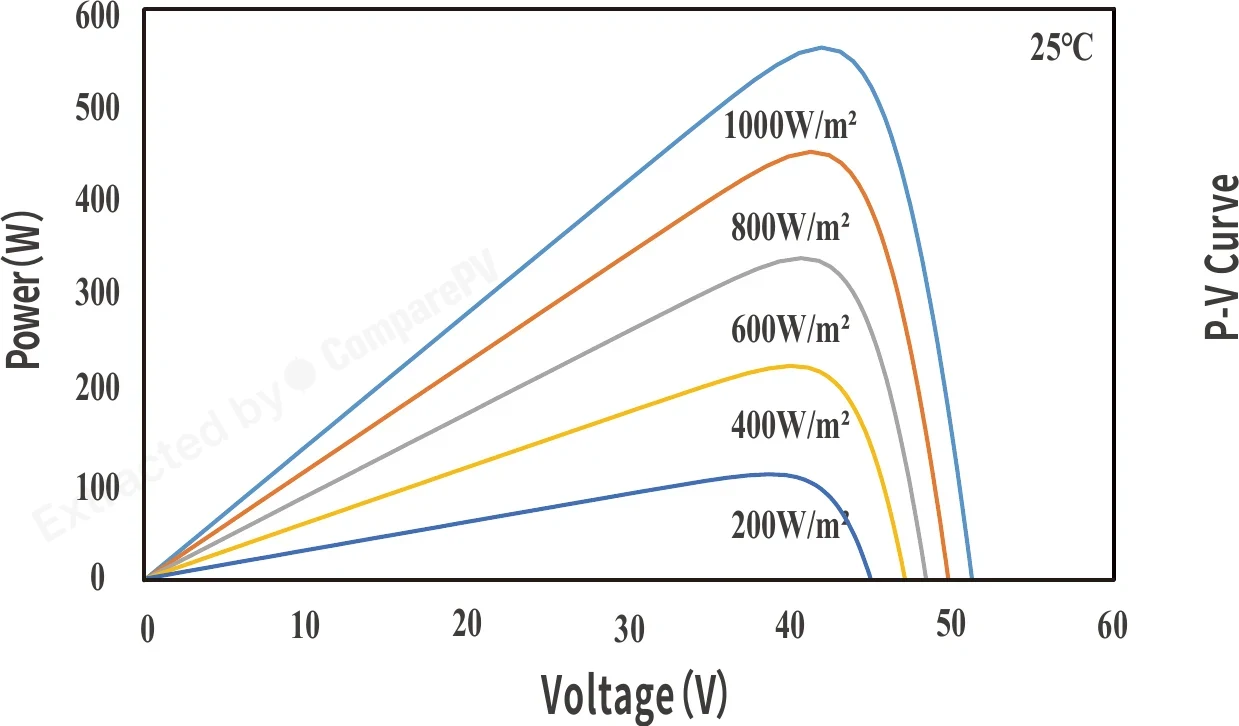
Measured curves published by DAS Solar in this model's datasheet. A chart carrying a wattage was measured on that variant alone - only the ones that describe 555 Wp appear here. The rest cover the whole series.
Simulations
Degradation from this panel's own datasheet figures. No inverter, soiling or shading losses.
Model: bifaciality × albedo × 0.6 view factor. A first-order estimate, not a yield simulation.




Found 2326 panels of the same or similar size to this one, within ±10 mm. See them here Found 2368 panels of the same or similar size to this one, within ±25 mm. See them here Found 2382 panels of the same or similar size to this one, within ±50 mm. See them here Found 2547 panels of the same or similar size to this one, within ±100 mm. See them here