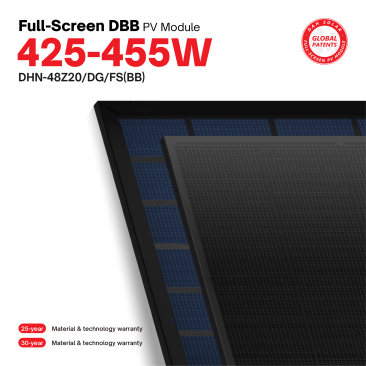
DAH Solar DHN-48Z20/DG(BB)-455W

DHN-48Z20/DG(BB)-455W

455 Wp TOPCon Bifacial 80%
ComparePV verdict

Solid all-round for its segment

Rank 5,689 of 14,005
Compare panels Datasheet PDF
Power (Wp)
455
Typical for its class
Efficiency (%)
22.77
Typical · median 22.52%
Density (Wp/m²)
227.7
Typical · median 225.2
Temp (%/°C)
-0.290
Typical · median -0.290
Weight (kg)
23.9
Typical · median 24.0 kg
Warranty (yrs)
30
Typical · median 30 yrs

The DAH DHN-48Z20/DG(BB) 425-455W series is a range of modules designed for maximum aesthetics and stable energy production in real rooftop conditions. They are characterized by a full black appearance and a design that seamlessly integrates with the roof, ensuring a consistent look, even on modern buildings. The use of N-type cells in TOPCon technology helps minimize losses over time and maintain high efficiency over a longer period, which will be appreciated by those planning long-term installations. These modules are also bifacial - they can utilize reflected light, which is important on bright roofs, terraces, and ground-based structures. Another advantage is the glass-glass construction, which improves resistance to loads and environmental conditions, reducing the risk of degradation. This series is suitable for investors who want to combine premium aesthetics with predictable energy yield, whether in single-family homes or smaller commercial installations.

Ranking

1,089 panels in the segment TOPCon 450-500 W
Metric This panel Median Position in segment Overall rank
Module efficiency 22.77% 22.52% Typical 3,073
Power density 227.7 225.2 Typical 2,888
Temperature coefficient -0.290 -0.290 Typical 2,165
Weight per kWp 52.5 52.2 Typical 6,129
Performance warranty 30 yrs 30 yrs Typical 21
Colour key Strong - top 25% Typical - middle 50% Weak - bottom 25%

Signals from the data

5 positive · 1 caution
Best for

Residential, commercial and BIPV.

What owners get
Favorable Temperature Coefficient

The temperature coefficient of -0.29%/°C (Pmax) is notably better than that of typical PERC modules (-0.34–0.37%/°C), translating into meaningfully higher energy yield on warm, sunny days. For rooftop installations in Poland, this difference can represent up to 2–3% higher annual yield during peak summer production months.

30-Year Linear Power Warranty ≥87.4%

DAH guarantees ≥89.4% of nominal power after 25 years and ≥87.4% after 30 years. Peer comparable Waaree ARKA Series offers only a 25-year power warranty, and the 30-year retention level places this series above the market norm for the residential segment.

Glass-Glass Durability: Snow Load 5400 Pa

The dual-glass construction (2+2 mm glass) withstands snow loads of up to 5400 Pa and wind loads of up to 2400 Pa — above-standard values compared to the typical 2400/2400 Pa ratings of glass-backsheet modules. Particularly relevant for installations in mountainous and sub-alpine locations in Poland.

BNEF Tier 1 Confirmed Q1 2026

DAH Solar maintains uninterrupted BNEF Tier 1 status, confirmed in both Q4 2025 and Q1 2026. Bankable status translates into access to installation insurance and bank financing — a key consideration for commercial projects and leasing arrangements.

Efficiency at the Top of the Segment

Peak efficiency of 22.77% (455W variant) is on par with the highest-rated peer comparables — Sunlike Solar SKT420~455M10-108D6 (22.8%) and IBC Solar LS-TA2 (22.8%) — while clearly outperforming the Waaree ARKA Series (20.93%). The series ranks within the top 10% of the 48-cell TOPCon module segment.

Trade-offs
Weight 23.9 kg — Structural Load Consideration

The glass-glass construction results in a weight of 23.9 kg, approximately 20–25% heavier than typical glass-backsheet modules in a comparable power range (~18–20 kg). On older roofs (rafter structures predating the 1990s), a structural load assessment is required prior to installation, increasing both project cost and preparation time.

Notes from the database
  • At 22.8% efficiency, this panel is on par with typical TOPCon 450-500W modules
  • At 227.7 W/m² power density, roof space requirements are typical for TOPCon 450-500W panels
  • Temperature coefficient of -0.29%/°C matches the TOPCon 450-500W median
  • Bifaciality factor of 80% can add 4-12% extra yield with reflective mounting surface
  • #3073 for efficiency, #2165 for temperature performance out of 14005 panels

Specifications

Open datasheet PDF
Nominal power (Pmax) 455 Wp Nameplate at 1000 W/m², 25 °C
Module efficiency 22.77 % Typical Segment median 22.52%
Vmpp · Impp 30.80 V · 14.77 A Operating point at max power
Voc · Isc 36.20 V · 15.70 A Sizes the string length
Max system voltage 1500 V Longer strings than 1000 V modules
Dimensions 1762×1134×30 mm · 2.00 m² of roof
Weight 23.9 kg Typical Typical · median 24.0 kg
Cells 96 · TOPCon Monocrystalline
Bifaciality 80 % Rear output as a share of front
Coefficient Pmax -0.290 %/°C Typical median -0.290 of its segment
Coefficient Voc · Isc -0.250 · 0.046 %/°C
NOCT 45 °C At 800 W/m², 20 °C ambient
Product warranty 25 years Hardware defects only
Performance warranty 30 years Typical median 30 yrs · median 30 yrs

Datasheet charts

Open datasheet PDF

Measured curves published by DAH Solar in this model's datasheet. A chart carrying a wattage was measured on that variant alone - only the ones that describe 455 Wp appear here. The rest cover the whole series.

Simulations

Live - change any input
Lifetime output & value
30 years at 1200 kWh/kWp/year and €0.50 per kWh
Power in year 30
-
Lifetime energy
-
Energy value
-
With bifacial gain
-

Degradation from this panel's own datasheet figures. No inverter, soiling or shading losses.

Heat losses
-0.290 %/°C against a segment median of -0.290
-
Bifacial gain
Rear gain over light concrete: -
-

Model: bifaciality × albedo × 0.6 view factor. A first-order estimate, not a yield simulation.

Filter these
Size
Panel Power Eff. Temp. Weight Difference
DAH Solar DHN-48Z20/DG(BB)-455W 455 W 22.77% -0.290 23.9 kg You are here
AIKO-A495-MCE54Mw 495 W 24.80% -0.260 21.0 kg +40 W, cooler, +2.0 pp
LR7-54HJD-505M 505 W 24.70% -0.240 23.5 kg +50 W, cooler, +1.9 pp
AIKO-A490-MCE54Mw 490 W 24.50% -0.260 21.0 kg +35 W, cooler, +1.7 pp
LR7-54HJD-500M 500 W 24.50% -0.240 23.5 kg +45 W, cooler, +1.7 pp
CIPRO-TN9C54M-500W 500 W 24.50% -0.260 21.4 kg +45 W, cooler, +1.7 pp
GK-3-54HGb-500M 500 W 24.50% -0.260 21.4 kg +45 W, cooler, +1.7 pp
DHN-48Z16/DG(RR)-380W 380 W 19.02% -0.290 23.9 kg -75 W, -3.8 pp
DHN-48Z16/DG(RR)-385W 385 W 19.27% -0.290 23.9 kg -70 W, -3.5 pp
DHN-48Z16/DG(RR)-390W 390 W 19.52% -0.290 23.9 kg -65 W, -3.2 pp
DHN-48Z16/DG(RR)-395W 395 W 19.77% -0.290 23.9 kg -60 W, -3.0 pp
DHN-48Z16/DG(RR)-400W 400 W 20.02% -0.290 23.9 kg -55 W, -2.8 pp
LR7-54HJD-510M 510 W 25.00% -0.240 23.5 kg +55 W, cooler, +2.2 pp

Found 1395 panels of the same or similar size to this one, within ±10 mm. See them here Found 1425 panels of the same or similar size to this one, within ±25 mm. See them here Found 3614 panels of the same or similar size to this one, within ±50 mm. See them here Found 3962 panels of the same or similar size to this one, within ±100 mm. See them here

Common questions

6 answered
What warranty is provided for the DAH Solar DHN-48Z20/DG(BB) 425–455W series?
The DHN-48Z20/DG(BB) series comes with a 25-year product warranty covering manufacturing defects and a 30-year linear power output warranty. This is one of the most comprehensive warranty packages available on the market — most competing modules offer a power warranty of up to 25 years. DAH Solar is a Bloomberg NEF Tier 1 manufacturer, providing genuine confidence that these commitments will be honored over a three-decade horizon.
What does the BB designation in the DHN-48Z20/DG(BB) series name mean, and how do these panels look on a rooftop?
BB stands for Black Back, indicating a fully black module — black cells, black frame, and black backsheet. The result is a uniform, aesthetically refined appearance that blends seamlessly with dark roof tiles or standing-seam metal roofing. On modern buildings and flat-roof installations, these modules deliver a clean, discreet look with no contrasting silver elements.
Do the DAH Solar DHN-48Z20/DG(BB) panels perform well on hot days or at elevated temperatures?
Yes. The N-type TOPCon cells used in this series feature a lower Pmax temperature coefficient of approximately -0.29%/°C, which outperforms typical PERC modules at -0.35%/°C. This translates to reduced power losses during hot weather — at 70°C, the cells lose roughly 15% less energy than standard polycrystalline modules. This is a meaningful advantage during hot summer conditions.
How much does a single panel from the DHN-48Z20/DG(BB) series weigh, and can it be installed on a typical pitched roof?
The module weighs approximately 23.9 kg with dimensions of 1762×1134×30 mm. This is slightly heavier than conventional aluminum-framed modules because the glass-glass construction — two glass panes instead of a polymer backsheet — adds mass. Installation on typical residential pitched roofs is feasible, but it is important to verify that the roof structure can bear the calculated load. An installer should assess load-bearing capacity before ordering.
Does the bifacial design of the DHN-48Z20/DG(BB) panels make sense on a standard pitched roof in Poland?
On dark roof tiles, the bifacial gain is minimal due to low rear-surface albedo. Dual-side energy harvesting is most beneficial on high-reflectivity surfaces — light-colored facades, white TPO/PVC membranes on flat roofs, gravel, or grass in ground-mounted systems. If the roof surface is dark, the primary benefit of bifaciality shifts from additional power output to enhanced mechanical durability inherent in the glass-glass construction.
How does TOPCon technology in the DHN-48Z20/DG(BB) series differ from mainstream PERC cells?
TOPCon (Tunnel Oxide Passivated Contact) is an N-type cell architecture featuring an additional passivation layer that suppresses charge carrier recombination. In practice, this results in higher efficiency (above 22%) and a slower degradation rate compared to PERC modules. The DHN-48Z20/DG(BB) series achieves up to 455W in a 48-cell format — an output level that is difficult to reach with legacy PERC technology at the same physical dimensions.
Add to compare