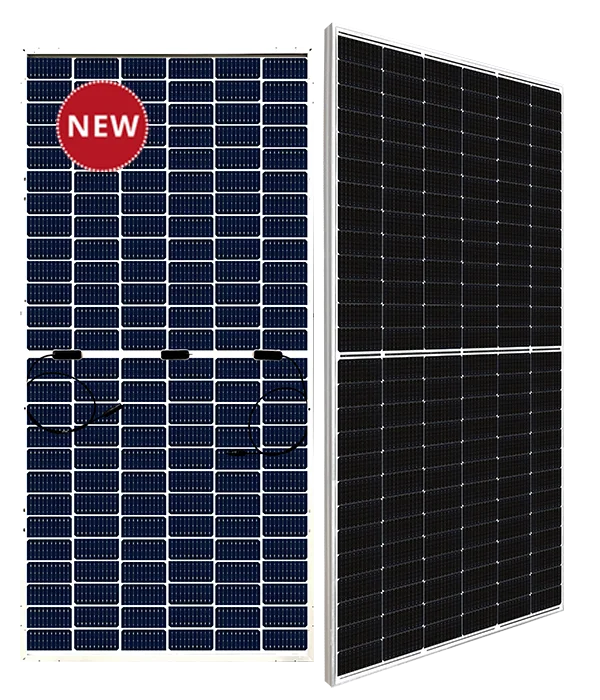
Canadian Solar CS6W-555MB-AG

CS6W-555MB-AG

555 Wp PERC Bifacial 70%
ComparePV verdict

Efficiency leader, heavy for its output

Rank 6,560 of 14,005
Compare panels Datasheet PDF
Power (Wp)
555
Typical for its class
Efficiency (%)
21.50
Strong · top 18%
Density (Wp/m²)
214.8
Strong · top 20%
Temp (%/°C)
-0.340
Typical · median -0.350
Weight (kg)
32.3
Weak · 1.5 kg above median
Warranty (yrs)
30
Strong · top 25%

The Canadian Solar BiHiKu6 series features advanced bifacial modules that redefine the efficiency of large-scale energy projects. Thanks to the use of p-type cell technology and bifacial construction, these panels allow for the recovery of energy reflected from the ground, significantly increasing the total yield per square meter. This is an ideal solution for investors building ground-mounted farms, where maximizing efficiency while reducing BOS system costs is crucial. The design based on 182 mm wafers and an innovative cell-cutting method reduces resistive losses and minimizes the risk of micro-cracks. BiHiKu6 stands out from the competition with excellent resistance to LID and LeTID degradation, guaranteeing stable electricity production for decades. The use of multi-busbar technology ensures better electron flow and higher shading tolerance, translating into real gains in difficult weather conditions. High bifacial gain reaching up to a dozen percent makes the return on investment much faster than with standard monofacial solutions. By choosing this series, you get a product with a low temperature coefficient that performs perfectly during hot days, eliminating voltage drop issues. It is the optimal choice for professionals seeking a balance between innovative technology and proven reliability in the most demanding commercial and industrial installations.

Ranking

589 panels in the segment PERC 550-600 W
Metric This panel Median Position in segment Overall rank
Module efficiency 21.50% 21.29% Strong · top 18% 7,958
Power density 214.8 212.9 Strong · top 20% 8,034
Temperature coefficient -0.340 -0.350 Typical 8,778
Weight per kWp 58.2 52.7 Weak · bottom 23% 11,629
Performance warranty 30 yrs 27 yrs Strong · top 25% 21
Colour key Strong - top 25% Typical - middle 50% Weak - bottom 25%

Signals from the data

8 positive · 3 caution
Best for

Utility-scale, commercial and shaded-installations.

Not ideal for

Weight-limited structures.

Strengths
21.50% module efficiency

Top 18% of the PERC 550-600 W segment, against a median of 21.29%.

214.8 watts per square metre

Top 20% of the PERC 550-600 W segment, against a median of 212.9.

30 year performance warranty

Top 25% of the PERC 550-600 W segment, against a median of 27 yrs.

Watch-outs
58.2 kg per kWp

Bottom 23% of the PERC 550-600 W segment, against a median of 52.7.

What owners get
30-Year Linear Power Output Warranty

The manufacturer guarantees degradation of ≤0.45%/year after year one (≤2% in year 1), ensuring retention of approximately 84.95% of nominal power output after 30 years. Peer comparables (JA Solar DEEP BLUE 3.0, Boviet VEGA) offer equivalent 30-year terms; however, Canadian Solar's Tier-1 standing and continuous market presence since 2001 translate into a materially higher probability of warranty enforceability.

Bifacial Rear-Side Gain of Up to 30%

The bifacial design enables energy harvest from ground-reflected irradiance, with the manufacturer's official datasheet citing a rear-side bifacial gain of up to 30%. In utility-scale installations over high-albedo surfaces (sand, gravel, snow, light-colored geotextiles), this translates into a real-world LCOE reduction of approximately 12.3% compared to an equivalent monofacial module.

Efficiency Up to 21.5% — Segment-Leading Performance

The highest-efficiency variant in the series achieves 21.5%, matching JA Solar DEEP BLUE 3.0 (21.5%) and outperforming Boviet VEGA SERIES (21.3%) and ET Solar Elite PLUS (21.4%). The series ranks among the top tier of p-type PERC 182 mm peer comparables.

LID and LeTID Mitigation

The proprietary manufacturing processes reduce LID/LeTID-induced degradation by up to 50% compared to standard p-type PERC cells, according to manufacturer data. In practice, this delivers a more stable energy yield curve during the first 2–3 years of operation — particularly relevant in continental climates characterized by high irradiance variability.

Tier-1 Bankability and Utility-Scale Track Record

Canadian Solar has maintained continuous Tier-1 status on the BNEF bankable manufacturer list for over a decade, simplifying project finance for large-scale PV farms. With operations dating back to 2001 and verified references on projects exceeding 100 MWp, the company significantly reduces counterparty risk in long-term EPC contracts.

Trade-offs
P-Type PERC in the N-Type TOPCon Era

PERC (p-type) technology carries a higher baseline LID degradation rate than N-type TOPCon/HJT cells, which are increasingly standard in competitors' new series (e.g., JA Solar JAM72D40 TOPCon). As the utility-scale market progressively adopts N-type as the benchmark in 2025–2026, projects based on BiHiKu6 modules may face reduced residual asset values over a long investment horizon.

Temperature Coefficient of -0.34%/°C

The Pmax temperature coefficient of -0.34%/°C is less favorable than typical N-type TOPCon (~-0.29%/°C) and HJT (~-0.25%/°C) modules. At a cell temperature of 70°C (representative of summer conditions in Poland at Tair = 35°C), power losses reach approximately 14.3% versus ~11.6% for TOPCon — a meaningful real-world difference for installations in warm climates or MENA-region markets.

Notes from the database
  • Efficiency of 21.5% matches the PERC 550-600W median
  • Power density of 214.8 W/m² matches the PERC 550-600W median
  • Temperature coefficient of -0.34%/°C matches the PERC 550-600W median
  • Weight of 32.3 kg is 1.5 kg above PERC 550-600W median (30.8 kg) - verify structural support
  • Bifaciality factor of 70% can add 4-10% extra yield with reflective mounting surface

Specifications

Open datasheet PDF
Nominal power (Pmax) 555 Wp Nameplate at 1000 W/m², 25 °C
Module efficiency 21.50 % Strong Segment median 21.29%
Vmpp · Impp 41.90 V · 13.25 A Operating point at max power
Voc · Isc 49.80 V · 14.05 A Sizes the string length
Max system voltage 1500 V Longer strings than 1000 V modules
Dimensions 2278×1134×30 mm · 2.58 m² of roof
Weight 32.3 kg Weak Weak · 1.5 kg above median
Cells 144 · PERC Monocrystalline
Bifaciality 70 % Rear output as a share of front
Coefficient Pmax -0.340 %/°C Typical median -0.350 of its segment
Coefficient Voc · Isc -0.260 · 0.050 %/°C
NOCT 41 °C At 800 W/m², 20 °C ambient
Product warranty 12 years Hardware defects only
Performance warranty 30 years Strong top 25% · median 27 yrs
End-of-warranty output 85.0 % Equals 471 W guaranteed
Degradation 2.00 → 0.45 % First year, then annual

Simulations

Live - change any input
Lifetime output & value
30 years at 1200 kWh/kWp/year and €0.50 per kWh
Power in year 30
-
Lifetime energy
-
Energy value
-
With bifacial gain
-

Degradation from this panel's own datasheet figures. No inverter, soiling or shading losses.

Heat losses
-0.340 %/°C against a segment median of -0.350
-
Bifacial gain
Rear gain over light concrete: -
-

Model: bifaciality × albedo × 0.6 view factor. A first-order estimate, not a yield simulation.

Filter these
Size
Panel Power Eff. Temp. Weight Difference
Canadian Solar CS6W-555MB-AG 555 W 21.50% -0.340 32.3 kg You are here
LR7-54HJD-510M 510 W 25.00% -0.240 23.5 kg Cooler, lighter, +3.5 pp
LR7-60HVH-560M 560 W 24.80% -0.260 25.0 kg Cooler, lighter, +3.3 pp
LR7-54HJD-505M 505 W 24.70% -0.240 23.5 kg Cooler, lighter, +3.2 pp
LR7-60HVH-555M 555 W 24.60% -0.260 25.0 kg Cooler, lighter, +3.1 pp
LR7-60HVHL-550M 550 W 24.40% -0.260 16.3 kg Cooler, 16 kg lighter, +2.9 pp
JAT60S40-540/LR 540 W 24.40% -0.260 23.5 kg Cooler, lighter, +2.9 pp
CS6W-530MB-AG 530 W 20.50% -0.340 32.3 kg -25 W, -1.0 pp
CS6W-535MS 535 W 20.70% -0.340 27.6 kg Lighter, -0.8 pp, -5 yr warranty
CS6W-540MB-AG 540 W 20.90% -0.340 32.3 kg -15 W, -0.6 pp
CS6W-545MB-AG 545 W 21.10% -0.340 32.3 kg -10 W, -0.4 pp
CS6W-550MS 550 W 21.30% -0.340 27.6 kg Lighter, -5 yr warranty
AIKO-A650-MAE72Mw 650 W 25.20% -0.260 27.0 kg +95 W, cooler, +3.7 pp
AIKO-A645-MAE72Mw 645 W 25.00% -0.260 27.0 kg +90 W, cooler, +3.5 pp
AIKO-A640-MAE72Mw 640 W 24.80% -0.260 27.0 kg +85 W, cooler, +3.3 pp
AIKO-A635-MAE72Mw 635 W 24.60% -0.260 27.0 kg +80 W, cooler, +3.1 pp
AIKO-A630-MAH72Dw 630 W 24.40% -0.260 32.5 kg +75 W, cooler, +2.9 pp

Found 2326 panels of the same or similar size to this one, within ±10 mm. See them here Found 2368 panels of the same or similar size to this one, within ±25 mm. See them here Found 2382 panels of the same or similar size to this one, within ±50 mm. See them here Found 2547 panels of the same or similar size to this one, within ±100 mm. See them here

Common questions

6 answered
What warranty does Canadian Solar offer on the BiHiKu6 series?
Canadian Solar provides a 12-year product warranty on BiHiKu6 modules, covering material and workmanship defects. In addition, the manufacturer guarantees linear power output performance for 30 years, after which the panel should retain at least 80% of its nominal power. This is one of the longest power warranties available on the market, making the BiHiKu6 a sound choice for long-term utility-scale PV investments.
What does it mean that the BiHiKu6 is a bifacial panel, and what benefits does it offer?
Bifacial means the panel generates electricity from both the front and rear sides of the module. The rear face of the BiHiKu6 captures light reflected from the ground surface (albedo), which can increase total energy yield by up to several percentage points compared to a monofacial module. This gain is greatest over bright or white ground surfaces, grass-covered terrain, and installations equipped with solar trackers. In practice, this translates to a faster return on investment for the same roof or land area.
Is the Canadian Solar BiHiKu6 555W suitable for ground-mounted utility-scale installations?
Yes, the BiHiKu6 series is specifically engineered for large-scale ground-mounted systems. The large-format 182 mm cells, power output up to 555 Wp, and bifacial construction align perfectly with the economics of utility-scale PV farms, where maximizing energy production per hectare and minimizing BoS costs — including cabling, mounting structures, and inverters — are critical. The modules are certified for use with solar trackers, further increasing yield in utility-scale deployments.
How does the BiHiKu6 perform at high temperatures during summer?
The BiHiKu6 series features a low temperature coefficient of power, resulting in reduced output losses on hot days. Standard panels typically lose approximately 0.35–0.45% of power per degree Celsius above 25°C; the BiHiKu6 sits at the lower end of this range thanks to its PERC cell technology combined with half-cut cell architecture. This translates into measurably higher energy production during summer months compared to older or lower-cost module generations.
Is Canadian Solar a reliable manufacturer, and is the BiHiKu6 available in Poland?
Canadian Solar is a Tier 1 manufacturer according to Bloomberg NEF rankings, which represents the highest financial and technical rating in the PV industry. Despite its name, the company is a global player with manufacturing facilities in Asia and offices worldwide. The BiHiKu6 series remains active — it has not been discontinued by the manufacturer — and is available through PV distributors in Poland. When purchasing, it is advisable to verify that the supplier provides modules accompanied by a current documentation package, including IEC certifications and the applicable PAN file.
How many cells do the BiHiKu6 panels contain, and why does this matter for partial shading?
The BiHiKu6 CS6W modules contain 144 cells arranged in a dual-cell half-cut configuration, diced from 182 mm wafers. The half-cut cell technology splits each cell in two, reducing operating current and minimizing resistive losses. Importantly, the upper and lower halves of the panel operate independently — shading on one half causes a smaller drop in the total module output than would occur in a conventional full-cell design. This is a significant advantage in installations where intermittent shading from poles, trees, or other objects is expected.
Add to compare
