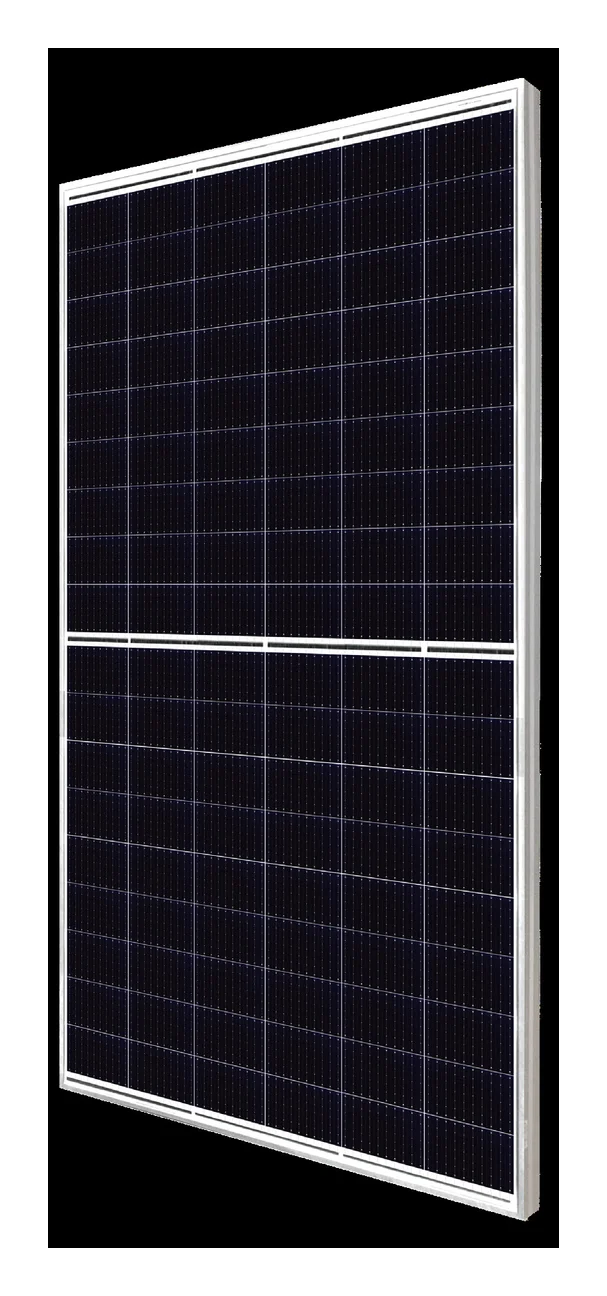
Middle of its segment, modest efficiency
The Canadian Solar HiHero series utilizes groundbreaking HJT heterojunction technology, which redefines efficiency standards in modern photovoltaic systems. Thanks to the unique combination of crystalline silicon with amorphous layers, these modules effectively eliminate the common problem of light-induced degradation and minimize the negative impact of high temperatures on electricity production. This is the optimal solution for investors who expect maximum energy yield from limited roof space, while maintaining the highest aesthetics of the installation. HiHero panels stand out with one of the lowest temperature coefficients on the market, which makes them work extremely efficiently even on the hottest days, when competing products lose their nominal power. The use of advanced N-type cells guarantees users long-term stability of parameters and exceptional durability, which directly translates into a much faster return on investment costs. Unlike traditional modules, this series offers above-average resistance to micro-cracks and mechanical loads, ensuring operational safety throughout the entire warranty period. By choosing HiHero, you are opting for future technology that effectively solves the problem of energy losses in difficult weather conditions, offering innovation and uncompromising reliability for the most demanding residential and business projects.
Ranking
Signals from the data
Residential, commercial and hot-climate.
Tight roof space, roofs where every square metre has to count and hot climates.
Bottom 17% of the HJT 400-450 W segment, against a median of 22.20%.
Bottom 17% of the HJT 400-450 W segment, against a median of 221.6.
Bottom 23% of the HJT 400-450 W segment, against a median of -0.240.
The Pmax temperature coefficient is -0.26%/°C, compared to -0.34%/°C for standard PERC modules and -0.29 to -0.30%/°C for TOPCon. This translates to real-world power losses approximately 20–23% lower at a cell temperature of 75°C — an advantage that, under Polish summer conditions, can yield an additional 3–5% in annual energy output relative to PERC technology.
The series outperforms all three peer comparables — SunEvo SE6-46SC (21.4%), Solitek SOLRIF D Satin (22.06%), and Q-Cells Q.TRON BLACK (22.3%) — making HiHero the highest-efficiency series in the comparison and enabling greater power output from the same roof area.
HJT N-type cells exhibit no light-induced degradation (LID) or light and elevated temperature degradation (LeTID). Annual degradation after the first year is ≤0.35%, versus a typical ≤0.40–0.45% for TOPCon modules — meaning approximately 89.8% of rated power is retained after 30 years, assuming a linear degradation curve.
Dual-side energy harvesting delivers an estimated bifacial gain of 5–15%, depending on ground albedo (light gravel, EPDM membrane). Combined with a 30-year linear power warranty, the series stands apart from all peer comparables — none of the compared models simultaneously offer bifacial capability and warranty coverage of this length.
Canadian Solar has maintained bankable Tier-1 BloombergNEF status continuously for many years and appears on the Q1 2026 list, with an annual manufacturing capacity of approximately 61,000 MW. This substantially reduces the risk of manufacturer warranty default over a long operational lifetime.
At the wholesale level, HJT modules are priced at approximately $0.14–0.16/W versus $0.11–0.13/W for TOPCon — a premium of roughly 15–30%. For a typical 10 kWp residential system, the cost difference relative to comparable Tier-1 TOPCon modules is approximately $700–1,500, extending the simple payback period by roughly 0.5–1 year under Polish irradiation conditions.
The stated product warranty is 15 years, while select premium manufacturers — such as REC Alpha Pure-R (25 years) and Q-Cells Q.TRON BLACK (25 years) — offer substantially longer coverage against material and workmanship defects. For installations on hard-to-access industrial rooftops, this shortens the window of full service protection.
- At 21.5% efficiency, this panel is 0.7pp below the HJT 400-450W median of 22.2%
- At 215.1 W/m², this panel generates 6.5 W/m² less per unit area than HJT 400-450W median (221.6 W/m²)
- At -0.26%/°C, loses 0.02pp more power per degree than HJT 400-450W median (-0.24%/°C)
- In the top 57% for efficiency among all HJT panels
Specifications
Simulations
Degradation from this panel's own datasheet figures. No inverter, soiling or shading losses.



Found 1783 panels of the same or similar size to this one, within ±10 mm. See them here Found 1914 panels of the same or similar size to this one, within ±25 mm. See them here Found 3392 panels of the same or similar size to this one, within ±50 mm. See them here Found 3970 panels of the same or similar size to this one, within ±100 mm. See them here