BYD NLBK-30-470

NLBK-30-470

470 Wp TOPCon Bifacial 80%
ComparePV verdict

Middle of its segment, modest efficiency

Rank 9,311 of 14,005
Compare panels Datasheet PDF
Power (Wp)
470
Typical for its class
Efficiency (%)
21.72
Weak · bottom 10%
Density (Wp/m²)
217.2
Weak · bottom 10%
Temp (%/°C)
-0.300
Weak · bottom 20%
Weight (kg)
25.2
Typical · median 24.0 kg
Warranty (yrs)
30
Typical · median 30 yrs

The BYD AURO N NLBK-30 panel series is an advanced solution based on N-type TOPCon cell technology, which ensures significantly higher efficiency in challenging lighting conditions and better resistance to light-induced degradation. Thanks to the Full Black design, these modules combine elegance with functionality, making them an ideal choice for demanding residential users who care about modern roof aesthetics without compromising on power output. These panels effectively solve the problem of efficiency loss at high temperatures, offering an excellent temperature coefficient, which translates into stable energy yields even on hot days. The innovative cell structure minimizes the risk of micro-cracks, significantly extending the lifespan of the entire installation and increasing investment security. What sets them apart from the competition is their exceptional mechanical durability and manufacturing precision resulting from the manufacturer's full control over the entire module production process. The AURO N NLBK-30 series is primarily dedicated to the premium residential sector and buildings where high power density per square meter and an impeccable appearance count. By choosing these modules, you gain the certainty of stable operation and maximization of profits from producing your own electricity for many years.

Ranking

1,089 panels in the segment TOPCon 450-500 W
Metric This panel Median Position in segment Overall rank
Module efficiency 21.72% 22.52% Weak · bottom 10% 7,399
Power density 217.2 225.2 Weak · bottom 10% 7,384
Temperature coefficient -0.300 -0.290 Weak · bottom 20% 6,093
Weight per kWp 53.6 52.2 Typical 7,628
Performance warranty 30 yrs 30 yrs Typical 21
Colour key Strong - top 25% Typical - middle 50% Weak - bottom 25%

Signals from the data

5 positive · 5 caution
Not ideal for

Tight roof space, roofs where every square metre has to count and hot climates.

Watch-outs
21.72% module efficiency

Bottom 10% of the TOPCon 450-500 W segment, against a median of 22.52%.

217.2 watts per square metre

Bottom 10% of the TOPCon 450-500 W segment, against a median of 225.2.

-0.300 %/°C temperature coefficient

Bottom 20% of the TOPCon 450-500 W segment, against a median of -0.290.

What owners get
Zero LID and Low Temperature Coefficient

N-type TOPCon cells exhibit zero light-induced degradation (Zero LID) and a temperature coefficient of -0.30%/°C — approximately 0.05 percentage points better than typical PERC modules (-0.35%/°C). In the Polish climate, where summer peaks exceed 35°C, this translates to a real-world annual energy yield gain of 1.5–2% over legacy technologies.

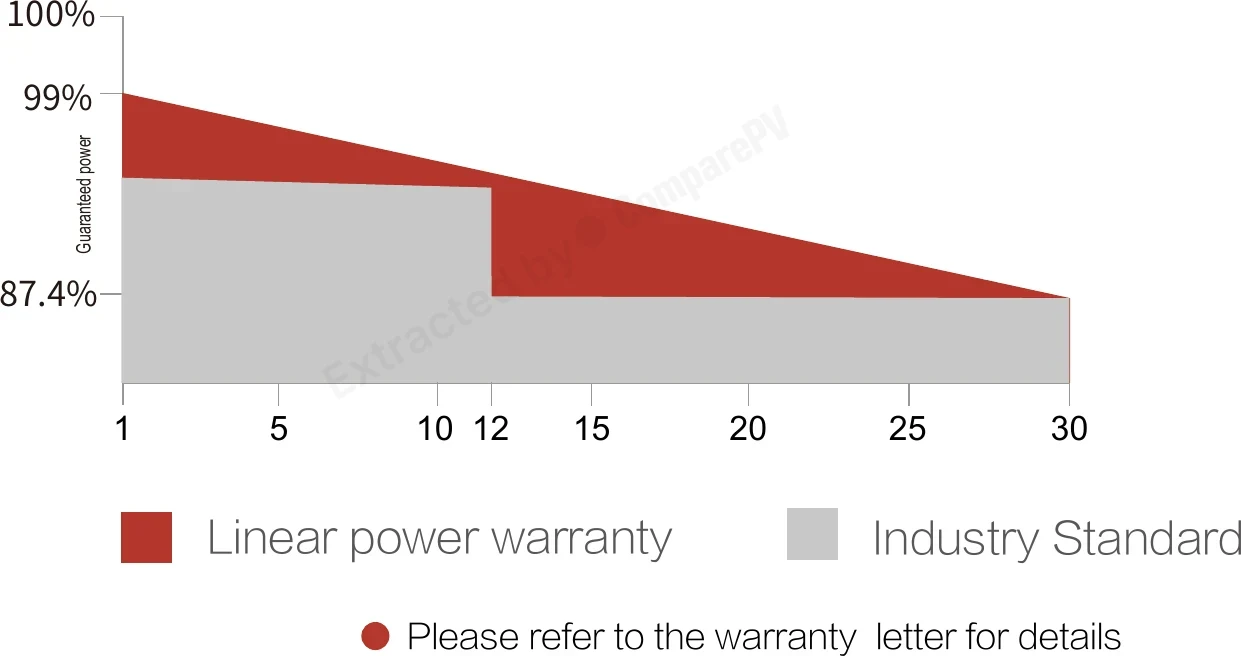
Degradation <0.4%/Year — 30-Year Linear Power Warranty

The manufacturer guarantees less than 0.4% annual degradation over 30 years, ensuring retention of >88% of nominal power at the end of the warranty period. Direct comparable peers — Renesola RS4-470~490NX-E1 and Horay Solar — offer equivalent terms, but BYD's Tier-1 status and fully integrated vertical supply chain provide greater assurance that these commitments will be honored.

Bifacial Design with >80% Bifaciality Ratio

The bifacial module generates an additional 5–15% energy from the rear surface depending on ground albedo (light gravel ~25%, snow ~80%). In a typical rooftop installation with light-colored finishing elements, the energy yield premium is approximately 6–8%, directly reducing the project's LCOE.

22.65% Efficiency — Top of the TOPCon Full Black Segment

A peak efficiency of 22.65% positions the NLBK-30 series above the Horay Solar HS 182-120 TC Ocean (22.6%) and just below the Renesola RS4-470~490NX-E1 (22.71%). In the 470–490 W power class, the module occupies minimal roof area, which is critical for residential installations with limited available surface.

Full BYD Vertical Integration (Tier-1 Since 1995)

BYD manufactures its own silicon, cells, and modules within a closed supply chain, eliminating quality risks associated with outsourced cell procurement. Its BNEF-confirmed Tier-1 (bankable) status ensures access to project financing and guarantees consistent warranty support throughout the full coverage period.

Trade-offs
Product Warranty of Only 12 Years

A standard 12-year product warranty is the minimum acceptable for the premium segment. Premium Tier-1 competitors — such as the Jinko Tiger Neo and JA Solar Deep Blue 3.0 — offer 15-year workmanship warranties on comparable TOPCon models, giving the investor an additional three years of protection against manufacturing defects at no extra cost.

Higher Operating Temperature of the Full Black Version

The black backsheet and black frame absorb approximately 3–5°C more heat than standard modules with a silver frame and white backsheet. At a temperature coefficient of -0.30%/°C, this results in roughly 0.9–1.5% power loss during peak solar hours — a modest but measurable effect over the long-term energy balance.

Notes from the database
  • Efficiency of 21.7% is 0.8pp below the TOPCon 450-500W median (22.5%)
  • 217.2 W/m² power density is 8.0 W/m² below TOPCon 450-500W median (225.2 W/m²) - requires larger installation area
  • Temperature coefficient of -0.30%/°C matches the TOPCon 450-500W median
  • Weight of 25.2 kg is 1.2 kg above TOPCon 450-500W median (24.0 kg) - verify structural support
  • Bifacial design (80% factor) captures reflected light - adds 4-12% yield on ground-mount or white roof

Specifications

Open datasheet PDF
Nominal power (Pmax) 470 Wp Nameplate at 1000 W/m², 25 °C
Module efficiency 21.72 % Weak Segment median 22.52%
Vmpp · Impp 35.69 V · 13.17 A Operating point at max power
Voc · Isc 43.30 V · 13.69 A Sizes the string length
Max system voltage 1500 V Longer strings than 1000 V modules
Dimensions 1908×1134×30 mm · 2.16 m² of roof
Weight 25.2 kg Typical Typical · median 24.0 kg
Cells 120 · TOPCon Monocrystalline
Bifaciality 80 % Rear output as a share of front
Coefficient Pmax -0.300 %/°C Weak bottom 20% of its segment
Coefficient Voc · Isc -0.250 · 0.046 %/°C
NOCT 45 °C At 800 W/m², 20 °C ambient
Product warranty 12 years Hardware defects only
Performance warranty 30 years Typical median 30 yrs · median 30 yrs
End-of-warranty output 87.4 % Equals 411 W guaranteed
Degradation 1.00 → 0.40 % First year, then annual

Datasheet charts

Open datasheet PDF

Measured curves published by BYD in this model's datasheet. A chart carrying a wattage was measured on that variant alone - only the ones that describe 470 Wp appear here. The rest cover the whole series.
Simulations

Live - change any input
Lifetime output & value
30 years at 1200 kWh/kWp/year and €0.50 per kWh
Power in year 30
-
Lifetime energy
-
Energy value
-
With bifacial gain
-

Degradation from this panel's own datasheet figures. No inverter, soiling or shading losses.

Heat losses
-0.300 %/°C against a segment median of -0.290
-
Bifacial gain
Rear gain over light concrete: -
-

Model: bifaciality × albedo × 0.6 view factor. A first-order estimate, not a yield simulation.

Alternatives

All BYD panels
Filter these
Size
Panel Power Eff. Temp. Weight Difference
BYD NLBK-30-470 470 W 21.72% -0.300 25.2 kg You are here
LR7-54HJD-510M 510 W 25.00% -0.240 23.5 kg +40 W, cooler, +3.3 pp
AIKO-A495-MCE54Mw 495 W 24.80% -0.260 21.0 kg Cooler, lighter, +3.1 pp
LR7-54HJD-505M 505 W 24.70% -0.240 23.5 kg +35 W, cooler, +3.0 pp
AIKO-A490-MCE54Mw 490 W 24.50% -0.260 21.0 kg Cooler, lighter, +2.8 pp
LR7-54HJD-500M 500 W 24.50% -0.240 23.5 kg +30 W, cooler, +2.8 pp
CIPRO-TN9C54M-500W 500 W 24.50% -0.260 21.4 kg Cooler, lighter, +2.8 pp
NLBK-30-475W 475 W 21.95% -0.300 25.2 kg +0.2 pp
NLBK-30-480W 480 W 22.18% -0.300 25.2 kg +10 W, +0.5 pp
NLBK-30-485W 485 W 22.42% -0.300 25.2 kg +15 W, +0.7 pp
NLBK-30-490W 490 W 22.65% -0.300 25.2 kg +20 W, +0.9 pp
LR7-60HVH-560M 560 W 24.80% -0.260 25.0 kg +90 W, cooler, +3.1 pp
LR7-60HVH-555M 555 W 24.60% -0.260 25.0 kg +85 W, cooler, +2.9 pp
LR7-60HVHL-550M 550 W 24.40% -0.260 16.3 kg +80 W, lighter, +2.7 pp
JAT60S40-540/LR 540 W 24.40% -0.260 23.5 kg +70 W, cooler, +2.7 pp
GK-5-60HG-540M 540 W 24.40% -0.260 23.3 kg +70 W, cooler, +2.7 pp
JKM545-54QL6-DV-F1-EU 545 W 24.27% -0.260 27.5 kg +75 W, cooler, +2.6 pp

Found 746 panels of the same or similar size to this one, within ±10 mm. See them here Found 755 panels of the same or similar size to this one, within ±25 mm. See them here Found 910 panels of the same or similar size to this one, within ±50 mm. See them here Found 1489 panels of the same or similar size to this one, within ±100 mm. See them here

Common questions

6 answered
What warranty is provided on BYD AURO N NLBK-30 panels?
The BYD AURO N NLBK-30 series is covered by a two-tier warranty: a 12-year product warranty against material and workmanship defects, and a 30-year linear power output warranty. Annual power degradation is rated at less than 0.4%, meaning the module will retain significantly higher efficiency after three decades than industry standards require. As a Tier 1 manufacturer with a global service network, BYD provides genuine assurance that these commitments will be honored.
What is TOPCon technology, and how do the AURO N NLBK-30 panels differ from older BYD modules?
TOPCon (Tunnel Oxide Passivated Contact) is an N-type cell technology in which a thin silicon oxide layer reduces electron recombination losses at the cell surface. Compared to older BYD modules based on PERC technology, the AURO N NLBK-30 series achieves a module efficiency of up to 22.65% with an average cell efficiency of 25.50%. Key advantages include zero Light-Induced Degradation (Zero LID), a lower temperature coefficient of -0.30%/°C, and higher energy yields throughout the year.
Is the BYD AURO N NLBK-30 panel suitable for pitched roof installations?
Yes, the AURO N NLBK-30 series is designed primarily for residential installations, including pitched roofs. The black frame and black cells of the Full Black variant integrate seamlessly with dark roof tiles or metal roofing. The panel is bifacial; however, on a pitched roof the rear-side gain is minimal. The primary benefits are the high efficiency of the TOPCon cells and the module's mechanical resistance to snow and wind loads.
How much power will a BYD AURO N NLBK-30 490 W panel produce on a hot summer day?
The temperature coefficient of the NLBK-30 series is just -0.30%/°C, placing it among the best in its class. At a module temperature of 65°C, typical at solar noon on a hot summer day, power loss is approximately 12% rather than the 14–15% seen with older PERC technology. For a 490 Wp module, this translates to a real output of approximately 431 W under extreme heat conditions — a better result than P-type technology panels typically achieve.
Why choose the Full Black version of the BYD AURO N NLBK-30 over a panel with a silver frame?
The Full Black variant features an all-black frame, black backsheet, and dark cells, giving the installation the appearance of a uniform, elegant roof surface with no contrasting elements. This is particularly important for premium buildings where architectural aesthetics are as significant as technical specifications. The N-type TOPCon technology ensures that the increased heat absorption associated with the darker surface is effectively offset by the module's low temperature coefficient.
Is BYD, as a Chinese manufacturer, a reliable choice when purchasing photovoltaic panels?
BYD is classified as a Tier 1 manufacturer by the independent Bloomberg NEF agency, representing the highest rating for financial credibility and product quality. The company controls the entire production chain — from raw materials through cells to finished modules — which directly translates into panel consistency and longevity. The AURO N NLBK-30 series is backed by a 30-year power output warranty supported by one of the world's largest technology conglomerates.
Add to compare