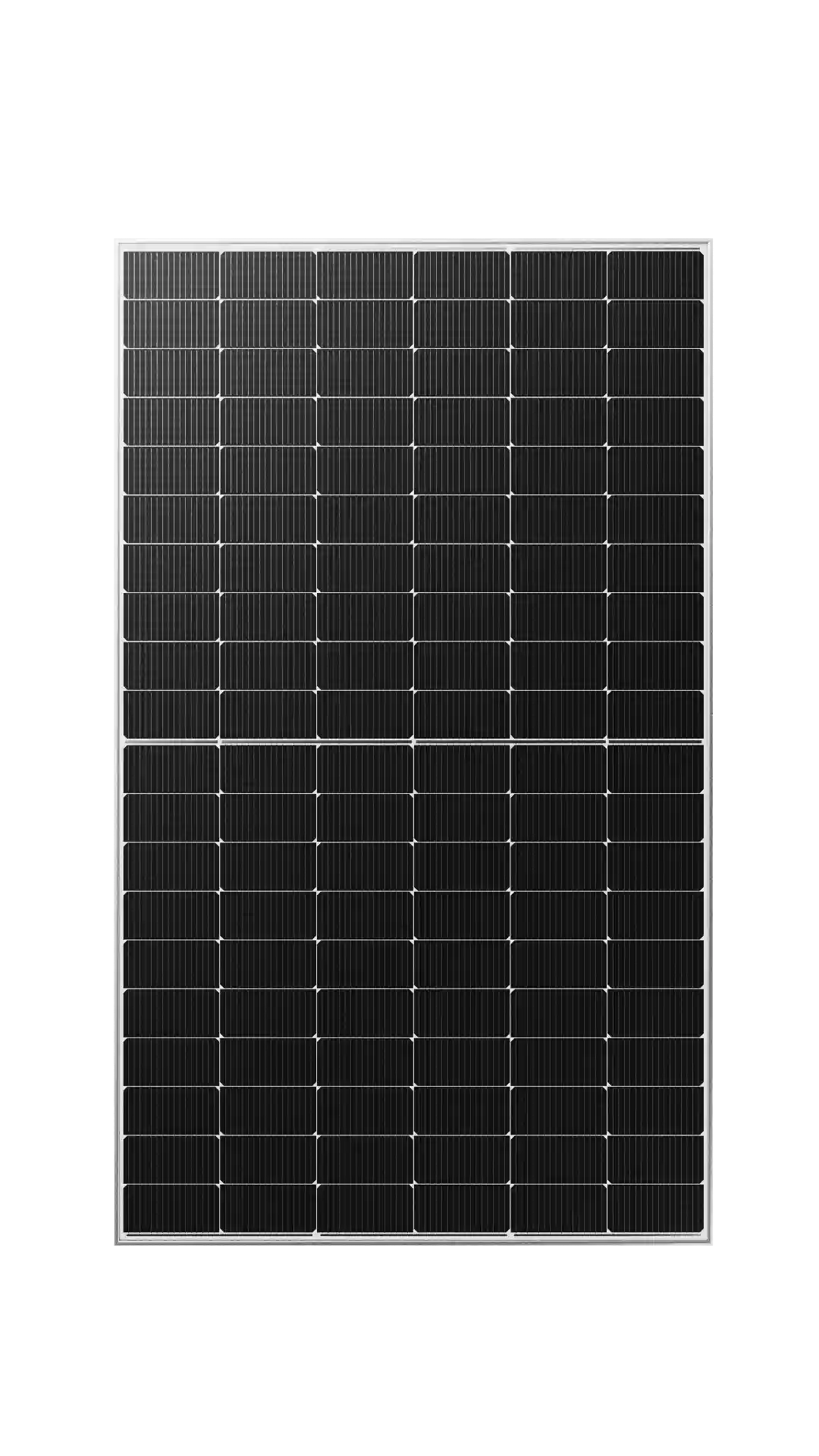
BYD NLBK-30-475W

NLBK-30-475W

475 Wp TOPCon Bifacial 80%
ComparePV verdict

Middle of its segment, modest efficiency

Rank 8,912 of 14,005
Compare panels Datasheet PDF
Power (Wp)
475
Typical for its class
Efficiency (%)
21.95
Weak · bottom 16%
Density (Wp/m²)
219.5
Weak · bottom 17%
Temp (%/°C)
-0.300
Weak · bottom 20%
Weight (kg)
25.2
Typical · median 24.0 kg
Warranty (yrs)
30
Typical · median 30 yrs

The BYD AURO N NLBK-30 (470-490W) series of photovoltaic panels are bifacial modules based on N-type TOPCon cells, designed to achieve higher energy yields in Polish conditions, even when the weather is unfavorable. A key feature is Zero LID, meaning resistance to typical degradation at the start of operation, which facilitates predictable energy production over many years. In practice, this translates to a more stable return on investment and a lower risk of disappointment after installing the system.

The use of SMBB (multi-bin) connection technology improves current collection and performance under partial shading, while good performance in low-light conditions supports energy generation on cloudy days and in foggy weather. The modules also have high compatibility with popular inverters and trackers, which simplifies system design.

This is the ideal choice for homes, businesses, and larger systems where power density, environmental resistance, and lower energy costs throughout the system's lifespan are important.

Ranking

1,089 panels in the segment TOPCon 450-500 W
Metric This panel Median Position in segment Overall rank
Module efficiency 21.95% 22.52% Weak · bottom 16% 6,745
Power density 219.5 225.2 Weak · bottom 17% 6,702
Temperature coefficient -0.300 -0.290 Weak · bottom 20% 6,093
Weight per kWp 53.1 52.2 Typical 6,808
Performance warranty 30 yrs 30 yrs Typical 21
Colour key Strong - top 25% Typical - middle 50% Weak - bottom 25%

Signals from the data

5 positive · 4 caution
Best for

Residential, commercial and shaded-installations.

Not ideal for

Tight roof space, roofs where every square metre has to count and hot climates.

Watch-outs
21.95% module efficiency

Bottom 16% of the TOPCon 450-500 W segment, against a median of 22.52%.

219.5 watts per square metre

Bottom 17% of the TOPCon 450-500 W segment, against a median of 225.2.

-0.300 %/°C temperature coefficient

Bottom 20% of the TOPCon 450-500 W segment, against a median of -0.290.

What owners get
N-type TOPCon with Zero LID Technology

N-type TOPCon cells eliminate the Light-Induced Degradation (LID) effect at the start of operation, which is typical of P-type PERC modules. This translates into more stable power output during the initial months of operation and more predictable annual energy yields — a critical factor in financial modeling for both residential prosumer and commercial installations.

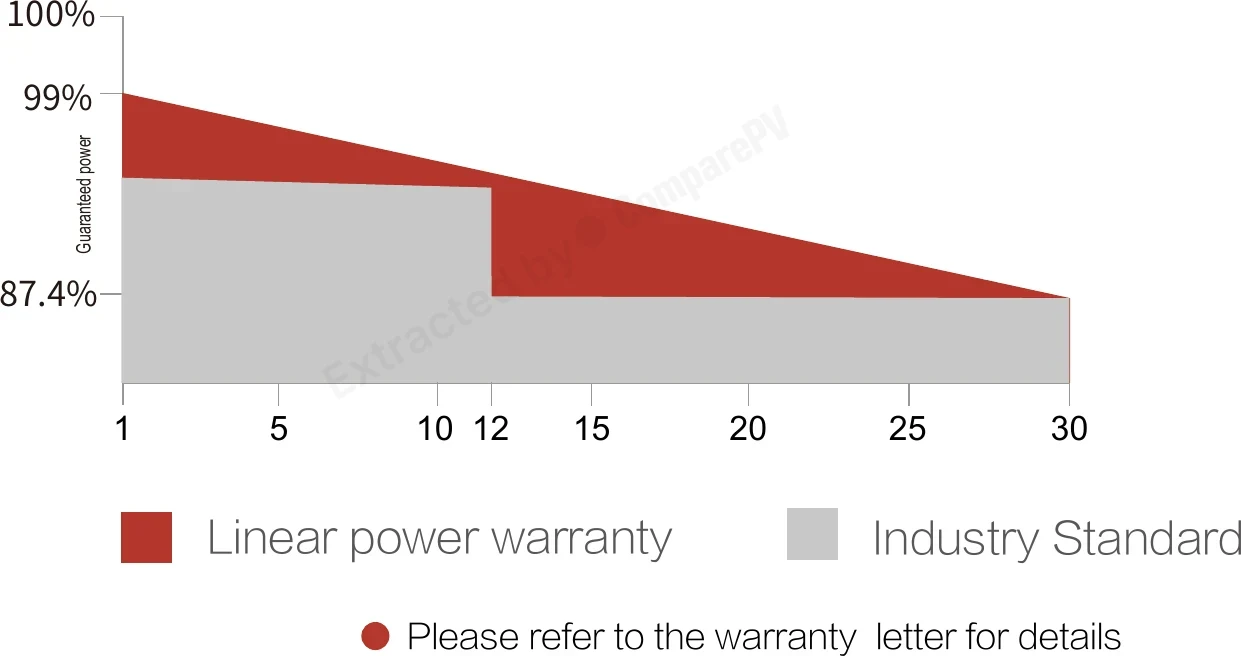
30-Year Linear Power Output Warranty

BYD offers a 30-year linear power output warranty for the AURO N series, while the market standard — including the Renesola RS4-470~490NX-E1 — typically stops at 25 years. The extended warranty horizon lengthens the bankability window of a project and can improve IRR metrics in debt-financing models.

Module Efficiency up to 22.65% — Competitive Within the Segment

The peak efficiency of 22.65% for the 490 Wp variant places the series on par with its direct competitors: the Renesola RS4-470~490NX-E1 achieves 22.71%, while the Horay Solar HS 182-120 TC Ocean reaches 22.6%. The gap relative to the segment leader (Renesola) is just 0.06 percentage points — negligible under real-world operating conditions.

Bifacial Design with SMBB Technology

The combination of a bifacial architecture (typical bifaciality factor for TOPCon: 80–85%) and multi-busbar SMBB technology reduces resistive losses and improves resilience to partial shading. Under Polish conditions (ground albedo approximately 0.2–0.3 in summer), the realistic rear-side energy gain ranges from 5–12%, depending on the surface type beneath the array.

BNEF Tier-1 Manufacturer, Bankable Since 1995

BYD appears on the BloombergNEF Tier-1 list, confirming full bankability for projects requiring bank financing. The manufacturer's financial stability and global service network — built since 1995 — reduce counterparty risk on long-term warranties, a material consideration over a 30-year investment horizon.

Trade-offs
12-Year Product Warranty — Below Premium Standard

The materials and workmanship warranty stands at 12 years, whereas premium manufacturers in the same power class (e.g., Solar-Fabrik) offer 15 years. For commercial installations financed through investment loans, the shorter product warranty period may require additional contractual protections from the installer.

Notes from the database
  • At 21.9% efficiency, this panel is 0.6pp below the TOPCon 450-500W median of 22.5%
  • At 219.5 W/m², this panel generates 5.7 W/m² less per unit area than TOPCon 450-500W median (225.2 W/m²)
  • At -0.30%/°C, hot weather performance is typical for TOPCon 450-500W panels
  • At 25.2 kg, this panel is 1.2 kg heavier than the TOPCon 450-500W median (24.0 kg) - more demanding for installation crews
  • Bifaciality factor of 80% can add 4-12% extra yield with reflective mounting surface

Specifications

Open datasheet PDF
Nominal power (Pmax) 475 Wp Nameplate at 1000 W/m², 25 °C
Module efficiency 21.95 % Weak Segment median 22.52%
Vmpp · Impp 35.88 V · 13.24 A Operating point at max power
Voc · Isc 43.45 V · 13.77 A Sizes the string length
Max system voltage 1500 V Longer strings than 1000 V modules
Dimensions 1908×1134×30 mm · 2.16 m² of roof
Weight 25.2 kg Typical Typical · median 24.0 kg
Cells 120 · TOPCon Monocrystalline
Bifaciality 80 % Rear output as a share of front
Coefficient Pmax -0.300 %/°C Weak bottom 20% of its segment
Coefficient Voc · Isc -0.250 · 0.046 %/°C
NOCT 45 °C At 800 W/m², 20 °C ambient
Product warranty 12 years Hardware defects only
Performance warranty 30 years Typical median 30 yrs · median 30 yrs
End-of-warranty output 87.4 %
Degradation -0.40 % Per year after the first

Datasheet charts

Open datasheet PDF

Measured curves published by BYD in this model's datasheet. A chart carrying a wattage was measured on that variant alone - only the ones that describe 475 Wp appear here. The rest cover the whole series.
Simulations

Live - change any input
Lifetime output & value
30 years at 1200 kWh/kWp/year and €0.50 per kWh
Power in year 30
-
Lifetime energy
-
Energy value
-
With bifacial gain
-

Degradation from this panel's own datasheet figures. No inverter, soiling or shading losses.

Heat losses
-0.300 %/°C against a segment median of -0.290
-
Bifacial gain
Rear gain over light concrete: -
-

Model: bifaciality × albedo × 0.6 view factor. A first-order estimate, not a yield simulation.

Alternatives

All BYD panels
Filter these
Size
Panel Power Eff. Temp. Weight Difference
BYD NLBK-30-475W 475 W 21.95% -0.300 25.2 kg You are here
LR7-54HJD-510M 510 W 25.00% -0.240 23.5 kg +35 W, cooler, +3.1 pp
AIKO-A495-MCE54Mw 495 W 24.80% -0.260 21.0 kg Cooler, lighter, +2.9 pp
LR7-54HJD-505M 505 W 24.70% -0.240 23.5 kg +30 W, cooler, +2.8 pp
AIKO-A490-MCE54Mw 490 W 24.50% -0.260 21.0 kg Cooler, lighter, +2.6 pp
LR7-54HJD-500M 500 W 24.50% -0.240 23.5 kg +25 W, cooler, +2.6 pp
CIPRO-TN9C54M-500W 500 W 24.50% -0.260 21.4 kg Cooler, lighter, +2.6 pp
NLBK-30-470W 470 W 21.72% -0.300 25.2 kg -0.2 pp
NLBK-30-480W 480 W 22.18% -0.300 25.2 kg +0.2 pp
NLBK-30-485W 485 W 22.42% -0.300 25.2 kg +10 W, +0.5 pp
NLBK-30-490W 490 W 22.65% -0.300 25.2 kg +15 W, +0.7 pp
LR7-60HVH-560M 560 W 24.80% -0.260 25.0 kg +85 W, cooler, +2.9 pp
LR7-60HVH-555M 555 W 24.60% -0.260 25.0 kg +80 W, cooler, +2.7 pp
LR7-60HVHL-550M 550 W 24.40% -0.260 16.3 kg +75 W, lighter, +2.4 pp
JAT60S40-540/LR 540 W 24.40% -0.260 23.5 kg +65 W, cooler, +2.4 pp
GK-5-60HG-540M 540 W 24.40% -0.260 23.3 kg +65 W, cooler, +2.4 pp
JKM545-54QL6-DV-F1-EU 545 W 24.27% -0.260 27.5 kg +70 W, cooler, +2.3 pp

Found 746 panels of the same or similar size to this one, within ±10 mm. See them here Found 755 panels of the same or similar size to this one, within ±25 mm. See them here Found 910 panels of the same or similar size to this one, within ±50 mm. See them here Found 1489 panels of the same or similar size to this one, within ±100 mm. See them here

Common questions

6 answered
What warranty coverage applies to the BYD AURON NLBK-30 series, and what does it include?
The BYD AURON NLBK-30 series comes with a 12-year product warranty covering material and workmanship defects, along with a 30-year linear power output warranty. The linear power warranty means the manufacturer guarantees a defined minimum output level over three decades, with annual degradation kept below 0.4%. This is one of the longest and most precisely defined warranty packages available in the TOPCon module market.
Do the BYD AURON NLBK-30 panels perform well in winter and on overcast days?
Yes. N-type TOPCon cells feature a low temperature coefficient (approx. -0.30%/°C), which improves summer performance compared to older P-type modules. In the Polish climate, however, strong low-irradiance performance is equally important — the NLBK-30 series handles diffuse and weak sunlight better than previous-generation monocrystalline modules, translating to measurably higher annual energy yield under frequent cloud cover conditions.
What is Zero LID in the BYD AURON NLBK-30 panels, and why does it matter?
LID (Light Induced Degradation) is a phenomenon in which conventional P-type modules lose 1–3% of their rated power within the first hours of operation. The N-type TOPCon technology used in the NLBK-30 series virtually eliminates this effect — hence the Zero LID designation. In practice, this means the panel delivers output close to its nominal power rating from day one, with no initial power loss at commissioning, making ROI calculations more accurate and reliable.
Are the BYD AURON NLBK-30 490W panels compatible with inverters commonly used in Poland?
Yes. The AURON NLBK-30 series is engineered for broad compatibility with popular inverter brands, including SMA, Fronius, SolarEdge, Huawei, and Growatt, as well as standard MPPT trackers. The modules' standard electrical parameters and open-circuit voltage, which fall within typical inverter input ranges, mean that integration should present no difficulties and requires no special cabling or configuration.
How do the BYD AURON NLBK-30 panels differ from older BYD models based on P-type technology?
The key differences lie in cell technology and bifaciality. Older BYD modules were based on P-type PERC cells, whereas the NLBK-30 uses newer N-type TOPCon cells, which deliver higher conversion efficiency, lower annual degradation (below 0.4% versus up to 0.7% for PERC), and Zero LID performance. The bifacial design additionally captures albedo light reflected from the ground or mounting surface, boosting energy yield — especially on light-colored rooftops or ground-mounted systems with reflective substrates.
Are the BYD AURON NLBK-30 panels suitable for pitched roof installations with partial shading?
Yes. The SMBB (Super Multi-Busbar) technology used in these modules makes them less sensitive to partial shading from chimneys, antennas, or adjacent roof sections. Current from individual cells is collected across a greater number of conductive pathways, so shading of one section of the panel has a proportionally smaller impact on the output of the entire string. For rooftops with significant shading obstacles, complementing the installation with power optimizers or microinverters is also worth considering.
Add to compare