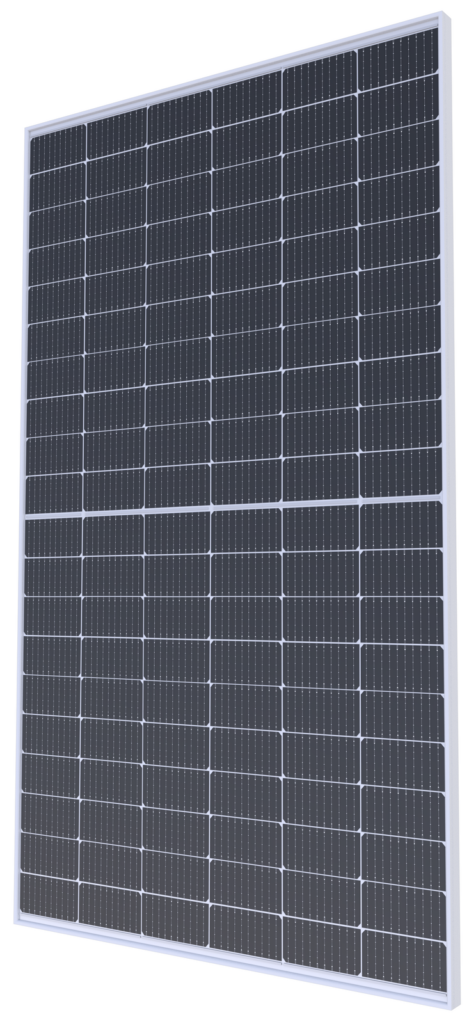
Solid all-round for its segment
The Boviet Solar VEGA SERIES consists of bifacial modules that generate power not only from the front, but also from reflected light from the ground - this makes it easier to increase energy yield without adding additional panels. In practice, this means a more cost-effective investment in locations where every square meter of roof space or limited ground area is valuable. The modules are based on PERC SE monocrystalline cells, and the design with half-cut cells provides more stable operation under partial shading and reduces losses in typical operating conditions. The use of a multi-busbar system improves current collection and supports long-term reliability. The VEGA SERIES also offers variants with a transparent back or a double glass version, which makes it easy to adapt to commercial roofs, industrial installations, and PV farms, especially in locations where resistance to environmental factors and stable production in diffuse light are important.
Ranking
Signals from the data
Commercial, utility-scale and shaded-installations.
Boviet Solar has maintained Tier 1 status according to Bloomberg NEF without interruption since 2017, including Q1 2026, and has been ranked among the Top 10 Most Bankable Global PV Module Manufacturers by Wood Mackenzie since 2024. This directly translates into improved availability of non-recourse project financing for utility-scale PV plants.
The manufacturer guarantees degradation of ≤2.5% in the first year and ≤0.6%/year in subsequent years for the full 30-year term, whereas the market standard for PERC modules — including the Jinko Solar JS-PERC — is typically 25 years. This 5-year extension lengthens the safe operating horizon of the plant without requiring warranty renegotiation.
The VEGA SERIES is available in both a transparent backsheet configuration and a double glass version, as confirmed by 2023–2024 datasheets. The double glass variant provides enhanced resistance to moisture, ammonia, and mechanical stress, facilitating certification for agricultural and agri-PV installations.
The manufacturer certifies comprehensive resistance to all three primary cell degradation mechanisms in PERC technology: PID (Potential Induced Degradation), LID (Light Induced Degradation), and LeTID (Light and Elevated Temperature Induced Degradation). For P-type PERC modules, this represents a significant operational advantage over earlier generations lacking this certification.
Ten power variants spanning 360–555 Wp allow a single series to address both residential prosumer installations (smaller modules at 360–375 Wp for space-constrained rooftops) and utility-scale projects (530–555 Wp). This eliminates the need to change manufacturers when scaling a project portfolio.
The maximum module efficiency of the VEGA SERIES is 21.3%, while direct competitors in the same technology achieve 21.48% (DAH DHM-72X10, Shinson S-Max) and 21.7% (Jinko Solar JS-PERC). The 0.4 percentage point gap versus Jinko translates to approximately 4 kWp less peak power in a 1 MWp installation at the same footprint.
Since 2024, N-type TOPCon has been emerging as the dominant technology in the utility-scale segment; Boviet Solar itself has introduced the VEGA TOPCon series (N-type, 560–580 Wp, datasheet 08/2024) in parallel with the PERC series under review. PERC modules exhibit higher LeTID susceptibility and lower temperature-coefficient performance compared to TOPCon equivalents, which may influence long-term investment decisions.
The materials and workmanship warranty stands at 12 years, placing the VEGA SERIES at the bottom threshold of current market offerings. Select premium-segment competitors — including certain Jinko Solar product lines — offer 15-year product warranties, a meaningful consideration for projects underpinned by land-lease agreements or PPAs exceeding 20 years.
- Efficiency of 20.9% matches the PERC 500-550W median
- Power density of 209.3 W/m² matches the PERC 500-550W median
- At -0.35%/°C, hot weather performance is typical for PERC 500-550W panels
- In the top 72% for efficiency among all PERC panels
Specifications
Simulations
Degradation from this panel's own datasheet figures. No inverter, soiling or shading losses.
Model: bifaciality × albedo × 0.6 view factor. A first-order estimate, not a yield simulation.
Alternatives



Found 11 panels of the same or similar size to this one, within ±10 mm. See them here Found 2352 panels of the same or similar size to this one, within ±25 mm. See them here Found 2421 panels of the same or similar size to this one, within ±50 mm. See them here Found 3658 panels of the same or similar size to this one, within ±100 mm. See them here