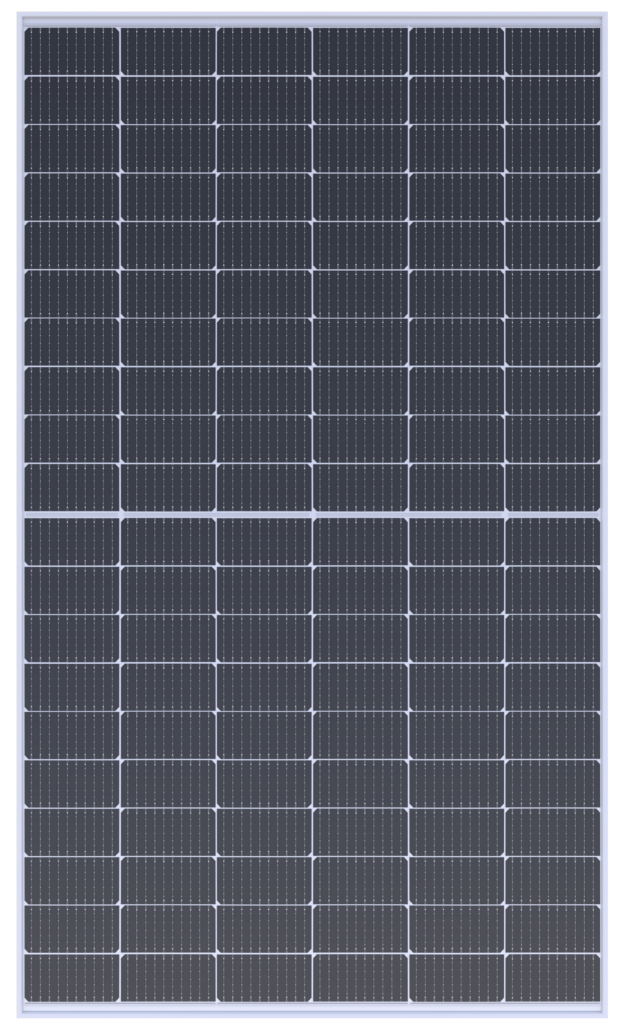
Warranty pick, heavy for its output
The Boviet Solar VEGA SERIES (Bifacial Double Glass) are bifacial modules with a glass-on-glass construction, designed to realistically increase energy yield by utilizing light from both sides - reflecting and diffuse light. In practice, this solves the common problem of "unused" installation surroundings: a clear roof, gravel, concrete, or snow, which can become an additional source of energy production.
Compared to many standard panels, it stands out due to its bifaciality and double-glass construction, which supports long-term stability and resistance in demanding operating conditions. The use of modern cell architecture, including half-cut and multi-busbar, helps minimize losses in partially shaded conditions and improves the module's performance under daily thermal and mechanical loads.
The VEGA SERIES is particularly suitable for commercial and industrial installations, as well as PV farms, where predictable yield and component durability are key. Projects with high albedo and mounting solutions that provide access to the back of the module offer the greatest benefits.
Ranking
Signals from the data
Commercial and shaded-installations.
Weight-limited structures, tight roof space and roofs where every square metre has to count.
Top 17% of the PERC 400-450 W segment, against a median of 25 yrs.
Bottom 4% of the PERC 400-450 W segment, against a median of 53.0. Ranked 12,865th in the whole database.
Bottom 18% of the PERC 400-450 W segment, against a median of 20.60%.
Bottom 23% of the PERC 400-450 W segment, against a median of 206.2.
Boviet Solar has maintained Bloomberg NEF Tier 1 status continuously since 2017, including Q1 2026. The manufacturer is also listed in the Wood Mackenzie Top 10 Most Bankable Global PV Module Manufacturers (since 2024) and the Sinovoltaics Top 10 Most Financially Stable Manufacturers (2025 edition) — translating into reduced project financing risk and broad bankability acceptance for utility-scale installations.
The manufacturer guarantees degradation of ≤0.5%/year from year 2 onward, with a minimum output of ≥83% after 30 years (year 1: ≥97.5%). A 30-year warranty is a clear differentiator against the 25-year market standard offered by the majority of competitors in the bifacial PERC segment.
The dual-glass encapsulation eliminates the rear EVA backsheet, significantly improving resistance to moisture ingress, PID, and mechanical loading. The bifacial design enables additional energy harvest from the rear side of the module in high-albedo installations (concrete, gravel, snow), typically yielding 5–15% additional annual production under European conditions.
Splitting cells in half reduces operating current and resistive losses (I²R), while multi-busbar technology shortens current-flow paths within each cell. The result is improved module performance under partial shading conditions and a higher fill factor (FF) in real-world operation — a meaningful advantage in commercial rooftop and utility-scale PV installations.
The series has achieved Top Performer status in independent PVEL (PV Evolution Labs) testing for three consecutive scorecard editions, confirming above-average durability and parameter stability across PAN, LeTID, and mechanical stress tests. This is a key consideration during technical due diligence for externally financed projects.
The series reaches a maximum efficiency of 21.06%, while comparably priced peer modules (Risen RSM96-11: 23%, SunKean SKT: 23.02%) achieve approximately 2 percentage points more using N-type TOPCon cells. This translates into a larger footprint required to achieve the same power output — a meaningful constraint in roof-area-limited installations.
PERC cells exhibit a bifaciality factor of approximately 70%, compared to 80–85% for TOPCon and ~90% for HJT. In high-albedo installations, the VEGA series generates less additional rear-side yield than N-type market alternatives — despite featuring a bifacial glass-glass construction.
- At 20.1% efficiency, this panel is on par with typical PERC 400-450W modules
- 203.1 W/m² power density is 3.1 W/m² below PERC 400-450W median (206.2 W/m²) - requires larger installation area
- Temperature coefficient of -0.35%/°C matches the PERC 400-450W median
- Weight of 27.8 kg is 5.8 kg above PERC 400-450W median (22.0 kg) - verify structural support
- #12074 for efficiency, #10419 for temperature performance out of 14005 panels
Specifications
Simulations
Degradation from this panel's own datasheet figures. No inverter, soiling or shading losses.
Alternatives







Found 751 panels of the same or similar size to this one, within ±10 mm. See them here Found 755 panels of the same or similar size to this one, within ±25 mm. See them here Found 1049 panels of the same or similar size to this one, within ±50 mm. See them here Found 1503 panels of the same or similar size to this one, within ±100 mm. See them here