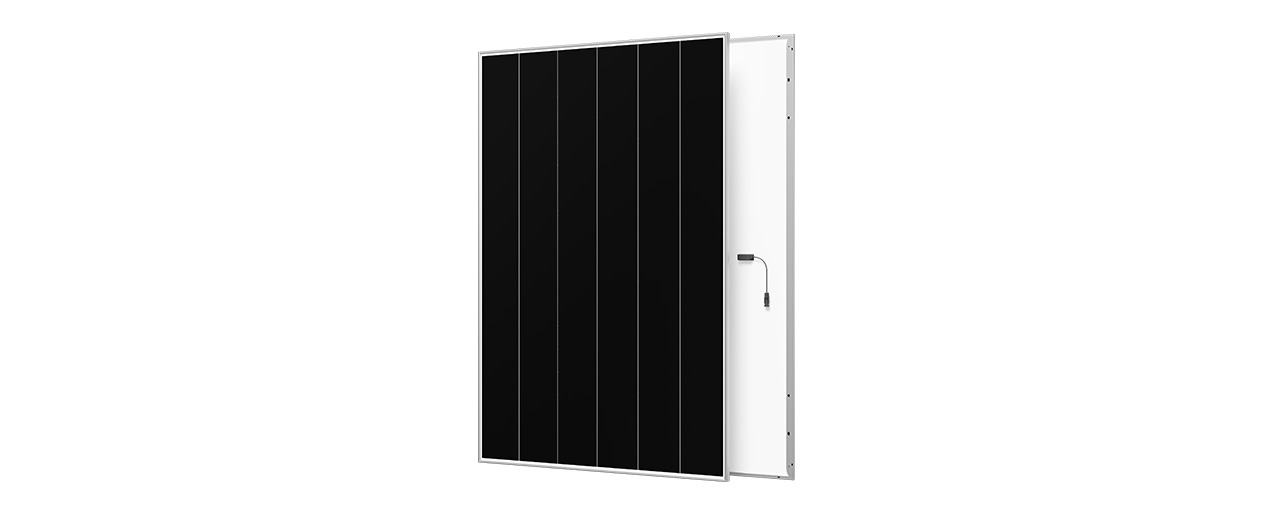
Light for its output, no clear weak spot
The AIKO Neostar 3N54 (mono-glass) series was designed to maximize energy output from the same rooftop surface - without compromising on aesthetics or reliability, typical trade-offs. Its key is ABC N-type (all-back-contact) technology, meaning the electrical connections are moved to the rear of the cell. In practice, this means more active surface area for light absorption, better performance in diffuse lighting, and lower resistive losses - leading to a more stable yield in real-world conditions.
The Neostar 3N54 stands out with high resistance to partial shading, which is beneficial in areas with chimneys, window frames, trees, or antennas. Additionally, favorable thermal stability supports energy production during summer, when standard modules often "breathe" their efficiency.
This is the right choice for premium home installations and C&I projects, where high yield per square meter, long-term reliability, and guaranteed performance parameters matter. Compared to many competitive modules, the advantage stems not from marketing but from the cell architecture and a consistent focus on real-world yield and system safety.
Ranking
Signals from the data
Residential, commercial, shaded-installations and hot-climate.
Top 10% of the Back Contact 450-500 W segment, against a median of 48.0. Ranked 336th in the whole database.
Top 18% of the Back Contact 450-500 W segment, against a median of 235.2.
Top 22% of the Back Contact 450-500 W segment, against a median of 23.50%.
The Neostar 3N54 series achieves an efficiency of 23.5–24.8%, while direct comparisons with other models (Seraphim YUKON N, Solarspace SS8-60HD, Resun RS8K-M) reach 22.87–22.94%. This difference of 0.56–1.93 p.p. translates to a real increase of 5–8% in energy production from the same roof area, without the need to increase the number of modules.
Among the lowest values in the segment – standard TOPCon technologies from competitors exhibit -0.30 to -0.35%/°C, while older PERC technologies can reach -0.40%/°C. In typical Polish summer days (module temperature of 65–70°C, i.e., ~40°C above STC), the thermal losses are 0.5–1.4% lower than those of comparable models, which directly translates into higher energy yield during the peak season.
AIKO guarantees a power drop of ≤1% in the first year and ≤0.35% per year for the next 29 years, which means maintaining ≥88.85% power output after 30 years. Peer comparisons with Seraphim and Resun offer 30-year guarantees, but at higher degradation rates; the linear guarantee (rather than a gradual one) eliminates ambiguity in performance-related claims.
Moving all electrical contacts to the back of the cell eliminates self-shading of the metallic fingers, increasing the active area for photoactivity. The ABC technology exhibits a lower light-induced degradation (LID) rate than P-type materials, and its improved performance under diffuse sunlight (cloudy conditions, partial shading) significantly enhances performance in Polish weather conditions for a large portion of the year.
AIKO is listed on BNEF's Tier-1 bankable list, which allows for the financing of C&I projects with bank credit without requiring additional collateral from the manufacturer. In 2025, the Neostar series won first place in the SolarQuotes Installers' Choice Awards, confirming the positive feedback from installers based on real-world performance, rather than just laboratory testing.
The Neostar 3N54 mono-glass series comes with a 15-year warranty for manufacturing defects, while the current Tier-1 standard (JA Solar, Jinko, LONGi, Canadian Solar) offers a 25-year warranty. Considering a 30-year lifespan, this means that for half of the installation's life, protection against manufacturing defects is solely the responsibility of the user – a significant risk for projects with long-term financing.
The mono-glass module does not generate energy from the back. In installations on light surfaces (white TPO membrane, light gravel, snow), bifacial modules from competing products in the same power segment generate an additional 5-15% of energy through reflected albedo – a feature that Neostar 3N54 does not structurally offer.
ABC modules are typically 10–15% more expensive than mainstream TOPCon modules with similar rated power. For a typical 10 kWp (approximately 20 panels) installation, the difference is estimated to be around 1,000–2,500 zł compared to comparable Seraphim YUKON N or Resun RS8K-M modules. The higher cost of premium modules may be difficult to justify with a short payback period or a limited budget.
- Efficiency of 24.0% matches the Back Contact 450-500W median
- At 240.2 W/m² power density, this panel generates 5.0 W/m² more per unit area than Back Contact 450-500W median (235.2 W/m²)
- At -0.26%/°C, hot weather performance is typical for Back Contact 450-500W panels
- At 21.0 kg, this panel is 2.5 kg lighter than Back Contact 450-500W median (23.5 kg) - easier handling during installation
- #303 for efficiency, #511 for temperature performance out of 14005 panels
Specifications
Datasheet charts
Measured curves published by AIKO in this model's datasheet. A chart carrying a wattage was measured on that variant alone - only the ones that describe 480 Wp appear here. The rest cover the whole series.

Simulations
Degradation from this panel's own datasheet figures. No inverter, soiling or shading losses.



Found 1395 panels of the same or similar size to this one, within ±10 mm. See them here Found 1425 panels of the same or similar size to this one, within ±25 mm. See them here Found 3614 panels of the same or similar size to this one, within ±50 mm. See them here Found 3962 panels of the same or similar size to this one, within ±100 mm. See them here