
Middle of its segment, heavy for its output
The AE Solar AURORA ME-120BD photovoltaic module series redefines performance standards through the use of innovative bifacial technology, which enables efficient energy harvesting from both sides of the panel. The use of Double Glass construction provides the modules with extreme resistance to external factors and chemical degradation, which directly translates into stable energy yields for decades. These panels effectively solve the problem of limited installation space, offering significantly higher power density while maintaining high efficiency in low-light conditions. A key differentiator is the advanced cell technology, which practically eliminates light-induced degradation, guaranteeing safety and predictability of electricity production for investors. Thanks to the half-cut structure, the AURORA series minimizes internal losses and handles partial shading much better than standard competing modules. This solution is primarily dedicated to demanding commercial installations and modern residential systems, where the priority is maximum durability and profit maximization from every square meter of surface area. These modules set a new direction in the premium sector, offering extraordinary resistance to micro-cracks and extreme mechanical loads, placing them at the forefront of products available on the Polish market. By choosing this series, the investor receives a guarantee of parameter stability even in the most demanding environmental conditions.
Ranking
Signals from the data
Commercial, utility-scale and shaded-installations.
Weight-limited structures.
Bottom 21% of the PERC 600-650 W segment, against a median of 55.7.
AE Solar (headquartered in Germany, founded in 2003) has been ranked in BloombergNEF's Tier 1 list for the 16th consecutive quarter (Q1 2025) and is the only European manufacturer with high bankability (50% in 2024 vs 26% in 2023). This directly translates to increased access to project financing from international banks.
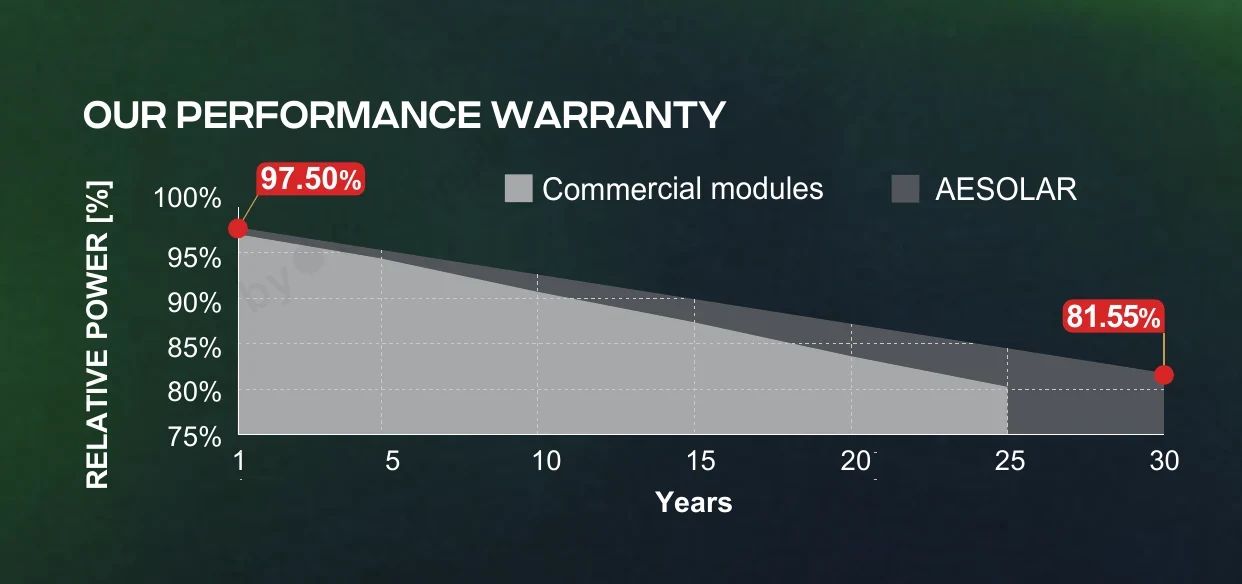
The ME-120BD series modules utilize gallium-doped silicon instead of the standard boron, which reduces light-induced degradation (LID). The manufacturer claims to maintain 82.2% of its initial power output after 30 years, which is a verifiable contractual commitment, given the 30-year linear warranty.
The double-glass design eliminates the need for a UV-sensitive backsheet, while the half-cut (6x10) configuration reduces internal resistance and minimizes losses in partially shaded conditions. The module weighs 35 kg and maintains IEC/TÜV-compliant resistance to ammonia, saline mist, and sand.
The bifaciality factor of approximately 70% allows for an additional 5-20% of energy generation, depending on the surface albedo (ground-mounted, light-colored roofs). Combined with a 30-year power warranty (compared to the standard 25 years offered by many competitors), this provides the investor with a longer period of return on investment.
With a peak power of 600 Wp and an efficiency of 21.23% (model AE600ME-120BD), this series places itself above the lower quartile of the 580-600 Wp segment. Despite the limited roof area, the power density remains competitive compared to older PERC models still available in the market.
Series_info.discontinued = true. The series, introduced in 2022, has been discontinued. This means that there will be no further supply, limited availability of replacement parts (frame, junction box), and potential difficulties in pursuing warranty claims after 15/30 years.
Direct competitors in the same power range achieve efficiencies of 21.5% (Talesun BISTAR), 23.2% (Tongwei N-type), and 23.23% (Lexron TOPCon) - representing a difference of 2-2 percentage points. The annual degradation rate for PERC cells is 0.6-0.8%/year, while N-type TOPCon cells degrade at a rate of 0.4-0.5%/year, resulting in a measurable difference in total energy yield after 30 years.
Bifaciality of approximately 70% (typical for PERC double-glass modules) is lower than the approximately 85% declared for N-type TOPCon modules (e.g., Tongwei TWMND). In ground-mounted systems with high albedo, this difference translates into actual losses on the rear side.
- At 21.2% efficiency, this panel is on par with typical PERC 600-650W modules
- At 212.3 W/m² power density, roof space requirements are typical for PERC 600-650W panels
- Temperature coefficient of -0.34%/°C matches the PERC 600-650W median
- Weight of 35.0 kg is typical for PERC 600-650W panels
- 70% bifaciality enables rear-side power generation, boosting yield by 4-10% on reflective surfaces
Specifications
Datasheet charts
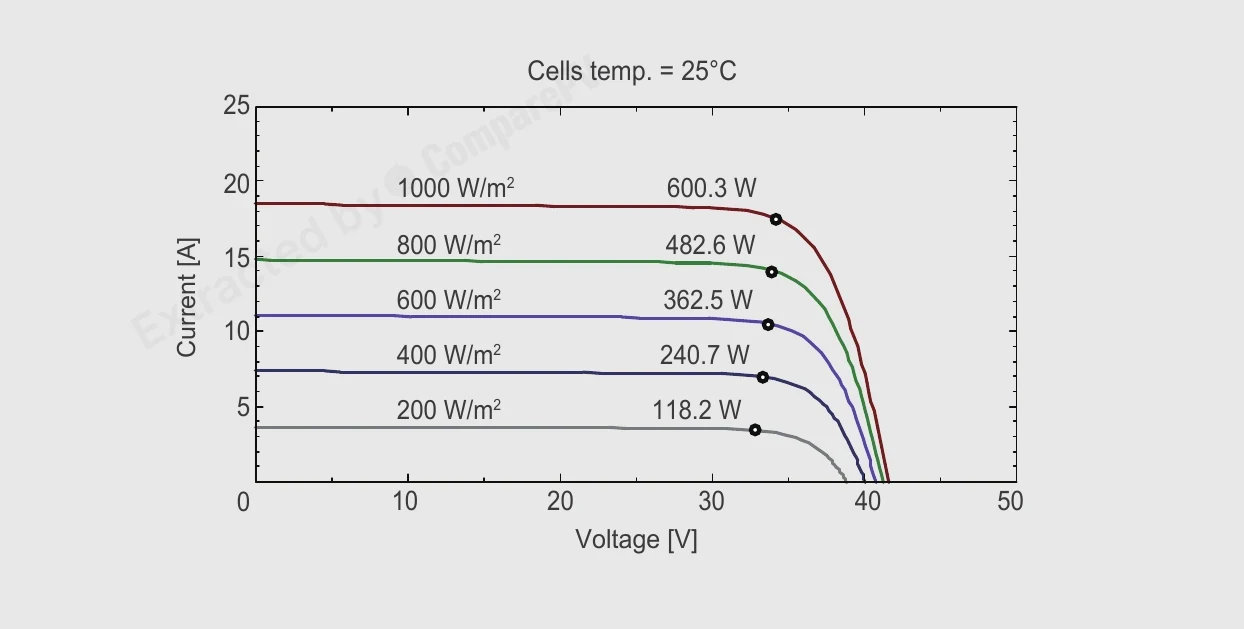
Measured curves published by AE Solar in this model's datasheet. A chart carrying a wattage was measured on that variant alone - only the ones that describe 600 Wp appear here. The rest cover the whole series.
Simulations
Degradation from this panel's own datasheet figures. No inverter, soiling or shading losses.
Model: bifaciality × albedo × 0.6 view factor. A first-order estimate, not a yield simulation.







Found 497 panels of the same or similar size to this one, within ±10 mm. See them here Found 502 panels of the same or similar size to this one, within ±25 mm. See them here Found 502 panels of the same or similar size to this one, within ±50 mm. See them here Found 502 panels of the same or similar size to this one, within ±100 mm. See them here
About the AURORA ME-120BD series
These answers cover the whole series. Where a figure differs, the specification above is this module's own.