
Light for its output, no clear weak spot
The AE Solar Aurora P-type PERC Technology panel series is a direct response to the growing demands of investors seeking the perfect balance between high efficiency and the long-term durability of PV systems. The use of PERC cell technology allows for much more efficient capture of sunlight, which translates into stable energy yields even in low-light or diffused light conditions. A key differentiator of this series is advanced resistance to LID and LeTID degradation, which effectively eliminates the problem of premature cell aging and guarantees that modules maintain high power for decades. Thanks to precise optimization of the production process, Aurora offers exceptional mechanical strength against extreme snow and wind loads, making it a safe choice for installations in the demanding Polish climate. This solution addresses the most common concerns regarding the financial stability of projects, ensuring the maximization of yields per square meter of roof or ground surface. Unlike competing solutions, this series combines rigorous quality control standards with innovative cell architecture, offering reliability in all weather conditions. It is the optimal choice for homeowners and businesses for whom the priority is trouble-free operation and a quick return on investment in photovoltaics.
Ranking
Signals from the data
Residential, commercial and cold-climate.
Top 12% of the PERC 350-400 W segment, against a median of 55.8.
Top 13% of the PERC 350-400 W segment, against a median of 25 yrs.
Top 20% of the PERC 350-400 W segment, against a median of 19.90%.
Since 2024, AE Solar has been recognized as the only Tier 1 European manufacturer according to BloombergNEF, with a bankability rating of 50% (up from 26% in 2023). This translates to a realistically lower financial risk for the project and easier access to bank financing for the installation. The Kiwa PVEL Top Performer 2025 award independently confirms the consistent quality of the products.
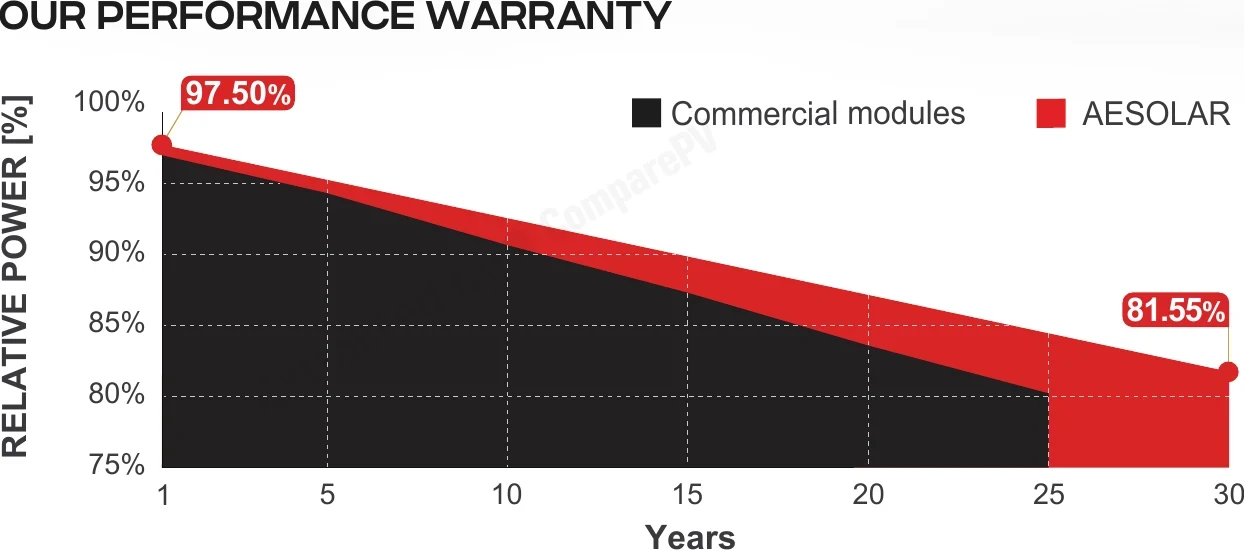
The manufacturer guarantees a 30-year warranty on both the product and its power output - a standard market practice for the PERC segment, typically offering 25 years. The technical documentation for the Aurora series states that at least 81.55% of the nominal power output will be maintained after 30 years (annual degradation ≤0.55% from year 2.).
The use of gallium-doped PERC (Ga-doped PERC) cells eliminates boron-oxygen pairs responsible for the classic LID (light-induced degradation), which distinguishes the Aurora series from cheaper PERC panels based on boron. This results in lower actual losses in the first few months of operation than would be expected based on typical technology specifications.
A wide range of models (with a step of approximately 7.5 W) allows for precise adaptation to the surface limitations of the roof or ground, without over-sizing the inverter - a significant advantage in prosumer and small-scale commercial installations.
In 2024, TOPCon (N-type) surpassed 66% of global production capacity, at the expense of PERC. A comparable Longi Solar S10 (LR7-54HJBB) achieves 24.7% efficiency with the same peak power of 505 Wp, which is more than 3.4 percentage points higher than the maximum 21.29% efficiency of the Aurora series. The difference in annual degradation is also significant: PERC ≤0.55%/year vs. TOPCon ≤0.40%/year - after 30 years, Aurora guarantees ≥81.55% efficiency, while typical N-type TOPCon maintain ≥87.4%. This results in a realistically higher cumulative energy yield from the same installed Wp power.
A typical temperature coefficient for PERC P-type silicon is approximately -0.35%/°C, while N-type TOPCon achieves -0.29 to -0.31%/°C. Under typical Polish summer temperatures of 55-65°C, this difference translates into an additional 1.5-2.5% in power loss at peak production compared to N-type competitors.
The Aurora series is monofacial only (is_bifacial: false), while the comparable Longi Solar S10 offers a bifacial design. In ground-mounted or white-surface installations (albedo 20-40%), bifacial panels can realistically generate an additional 5-15% of annual energy without increasing the footprint of the installation.
- 20.3% module efficiency - 0.8pp better than the PERC 0-400W median of 19.4%
- 202.6 W/m² power density - 8.4 W/m² more than PERC 0-400W median (194.2 W/m²), more power per roof area
- At -0.35%/°C, hot weather performance is typical for PERC 0-400W panels
- Bifaciality factor of 70% can add 4-10% extra yield with reflective mounting surface
- #11949 for efficiency, #10489 for temperature performance out of 14129 panels
Specifications
Datasheet charts
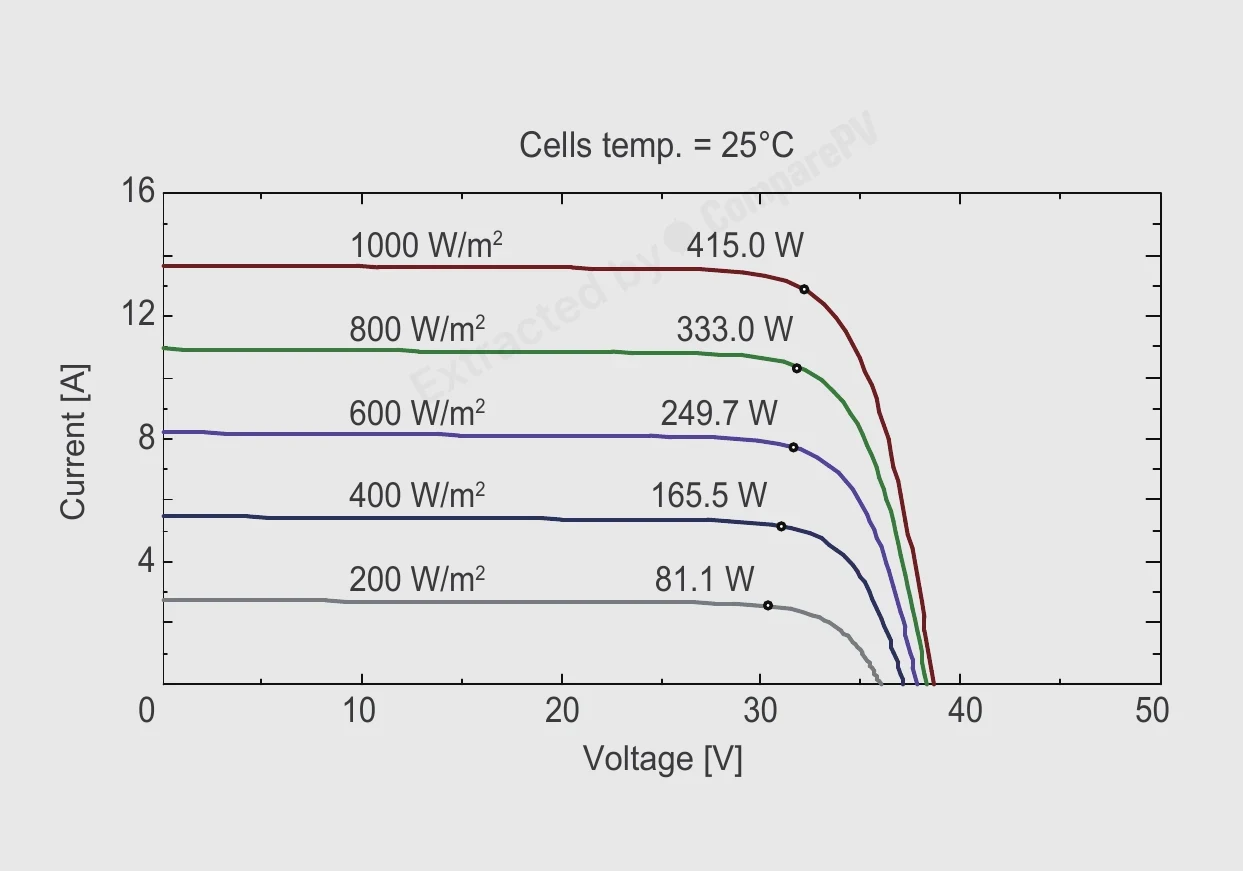
Measured curves published by AE Solar in this model's datasheet. A chart carrying a wattage was measured on that variant alone - only the ones that describe 395 Wp appear here. The rest cover the whole series.
Simulations
Degradation from this panel's own datasheet figures. No inverter, soiling or shading losses.
Model: bifaciality × albedo × 0.6 view factor. A first-order estimate, not a yield simulation.






Found 1797 panels of the same or similar size to this one, within ±10 mm. See them here Found 1928 panels of the same or similar size to this one, within ±25 mm. See them here Found 3413 panels of the same or similar size to this one, within ±50 mm. See them here Found 4015 panels of the same or similar size to this one, within ±100 mm. See them here
About the AURORA P-TYPE PERC TECHNOLOGY series
These answers cover the whole series. Where a figure differs, the specification above is this module's own.