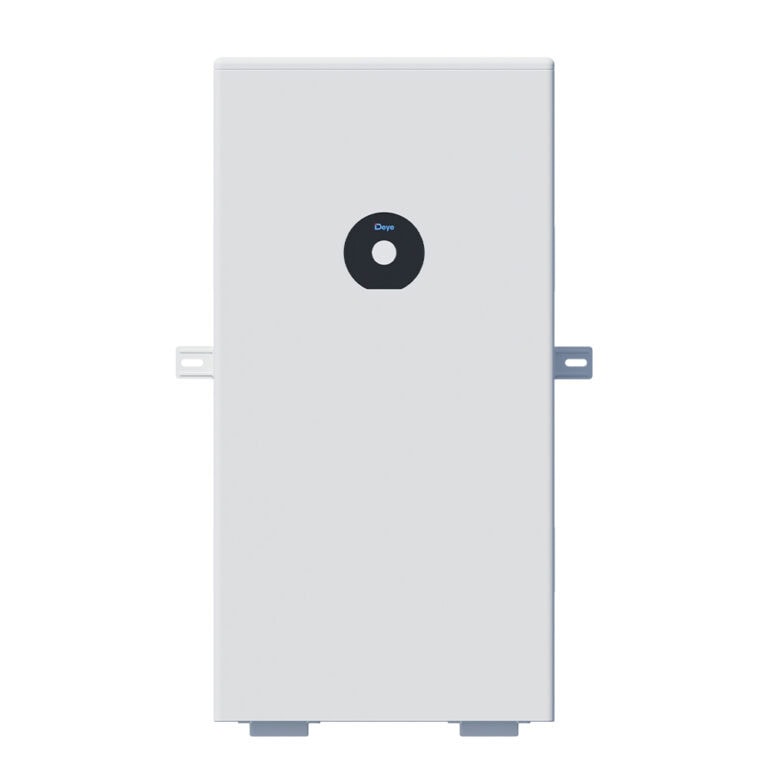

Deye RW-G10.6
The Deye Spring Series Residential ESS Solution (Wall-Mounted Battery LV) is a low-voltage energy storage unit designed for wall mounting, focused on maximizing PV self-consumption and providing a stable backup power supply. Its key advantage is the LiFePO4 (LFP) chemistry - cobalt-free, thermally stable, and known for its long lifespan. In practice, this translates to greater home safety compared to typical NMC solutions and reliable operation for years.
Each module operates under the control of an intelligent BMS, which balances the cells and protects the system from overloading, overcharging, or deep discharge. In daily use, this results in consistent efficiency and fewer service surprises.
The Spring Series stands out with its scalability - the system can be modularly expanded, adapting the capacity to growing needs (e.g., heat pump, EV charger, off-grid operation). Additionally, the solution is compatible with hybrid inverters from Deye and popular ESS systems, facilitating integration into both new and retrofitted installations. A high cycle life and long warranty ensure a truly lower operating cost from the energy storage unit throughout its entire lifespan.
Ranking
Specifications
Pros and cons
LFP (Lithium Iron Phosphate) batteries offer a declared lifespan of over 6,000 charge cycles while maintaining 70% of their nominal capacity (e.g., RW-F10.2-B: 51.2 V / 200 Ah). In comparison, typical NMC (Nickel Manganese Cobalt) batteries used by competitors in residential applications achieve 3,000-4,000 cycles under similar conditions, which means a 2-fold longer electrochemical lifespan without module replacement.
The Spring series (e.g., RW-F16) allows for the parallel connection of up to 32 units, providing a total capacity of 512 kWh with a single set of hybrid inverters. This represents one of the highest scalability limits in the residential LV segment, enabling expansion in stages - for example, starting with 10 kWh and eventually powering a heat pump and an EV charging station.
The modules have an IP65 sealing certificate, enabling installation both inside and outside of buildings. The operating temperature range of -20°C to +55°C exceeds the requirements of the Polish climate and is comparable to leading products such as Pylontech Force H2 and BYD Battery-Box Premium LVS.
Deye provides a 10-year warranty on Spring Series batteries (verified by the Deye ESS Limited Warranty document, available from Polish distributors). This warranty covers both material defects and minimum energy performance, protecting the investment throughout the typical payback period (typically 6-9 years for prosumer installations in Poland).
Each Spring Series module includes a built-in BMS that monitors each individual cell, performs load balancing, and provides multi-level protection (over-charge, over-discharge, over-temperature, short-circuit). Communication with the inverter is achieved via CAN or RS485, enabling full integration with the energy management system and remote monitoring via the manufacturer's application.
The official list of approved Deye batteries ("Approved Battery List", updated 2025) primarily includes inverters manufactured by Deye itself. Integration via CAN/RS485 with popular inverters from other manufacturers (e.g., Fronius Symo GEN24, SolarEdge with the StorEdge module) is not officially confirmed and requires individual verification before purchase - unlike Pylontech and BYD batteries, which are listed as compatible with many independent inverter manufacturers.
Alternatives

About the Spring Series Residential ESS Solution (Wall-Mounted Battery LV) series
These answers cover the whole series. Where a figure differs, the specification above is this model's own.