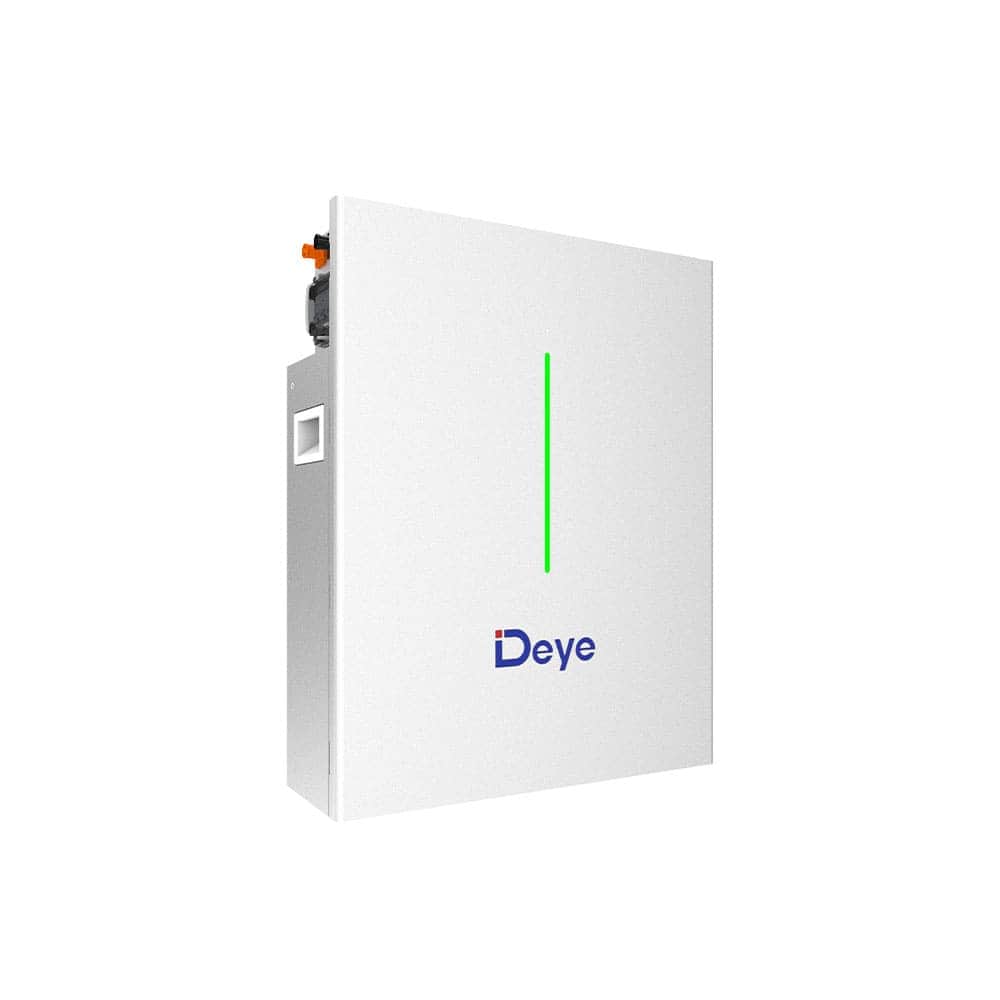

Deye RW-F10.2-B

Deye RW-F10.2-B

9.2 kWh usable LFP Low voltage
Compare with closest alternative Datasheet PDF
Usable (kWh)
9.20
Typical for its class
Round-trip (%)
-
Not published
Power (kW)
12.3
Strong · top 4%
Cycles
6000
Typical · median 6000
Weight (kg)
107.0
Typical · median 107.0 kg
Warranty (yrs)
10
Typical · median 10 yrs

Series Deye RW-F10.2 and RW-F10.2-B are low-voltage energy storage units designed for stable operation in hybrid and backup systems, where safety, easy expansion, and convenient operation are key. The key advantage is the LiFePO4 (LFP) chemistry-cobalt-free, with high thermal stability and long lifespan-meaning practically less risk of overheating and guaranteed performance during daily charging and discharging cycles compared to NMC.

An intelligent BMS built-in monitors operational parameters and protects the battery, while the modules support automatic parallel connection without manual coding, shortening installation time and simplifying maintenance. For users, it's also important that the series offers nearly 6000 cycles and 10-year warranty-a real perspective of multi-year, predictable operation. The system is scalable (allowing connection of multiple modules), making it suitable for homes, businesses, and off-grid setups, especially when integrated with Deye inverters and compatible hybrid solutions.

Ranking

44 batteries from 6 to 12 kWh
Metric This battery Median Position in class Rank in class
Round-trip efficiency - 95.0% Not published -
Power per kWh 1.34 1.00 Strong · top 4% 1
Cycle life 6000 6000 Typical 5
Weight per kWh 11.6 12.3 Typical 18
Warranty 10 yrs 10 yrs Typical 3
Colour key Strong - top 25% Typical - middle 50% Weak - bottom 25%

Price offers

1 from shops we track
Shop Country Price Per kWh Stock Offer updated Link to shop
www.nejpanely.cz Czechia 55 000 Kč incl. VAT 5 978.26 Kč/kWh Not stated 15h ago Visit shop

See 44 Deye offers

Specifications

Open datasheet PDF
Usable energy 9.2 kWh What the battery delivers, full to empty
Nominal energy 10.24 kWh What the cells hold
Depth of discharge 90 %
Max system capacity 294.4 kWh
Units in parallel 32
Continuous discharge power 12.29 kW 1.34 kW per kWh
Continuous charge power 10.14 kW
Peak discharge power 15.36 kW For 120 s
Max discharge current 240 A
Max charge current 198 A
Peak discharge current 300 A
Cycle life 6000 cycles At 90 % depth of discharge
Capacity at end of life 70 %
Voltage class Low voltage
Nominal voltage 51.2 V
Operating voltage 43 to 58 V
Cell technology LFP LiFePO4 (LFP)
Cell management Cobalt-free
Dimensions 830 × 600 × 200 mm Height × width × depth
Weight 107.0 kg 11.6 kg per kWh
Enclosure IP65
Mounting wall
Cooling passive
Operating temperature -20 to 55 °C
Compatible inverters Deye (remote monitoring/upgrade mentioned; inverter models not specified)
Protocols CAN2.0RS485
Warranty 10 years
Warranted throughput 32.0 MWh Cover ends at the years or this, whichever first
Certifications UN38.3IEC62619CECEI 0-21VDE2510-50CECFCCUL1973UL9540A

Pros and cons

5 positive · 2 caution
What owners get
Thermal safety of LiFePO4 chemistry

LFP (lithium iron phosphate) cells exhibit a higher thermal runaway temperature (above 270°C) compared to ~150°C for NMC, which significantly reduces the risk of fire. This translates to a significantly lower operational risk in everyday charging cycles under home conditions, without the need for additional cooling systems.

6000 cycles at 90% Depth of Discharge (DoD), 10-year warranty

The declared 6000 full cycles at a 90% depth of discharge (9.2 kWh usable from 10.24 kWh nominal) positions the series above the standard for segments of approximately 4000-5000 cycles (e.g., Pylontech US5000: 6000 cycles, but at 80% DoD). A 10-year warranty provides predictable total cost of ownership (TCO) for residential and commercial & industrial installations.

Scalable up to 32 modules (327 kWh)

The ability to connect up to 32 RW-F10.2 units provides a total capacity of approximately 327 kWh in a single installation, opening up applications for both residential homes (1-3 modules) and commercial and off-grid systems without the need to change the hardware platform.

Auto-networking without DIP code

The integrated BMS supports automatic module linking - eliminating the need for manual DIP switch configuration. This reduces the startup time of multi-module installations and minimizes the risk of configuration errors during maintenance.

A wide range of certificates

The series also includes: UL1973, UL9540A (for the North American market), IEC 62619, CE, VDE 2510-50 (for the German/EU market), and CEC (Australia) - which allows for sale and installation on the three major markets without the need to certify local variants, and IP65 enables outdoor mounting (wall or floor).

Trade-offs
Low-voltage architecture (51.2 V)

Under a full load of 10 kW, the current on the main line is approximately 196 A, which requires cables with a cross-section of 70-95 mm² and robust busbars. High-voltage systems (e.g., BYD Battery-Box HVS: 200-500 V) reduce currents by 4-10 times, reducing cable costs and transmission losses - a significant drawback in large, multi-module installations.

Optimization for the Deye ecosystem

Communication via CAN2.0/RS485 is natively supported by Deye and Sol-Ark inverters. Integration with platforms from other manufacturers (Fronius, SMA, Victron) requires compatibility verification based on the list of approved batteries for a specific inverter, and this may limit the full functionality of the BMS (e.g., dynamic balancing by the inverter).

Alternatives

All Deye batteries
Battery Usable Round-trip Power Voltage Difference
Deye RW-F10.2-B 9.2 kWh - 12.3 kW Low voltage You are here
RW-F10.2 9.2 kWh - 12.3 kW LV Similar on paper
AI-W5.1-B (2 modules) 9.2 kWh - 9.2 kW LV -3.1 kW
RW-G10.6 9.58 kWh 90.0% - LV +0.4 kWh
LUX-E-48200LG03 9.98 kWh - - LV +0.8 kWh
RW-L10.2 10.24 kWh - 12.0 kW LV +1.0 kWh
SE-G 10.2 10.24 kWh - 5.0 kW LV +1.0 kWh, -7.3 kW
SE-F12 10.62 kWh - 11.8 kW LV +1.4 kWh, -0.5 kW
LUX-E-48230LG03 11.21 kWh - - LV +2.0 kWh

About the RW-F10.2 & RW-F10.2-B series

6 answered

These answers cover the whole series. Where a figure differs, the specification above is this model's own.

What is the actual energy output that can be obtained from the Deye RW-F10.2 storage system during a single cycle?
Although the nominal capacity is 10.24 kWh, the usable energy available in practice is approximately 9.2 kWh - the manufacturer specifies a depth of discharge (DOD) of 90%. This means that the system does not discharge completely to zero, which protects the LiFePO4 batteries and extends their lifespan. In a typical single-family home, these 9.2 kWh are sufficient to cover the evening and nighttime energy consumption with an average daily consumption of 10-15 kWh.
What are the differences between the Deye RW-F10.2 and the RW-F10.2-B version?
Both versions utilize the same LiFePO4 cells and have identical electrical parameters: 51.2 V, 200 Ah, 10.24 kWh. The difference lies in the enclosure and target market: RW-F10.2 is a version designed for the European and Australian markets, available as a standalone module, while RW-F10.2-B offers an integrated enclosure with an IP65 rating and the option for wall or floor mounting, making it more suitable for outdoor or damp environments.
How many Deye RW-F10.2 modules can be connected to form a single system, and what does system expansion look like?
The RW-F10.2 series supports parallel connections to up to 32 units, providing a total capacity exceeding 320 kWh. Expansion does not require manual coding - the modules support automatic networking, so adding another battery primarily involves connecting cables and updating the inverter settings. This is a particularly convenient solution for companies with gradually increasing energy needs.
What is the warranty for the Deye RW-F10.2, and what exactly does it cover?
The manufacturer provides a 10-year warranty on the RW-F10.2 series. This warranty guarantees that, after 6000 cycles at 90% DOD (Depth of Discharge), the battery's capacity will not fall below 70% of its nominal value - which corresponds to an energy throughput of approximately 32 MWh throughout its lifespan. The warranty covers manufacturing defects and battery degradation, but it is advisable to confirm the specific service conditions with your local Deye distributor.
Which inverters are compatible with the Deye RW-F10.2 energy storage system?
The RW-F10.2 series is optimized for use with hybrid inverters from Deye, such as single-phase (SUN-xK-SG04LP1-EU) and three-phase (SUN-xK-SG04LP3-EU) low-voltage models. Communication is achieved through CAN 2.0 and RS485 interfaces. The battery is also compatible with selected inverters from other manufacturers that support low-voltage LV storage systems in the BMS CAN/RS485 standard. However, it is recommended to verify the specific inverter model with the installer before purchasing.
Can the Deye RW-F10.2 be installed in an unheated garage or outdoors?
The RW-F10.2 module has an IP65 degree of protection, which means complete protection against dust and resistance to water jets, making it suitable for use in a garage or shed. For strictly outdoor installations exposed to direct rainfall, the RW-F10.2-B variant with a dedicated external enclosure is preferable. It is also worth checking the permissible operating temperature range (typically from -10°C to +50°C for LiFePO4), to avoid limitations in charging during very cold temperatures.
Compare with alternative