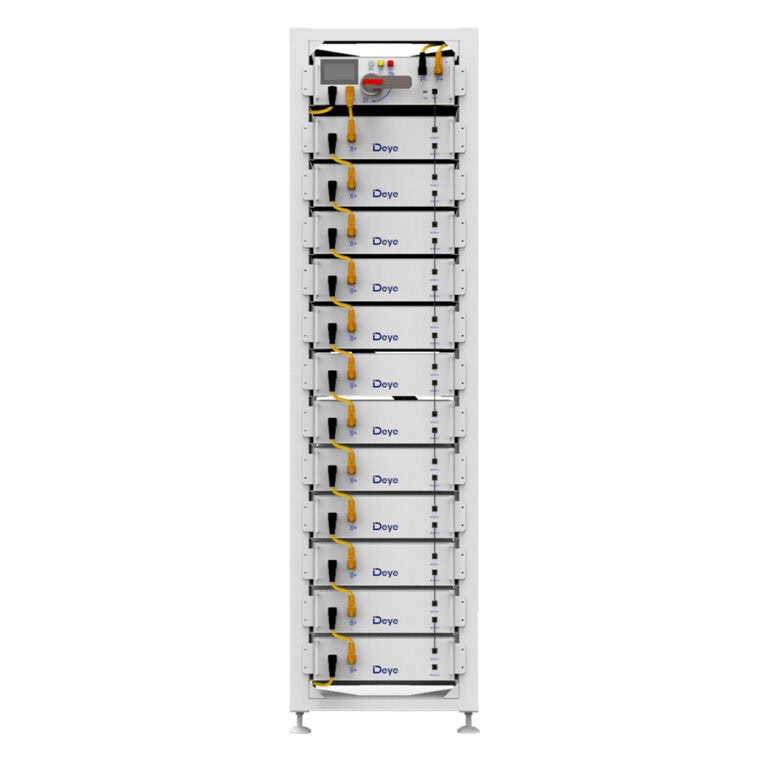

Deye BOS-G20

Deye BOS-G20

18.43 kWh usable LFP High voltage
Compare with closest alternative Datasheet PDF
Usable (kWh)
18.43
Strong · top 11%
Round-trip (%)
-
Not published
Power (kW)
-
Not published
Cycles
6000
Typical · median 6000
Weight (kg)
420.0
Weak · 230.2 kg above median
Warranty (yrs)
10
Typical · median 10 yrs

The BOS-G series are high-voltage rack-format energy storage units designed for rapid installation and seamless expansion without necessitating a complete system overhaul. Their most distinguishing feature is modular scalability - capacity increases by adding further modules, and the system performs effectively both as a UPS backup and for PV self-consumption in businesses or larger homes.

BOS-G utilizes the LiFePO4 (LFP) chemistry, which, compared to NMC, is typically more thermally stable, better withstands intensive operation, and promotes a long service life. This translates to a high cycle count and long warranty period - meaning predictable costs and reduced risk of performance decline after several seasons for the user.

In practice, an intelligent Battery Management System (BMS) with cell balancing and a comprehensive safety suite, along with communication (e.g., CAN/RS485), facilitating integration with inverters and hybrid systems, is also crucial. BOS-G is a suitable choice for grid-connected, hybrid, and specific off-grid scenarios where safety, serviceability, and flexible expansion are key.

Ranking

36 batteries from 12 to 20 kWh
Metric This battery Median Position in class Rank in class
Round-trip efficiency - 95.0% Not published -
Power per kWh - 0.68 Not published -
Cycle life 6000 6000 Typical 5
Weight per kWh 22.8 12.4 Weak · bottom 5% 29
Warranty 10 yrs 10 yrs Typical 3
Colour key Strong - top 25% Typical - middle 50% Weak - bottom 25%

See 44 Deye offers

Specifications

Open datasheet PDF
Usable energy 18.43 kWh What the battery delivers, full to empty
Nominal energy 20.48 kWh What the cells hold
Depth of discharge 90 %
Module energy 5.12 kWh
Modules per stack 3 to 12
Max system capacity 61.4 kWh
Max discharge current 100 A
Max charge current 100 A
Peak discharge current 125 A
Cycle life 6000 cycles At 90 % depth of discharge
Capacity at end of life 70 %
Voltage class High voltage
Nominal voltage 204.8 V
Operating voltage 166 to 234 V
Cell technology LFP LiFePO4
Cell management Cobalt-free
Dimensions 1629 × 530 × 602 mm Height × width × depth
Weight 420.0 kg 22.8 kg per kWh
Enclosure IP20
Mounting rack
Operating temperature -20 to 55 °C
Compatible inverters Deye (remote upgrade compatible)
Protocols CAN2.0RS485
Warranty 10 years
Certifications CEIEC62619VDE2510-50UL1973UL9540AUN38.3

Pros and cons

5 positive · 2 caution
What owners get
Modular scalability from 5.12 kWh

The system is built from BOS-GM5.1 modules rated at 5.12 kWh (51.2 V, 100 Ah), allowing capacity to scale from ~25.6 kWh (5 modules) to over 80 kWh (16 modules) without rebuilding the system - a typical strength of rack-mount architecture in C&I applications.

Rated cycle life ≥6000 cycles

The manufacturer specifies ≥6000 cycles to EOL 70% (25±2°C, 0.5C/0.5C test), placing it at the upper end for LiFePO4 rack storage and well above many older NMC designs (typically 3000-4000 cycles).

LiFePO4 chemistry - higher thermal safety margin

LFP has a higher thermal runaway onset temperature and lower propensity for uncontrolled runaway than NMC, which matters for installation in technical rooms of businesses and homes.

10-year manufacturer warranty

The warranty covers 10 years or the cycle-life limit, whichever comes first - standard among tier-1 LFP manufacturers and gives predictable operating costs over a typical PV amortization horizon.

Competitive pricing on multi-module purchases

Market listings show prices around €124-156/kWh for multi-module configurations (e.g., 60 kWh for ~$14,799, roughly $247/kWh in the US), which is attractive compared to many HV rack storage systems available in Europe and Africa.

Trade-offs
Inconsistent configuration data across resellers

Independent distributors list differing module counts for the series (e.g., 5/8/12/16 for Pro variants vs. 6/12 for BOS-G-L/H), and one configurator cites 153.6 V with only 3 modules, suggesting inconsistency in publicly available technical documentation outside Deye's official datasheet.

44 kg module weight complicates installation

Each BOS-GM5.1 module weighs about 44 kg, and full 12-16 module rack configurations require solid flooring and typically two installers or lift equipment - a common but real logistical barrier for installation and servicing.

Alternatives

All Deye batteries
Battery Usable Round-trip Power Voltage Difference
Deye BOS-G20 18.43 kWh - - High voltage You are here
Ai-HB 200A 18.43 kWh 95.0% 12.3 kW HV Similar on paper
GB-L20 18.4 kWh - 20.5 kW HV Similar on paper
GB-SL-EU (5 modules in series) 18.4 kWh - - HV Similar on paper
Tower Pro TP19 18.24 kWh 95.0% 19.2 kW HV -0.2 kWh
ECS4300H-H5 18.67 kWh 95.0% - HV +0.2 kWh
ECS2900-H7 18.14 kWh 95.0% - HV -0.3 kWh
HS20 19.06 kWh - - HV +0.6 kWh
Tower T17 17.76 kWh - 10.7 kW HV -0.7 kWh

About the BOS-G series

6 answered

These answers cover the whole series. Where a figure differs, the specification above is this model's own.

How much energy can a Deye BOS-G system store, and how is capacity expanded?
The BOS-G series is built from modules rated at roughly 5.12 kWh (51.2 V, 100 Ah), which are stacked into a single high-voltage rack. Depending on configuration, you can combine a few to more than a dozen modules for a total ranging from around 15 kWh to over 60 kWh. Expansion simply means adding more modules to the existing rack, without replacing the whole system and without interrupting the operation of the remaining modules.
What is the warranty on BOS-G batteries, and how many charge cycles do they handle?
Deye provides a standard 10-year warranty on the BOS-G series, and the manufacturer specifies at least 6,000 charge/discharge cycles at 90% depth of discharge (DoD), whichever limit is reached first. In practice, with a typical daily cycle (charging during the day, discharging in the evening), the battery should retain high usable capacity throughout the warranty period.
Can a Deye BOS-G battery be connected to an inverter from a different brand?
BOS-G communicates with the inverter via CAN or RS485, a standard interface used by many hybrid inverter manufacturers, so integration with non-Deye systems is sometimes possible at the protocol level. That said, the manufacturer only guarantees full compatibility and verified operating parameters (voltage, charge current) with Deye inverters - for other brands, it's best to confirm compatibility with the seller before purchase.
Does BOS-G work in winter, for example in an unheated garage or utility room?
BOS-G batteries use LiFePO4 chemistry, which handles low temperatures better than NMC, but the charging process still has limits - typically between 0°C and 55°C - while discharging is possible down to -20°C up to 55°C. In practice, the system can operate (discharge) in a cold room, but charging below 0°C requires preheating the modules or installing them in a heated location.
How does BOS-G differ from standard low-voltage (LV) battery storage?
BOS-G is a high-voltage (HV) rack-based system, which compared to LV storage achieves greater capacity with lower currents and reduced cable losses, making it easier to scale power for commercial installations or larger homes. An intelligent BMS with cell balancing and a full set of protections manages the safe operation of the entire module stack, which matters especially at higher operating voltages.
What applications is Deye BOS-G best suited for - home, business, or off-grid?
BOS-G is designed primarily for on-grid and hybrid installations, where it serves as backup power and boosts self-consumption of PV energy, both in larger single-family homes and in commercial settings. It also works for select off-grid scenarios, though in those cases choosing the right number of modules and an inverter capable of handling full grid disconnection is essential.
Compare with alternative