
Specifications
What snow and wind load rating does a solar panel need?
What the front and rear load ratings in pascals on a solar panel datasheet mean, how to turn your roof's snow and wind into the same unit, and where clamps go.
In short: the two pascal figures on a datasheet are test loads, what the module survived in the lab, and the load you may put on it is the test load divided by 1.5. The median module in our catalogue states 5,400 Pa on the front and 2,400 Pa on the rear. Whether that's enough depends on your roof's snow and wind, which you can turn into pascals yourself, and on the clamps: one manufacturer's manual rates the same module at less than half its front figure when it's clamped on the short sides.
A module on a roof carries two kinds of push. Snow presses on the glass, and wind does too when it blows at the roof, but wind passing over a roof also sucks the module upwards, away from the rails. Datasheets answer both with one number each, in pascals: newtons per square metre of glass. This article explains where those numbers come from, how to turn the snow and wind at your house into the same unit, and why the clamps matter as much as the module.
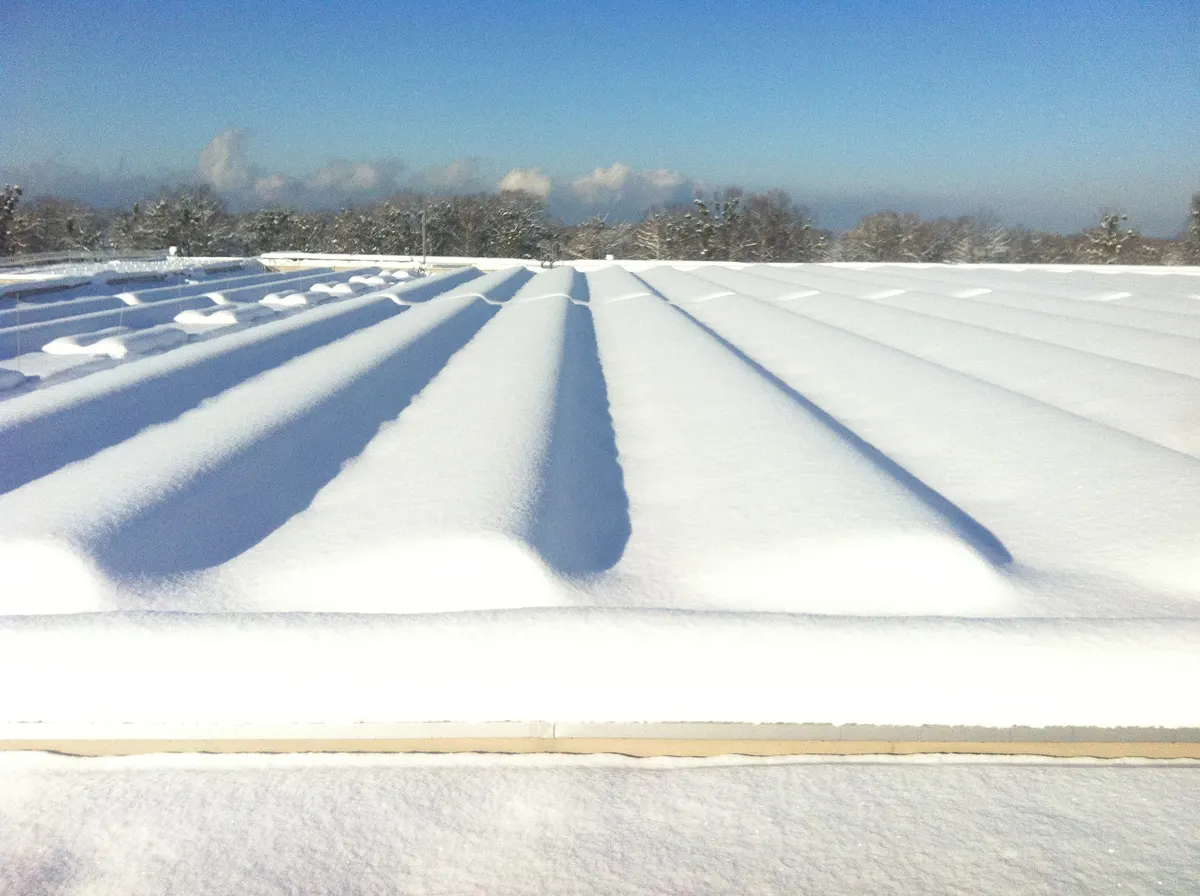

Two numbers on every datasheet
Look for a line called mechanical load, static load or maximum load. It usually prints two figures, a positive one for the front and a negative one for the rear, like +5400 Pa / -2400 Pa. The mechanical load glossary entry has the vocabulary; the datasheet guide shows where the line sits on the sheet.
The front figure is the one people call the snow load. It's a pressure on the glass, pushing the module towards the roof. The rear figure is the wind load in the sense that matters most: suction that tries to lift the module off its rails. Wind can push on the front too, but snow usually decides that side.
A pascal is small. A kilopascal (1,000 Pa) is about the weight of 100 kg spread over a square metre, so a module rated 5,400 Pa on the front survived the equivalent of roughly 550 kg on each square metre of glass in the lab. That last part, in the lab, is the one to hold on to.
Test load is not design load
The figure on the datasheet is normally the load the module was tested at, and the test has a safety factor built into it. LONGi's installation manual says it in one line: the load it describes "is for the test load", and "on the basis of IEC 61215-2021 installation requirements, when computing the corresponding maximum design load, a safety factor of 1.5 need to be considered". In its own shorthand: test load = design load × 1.5.
The test itself is the static mechanical load test of IEC 61215, MQT 16 in part 2 of the 2021 edition. The module is mounted the way its manual says and loaded on the front and on the rear; the pass criteria are the standard's, not the manufacturer's.
So the number to compare with your roof is the test load divided by 1.5:
| Datasheet test load | Design load the module may carry |
|---|---|
| 2,400 Pa | 1,600 Pa |
| 3,600 Pa | 2,400 Pa |
| 5,400 Pa | 3,600 Pa |
A few datasheets print the design load instead, or both. If the sheet says "design load" next to the figure, don't divide it again. If it doesn't say, the manual's mechanical section will.
What the catalogue states
12,969 of the 14,005 modules in our catalogue state a front figure, and 12,678 a rear one. Read the percentile columns next to the median: where they match it, most modules print the same number and the rating hardly separates one from another.
| Figure | Median | 10th percentile | 90th percentile |
|---|---|---|---|
| Front static load | 5,400 Pa | 5,400 Pa | 5,400 Pa |
| Rear static load | 2,400 Pa | 2,400 Pa | 4,000 Pa |
11,098 modules state exactly 5,400 Pa on the front, and 10,163 exactly 2,400 Pa on the rear. Those are test levels manufacturers pick, not measurements of a breaking point: a module that passes at 5,400 Pa is not shown to fail at 5,500. So between two modules printing the same pair, the datasheet tells you nothing about which is stronger.
Compare the rear's 90th percentile with its median. If it sits higher, at least one module in ten is tested harder on the back than the common level. A higher rear rating is worth having on a windy site, and the worked example below shows why the rear can be the tighter side.
766 modules state a lower figure for the front than for the rear. That can be real, but I'd read the original sheet before trusting it: the two columns are easy to swap.
From the snow on the ground to pascals on the module
Snow loads on roofs in Europe are worked out with EN 1991-1-3, part 1-3 of Eurocode 1. It starts from the characteristic snow load on the ground, sk, in kN/m², which each country publishes in its national annex, usually as a map by zone and altitude. Denmark's annex, for example, sets one value for the whole country, sk = 1.0 kN/m². Your building authority or your installer can tell you yours.
The ground value then becomes a roof value: s = μ1 × Ce × Ct × sk. Ce (exposure) and Ct (thermal) are 1 on most houses; the JRC's worked example of the second-generation code uses exactly that, with μ1 = 0.8 on a flat roof. μ1, the shape coefficient, carries the roof's pitch, because snow slides off steep roofs:
- up to 30°: μ1 = 0.8
- from 30° to 60°: μ1 = 0.8 × (60 - pitch) / 30, falling in a straight line
- 60° and steeper: μ1 = 0
1 kN/m² is 1,000 Pa, so the roof value is already in the datasheet's unit. One more step: building codes put their own safety factor on the load as well, and the figure below uses 1.5, the usual factor on snow and wind in the Eurocodes. The comparison is then the factored load against the module's design load.
A worked example, with example numbers rather than any real site's:
- ground snow load sk = 1.5 kN/m², roof pitch 30°
- snow on the roof: 0.8 × 1.5 = 1.2 kN/m², or 1,200 Pa
- with the load factor: 1,200 × 1.5 = 1,800 Pa
- module tested at 5,400 Pa: design load 5,400 / 1.5 = 3,600 Pa, twice what the roof asks
The rear works the same way with the wind uplift your mounting supplier's calculation gives for the module's place on the roof. Say 1,000 Pa: × 1.5 is 1,500 Pa, against 2,400 / 1.5 = 1,600 Pa for a module tested at 2,400 Pa. That passes by less than a tenth. In this example the rear, not the snow, is the tighter side.
The figure below runs the same sums. The module starts at the catalogue's median test loads; the snow, the pitch and the wind are example inputs, so put in your own.
Is the module rated for your roof?
Set the ground snow load, the roof pitch and the wind uplift, give the module its two datasheet test loads, and see whether each face carries its load once both safety factors are in.
How this is computed
Snow on the roof s = mu1 × sk, with sk the characteristic ground snow load from the national annex to EN 1991-1-3 and mu1 the shape coefficient of a pitched roof: 0.8 up to 30 degrees, 0.8 × (60 - pitch) / 30 from 30 to 60 degrees, 0 beyond. The exposure and thermal coefficients Ce and Ct are taken as 1.
Each face's load is multiplied by 1.5, a load factor of the kind building codes apply, and each test load is divided by 1.5, the factor between test load and design load in IEC 61215-2 as installation manuals state it. A face passes when its design rating is at least its factored load; the margin is the rating over the load, minus one. The test load a failing face would need is its factored load times 1.5.
The model takes the whole snow load as pressing straight into the glass, although on a pitched roof part of it acts along the module, so it errs on the safe side. It ignores drifts at parapets, dormers and steps in the roof, local snow rules and the stronger suction at roof edges and corners, which the wind uplift you enter has to include. It checks the module only; the rails, the fixings and the roof structure need their own calculation.
Illustrative model, not a measurement.
The sums leave out what the code adds for real roofs: drifts against a parapet or a dormer, snow piling where a steep roof meets a flat one, and stronger suction at the roof's edges and corners. National annexes can add their own cases on top: Denmark's has a drifted one for exposed pitched roofs, with no snow on the windward side and up to 1.2 times the ground snow load on the leeward side, half as much again as the 0.8 above. They also ignore that snow on a pitched roof presses partly along the module rather than straight into it, which makes the simple version err on the safe side. Treat it as a first check, not as the structural calculation.
Where the clamps go changes the rating
The datasheet figure belongs to one way of mounting the module, and the manual says which. LONGi's V19 manual prints a table for each module and each mounting method. For the LR5-54HPH, a 54-cell module:
| Mounting, from the manual | Test load front / rear |
|---|---|
| Clamps on the long frame, rails across it, D from 250 to 350 mm | +5400 / -2400 Pa |
| Rails across the short frame | ±2400 Pa |
| Clamps at the corners of the short frame | +2400 / -1800 Pa |
The same module, clamped at the corners of its short sides, is rated less than half on the front. Run the worked example again with those figures: 2,400 / 1.5 = 1,600 Pa against 1,800 Pa of snow, and 1,800 / 1.5 = 1,200 Pa against 1,500 Pa of uplift. It fails on both faces, on a roof the same module carries easily when clamped on its long sides. The button for short-side clamps in the figure above does exactly that.
Larger modules do worse in the same manual. The 66-cell LR5-66HTH gets +1800 / -1400 Pa with rails across the short frame, and for the 72-cell LR5-72HTHF and LR7-72HTHF both short-side methods are marked "Not Allow". A longer module has more glass between supports on the short sides, so the same pressure bends it further. The module size article covers how much larger they've become.
The manual also sets the clamp itself: LONGi recommends clamps at least 50 mm long, requires them to overlap the frame by 10 to 12 mm, and says they must never touch the glass. And for snowy places it adds one line that has nothing to do with pascals: "adjust the height of the mounting system so that the lower edge of the module is not covered by snow". The manual doesn't give the reason; the plain reading is that snow should be able to slide off the bottom row rather than build up against it.
How the figures were read
Every catalogue figure here is what a manufacturer printed on a datasheet, read as printed, in pascals. Values below 1,000 or above 20,000 Pa are left out as extraction slips. The catalogue doesn't record whether a sheet calls its figure a test load or a design load, so a few modules in the table may carry a design load where most carry a test load. Counts are modules, not datasheets: one sheet usually covers a ladder of power ratings, and each rating is its own row. The full rules are under the article.
What to check when you buy
- Find your ground snow load sk in your country's national annex, or ask the installer. Multiply by 0.8 for a roof up to 30°, less for a steeper one, and by 1.5 for the code's safety factor.
- Ask the mounting supplier for the wind uplift at the modules' positions, edges and corners included, and multiply that by 1.5 too.
- Divide the module's front and rear test loads by 1.5 and check both are above those two numbers. Check the rear even if snow is your worry.
- Open the installation manual, not just the datasheet, and find the rating for the mounting your installer plans. If the rails run across the short side or the clamps sit at the corners, use that row.
- Between two modules that print the same pair of figures, the load rating doesn't pick a winner. If one prints a higher rear figure and your site is windy, that one is worth a closer look in the panel comparison calculator.
Your installer or a structural engineer signs off the real calculation, with the roof structure under the modules as well, which this article doesn't touch. What you can do before that is make sure the module and the mounting you're quoted are rated for the numbers they'll use.
Figures and denominators
How the figures above were computed. Every figure is recomputed from the catalogue and the live shop offers when the page is served, and each one counts only the modules or offers that publish the value.
Catalogue figures are computed from the modules listed in our catalogue (the rankings view, which keeps only modules with a power rating and a page): 14,005 modules. Each is a row read from its manufacturer's datasheet, and one datasheet usually covers a ladder of power ratings, so a datasheet with eight ratings is eight modules here.
The front figure is the static load the datasheet prints for the glass side (often labelled snow load or front side maximum static load), the rear figure the one for the back (wind load, uplift, rear side). Both are taken as printed, in pascals. A value counts only between 1,000 and 20,000 Pa; outside that range it is a unit slip or a misread column, not a claim. That leaves 12,969 modules with a front figure and 12,678 with a rear one. Percentiles are continuous percentiles over the modules in range.
The counts of modules at exactly 5,400 Pa on the front and 2,400 Pa on the rear are over all catalogue modules, as is the count of modules whose front figure is lower than the rear one (both figures in range). The catalogue does not record whether a datasheet's figure is a test load or a design load; most say test load or say nothing.
All 12 figures on this page and what each counts
| Figure | Value | Computed over |
|---|---|---|
| Front (snow and wind) static load rating, median | 5,400 Pa | 12,969 modules |
| Rear (wind uplift) static load rating, median | 2,400 Pa | 12,678 modules |
| Modules stating a front static load rating | 12,969 | 14,005 modules |
| Modules in the catalogue | 14,005 | 14,005 modules |
| Modules stating a rear static load rating | 12,678 | 14,005 modules |
| Front static load rating, 10th percentile | 5,400 Pa | 12,969 modules |
| Front static load rating, 90th percentile | 5,400 Pa | 12,969 modules |
| Rear static load rating, 10th percentile | 2,400 Pa | 12,678 modules |
| Rear static load rating, 90th percentile | 4,000 Pa | 12,678 modules |
| Modules rated 5400 Pa on the front | 11,098 | 14,005 modules |
| Modules rated 2400 Pa on the rear | 10,163 | 14,005 modules |
| Modules whose front load figure is lower than the rear | 766 | 14,005 modules |
Related tools
Reference list
- LONGi, Installation Manual for LONGi Solar PV Modules, V19, section 5 (mechanical load, test load and design load, clamp mounting tables)
- IEC 61215-2:2021, Terrestrial photovoltaic (PV) modules, Design qualification and type approval, Part 2: Test procedures (static mechanical load test MQT 16)
- EN 1991-1-3, Eurocode 1: Actions on structures, Part 1-3: General actions, Snow loads (European Commission JRC, Eurocode 1 overview)
- Malakatas, Stacy and Ricciardelli, The second generation Eurocodes: EN 1991 design examples, snow load on a roof (JRC online workshop, June 2025)
- Danish national annex to EN 1991-1-3, clause 4.1(1), characteristic ground snow load, and clause 5.3.3(4), drifted snow on pitched roofs