
WINAICO WST-500BKX54-B3

500 Wp Back Contact Bifacial 2000%
ComparePV verdict

Efficiency leader, no clear weak spot

Rank 1,680 of 14,129
Compare panels Datasheet PDF
Power (Wp)
500
Strong · top 17%
Efficiency (%)
24.50
Strong · top 4%
Density (Wp/m²)
245.0
Strong · top 4%
Temp (%/°C)
-0.260
Typical · median -0.260
Weight (kg)
25.0
Typical · median 23.3 kg
Warranty (yrs)
30
Typical · median 30 yrs

The WBC Ultra Black G2 series is WINAICO's answer for homeowners who want a visually striking rooftop installation without sacrificing performance. The modules are built on back contact (WBC) technology, where all electrodes are moved to the rear of the cell, leaving the front surface free of visible grid lines and busbars - the result is a uniform, deep black surface with no striping effect. The series uses N-type monocrystalline cells with a bifacial design, allowing the panel to capture light reflected from the roof or surroundings and boost energy yield without increasing the installed area. The module features a glass-glass construction, resistant to microcracks, moisture ingress, and UV degradation, while the black anodized aluminum frame completes a clean, minimalist look. The series is PFAS-free, aligning with growing environmental requirements in the construction sector. Backed by a 30-year product warranty and a linear power warranty, investors gain confidence in long-term performance stability. This solution is aimed primarily at premium single-family home customers for whom both roof aesthetics and maximum energy yield per square meter matter equally.

Ranking

271 panels in the segment Back Contact 400-600 W
Metric This panel Median Position in segment Overall rank
Module efficiency 24.50% 23.30% Strong · top 4% 82
Power density 245.0 233.0 Strong · top 4% 85
Temperature coefficient -0.260 -0.260 Typical 515
Weight per kWp 50.0 47.8 Typical 3,329
Performance warranty 30 yrs 30 yrs Typical 21
Colour key Strong - top 25% Typical - middle 50% Weak - bottom 25%

Signals from the data

2 positive · 0 caution
Best for

Residential and BIPV.

Strengths
24.50% module efficiency

Top 4% of the Back Contact 400-600 W segment, against a median of 23.30%. Ranked 82nd in the whole database.

245.0 watts per square metre

Top 4% of the Back Contact 400-600 W segment, against a median of 233.0. Ranked 85th in the whole database.

Notes from the database
  • At 24.5% efficiency, this panel is on par with typical Back Contact 500-550W modules
  • 244.9 W/m² power density - 4.5 W/m² more than Back Contact 500-550W median (240.4 W/m²), more power per roof area
  • At -0.26%/°C, hot weather performance is typical for Back Contact 500-550W panels
  • At 25.0 kg (1.6 kg above Back Contact 500-550W median of 23.4 kg), requires checking roof load capacity
  • #82 for efficiency, #515 for temperature performance out of 14129 panels

Specifications

Open datasheet PDF
Nominal power (Pmax) 500 Wp Nameplate at 1000 W/m², 25 °C
Module efficiency 24.50 % Strong Segment median 23.30%
Vmpp · Impp 33.97 V · 14.72 A Operating point at max power
Voc · Isc 40.77 V · 15.48 A Sizes the string length
Max system voltage 1500 V Longer strings than 1000 V modules
Dimensions 1800×1134×35 mm · 2.04 m² of roof
Weight 25.0 kg Typical Typical · median 23.3 kg
Cells 108 · Back Contact Monocrystalline
Bifaciality 2000 % Rear output as a share of front
Coefficient Pmax -0.260 %/°C Typical median -0.260 of its segment
Coefficient Voc · Isc -0.220 · 0.050 %/°C
NOCT 45 °C At 800 W/m², 20 °C ambient
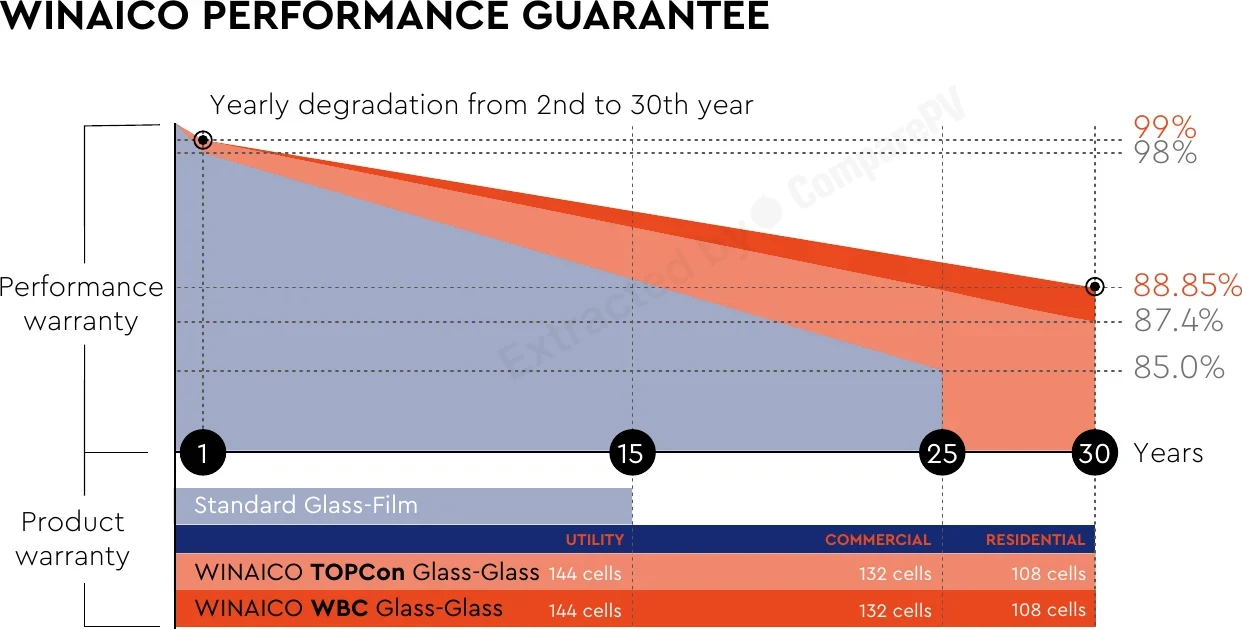
Product warranty 30 years Hardware defects only
Performance warranty 30 years Typical median 30 yrs · median 30 yrs
End-of-warranty output 87.4 % Equals 444 W guaranteed
Degradation 1.00 → 0.35 % First year, then annual

Datasheet charts

Open datasheet PDF

Measured curves published by WINAICO in this model's datasheet. A chart carrying a wattage was measured on that variant alone - only the ones that describe 500 Wp appear here. The rest cover the whole series.
Simulations

Live - change any input
Lifetime output & value
30 years at 1200 kWh/kWp/year and €0.50 per kWh
Power in year 30
-
Lifetime energy
-
Energy value
-
With bifacial gain
-

Degradation from this panel's own datasheet figures. No inverter, soiling or shading losses.

Heat losses
-0.260 %/°C against a segment median of -0.260
-
Bifacial gain
Rear gain over light concrete: -
-

Model: bifaciality × albedo × 0.6 view factor. A first-order estimate, not a yield simulation.

Filter these
Size
Panel Power Eff. Temp. Weight Difference
WINAICO WST-500BKX54-B3 500 W 24.50% -0.260 25.0 kg You are here
LR7-54HJD-510M 510 W 25.00% -0.240 23.5 kg Cooler, lighter, +0.5 pp
AIKO-A495-MCE54Mw 495 W 24.80% -0.260 21.0 kg Lighter, +0.3 pp
LR7-54HJD-505M 505 W 24.70% -0.240 23.5 kg Cooler, lighter
WST-505BKX54-A2 505 W 24.70% -0.260 25.0 kg Very close match
AIKO-A490-MCE54Mw 490 W 24.50% -0.260 21.0 kg -10 W, lighter
LR7-54HJD-500M 500 W 24.50% -0.240 23.5 kg Cooler, lighter
CIPRO-TN9C54M-500W 500 W 24.50% -0.260 21.4 kg Lighter
WST-475BDX54-A2 475 W 23.30% -0.260 25.0 kg -25 W, -1.2 pp
WST-480BDX54-B2 480 W 23.50% -0.260 25.0 kg -20 W, -1.0 pp
WST-485BDX54-A2 485 W 23.80% -0.260 25.0 kg -15 W, -0.7 pp
WST-490BDX54-A2 490 W 24.00% -0.260 25.0 kg -10 W, -0.5 pp
WST-495BKX54-B2 495 W 24.30% -0.260 25.0 kg Very close match

Found 213 panels of the same or similar size to this one, within ±10 mm. See them here Found 217 panels of the same or similar size to this one, within ±25 mm. See them here Found 1735 panels of the same or similar size to this one, within ±50 mm. See them here Found 4051 panels of the same or similar size to this one, within ±100 mm. See them here

About the WST-BKX54-B3 WBC Ultra Black Series series

6 answered

These answers cover the whole series. Where a figure differs, the specification above is this module's own.

What is back contact (WBC) technology in WINAICO WST-BKX54-B3 panels?
Back contact (WBC) is a cell design where all electrodes and busbars are moved to the rear side of the cell. This leaves the front surface completely free of visible metal grids, resulting in a uniform, deep black appearance without the characteristic striping. Removing front-side shading also increases the active cell area exposed to light, which boosts overall conversion efficiency.
Are WBC Ultra Black panels bifacial, and does that translate into real energy gains?
Yes, the series uses N-type monocrystalline bifacial cells, meaning the module also generates energy from light reflected onto its rear side. The actual gain depends on the surface beneath the array, mounting angle, and roof clearance - on bright, reflective surfaces it can add a few extra percent of energy output without increasing the installed area.
What warranty does WINAICO offer on the WST-BKX54-B3 WBC Ultra Black series, and what does it cover?
The manufacturer provides a 30-year product warranty along with a 30-year linear power warranty. This means WINAICO, a Tier 1 manufacturer based in Taiwan, guarantees the module's structural integrity and a defined power output level over three decades, giving investors confidence in the long-term stability of their installation.
Is the glass-glass construction of WBC Ultra Black panels more durable than a standard glass-backsheet module?
Yes, the glass-glass design replaces the rear backsheet with an additional glass layer, significantly improving resistance to microcracks, moisture ingress, and UV-related degradation. This construction is also less prone to laminate yellowing over time and better retains power output, aligning well with the series' 30-year product warranty.
Who is the WINAICO WBC Ultra Black series designed for?
This series targets premium single-family homeowners who want both an elegant roof and facade appearance and maximum energy yield per square meter. The uniform black surface without visible grid lines, paired with an anodized black aluminum frame, blends well with modern architecture without sacrificing performance, with module power reaching up to 500 Wp.
Are WBC Ultra Black panels PFAS-free, and why does that matter to buyers?
Yes, the entire series is manufactured without PFAS, the persistent fluorinated compounds sometimes found in laminating materials and coatings used in earlier solar panel generations. For investors, this means better compliance with tightening environmental regulations in construction and easier qualification for green building certifications or subsidy programs.
Add to compare
