VSUN460N-120BMH-DG-BB

460 Wp TOPCon Bifacial 80%
ComparePV verdict

Middle of its segment, modest efficiency

Rank 7,480 of 14,005
Compare panels Datasheet PDF
Power (Wp)
460
Typical for its class
Efficiency (%)
21.26
Weak · bottom 4%
Density (Wp/m²)
212.6
Weak · bottom 4%
Temp (%/°C)
-0.300
Weak · bottom 20%
Weight (kg)
26.7
Weak · 2.7 kg above median
Warranty (yrs)
30
Typical · median 30 yrs

The VSUN N-120BMH-DG-BB series are N-type TOPCon modules with a bifacial design, specifically engineered to maximize energy yield not only from the front, but also from reflected light off the ground. This means improved performance in locations with bright roofs, gravel, concrete, snow, or carport structures - where traditional panels "lose" potential from the surrounding environment.

The use of double-glass improves weather resistance and long-term stability, which is important for installations designed for long-term operation and predictable results. The TOPCon technology supports low degradation and more stable performance in varying temperatures, allowing the modules to better protect yield in hot weather and under less sunlight.

The entire system is complemented by a black frame, which is a good choice when a consistent look is desired on modern roofs. This series is suitable for homes, commercial buildings, and premium projects where the balance of aesthetics, durability, and bifacial gain is key.

Ranking

1,089 panels in the segment TOPCon 450-500 W
Metric This panel Median Position in segment Overall rank
Module efficiency 21.26% 22.52% Weak · bottom 4% 8,894
Power density 212.6 225.2 Weak · bottom 4% 8,778
Temperature coefficient -0.300 -0.290 Weak · bottom 20% 6,093
Weight per kWp 58.0 52.2 Weak · bottom 5% 11,546
Performance warranty 30 yrs 30 yrs Typical 21
Colour key Strong - top 25% Typical - middle 50% Weak - bottom 25%

Signals from the data

0 positive · 3 caution
Best for

Residential and commercial.

Not ideal for

Tight roof space, roofs where every square metre has to count and weight-limited structures.

Watch-outs
21.26% module efficiency

Bottom 4% of the TOPCon 450-500 W segment, against a median of 22.52%. Ranked 8,894th in the whole database.

212.6 watts per square metre

Bottom 4% of the TOPCon 450-500 W segment, against a median of 225.2. Ranked 8,778th in the whole database.

58.0 kg per kWp

Bottom 5% of the TOPCon 450-500 W segment, against a median of 52.2. Ranked 11,546th in the whole database.

Notes from the database
  • Module efficiency of 21.3% is 1.3pp below average for TOPCon 450-500W panels (median: 22.5%)
  • Power density of 212.6 W/m² is 12.6 W/m² below TOPCon 450-500W median (225.2 W/m²) - needs more roof space
  • At -0.30%/°C, hot weather performance is typical for TOPCon 450-500W panels
  • Weight of 26.7 kg is 2.7 kg above TOPCon 450-500W median (24.0 kg) - verify structural support
  • Bifaciality factor of 80% can add 4-12% extra yield with reflective mounting surface

Specifications

Open datasheet PDF
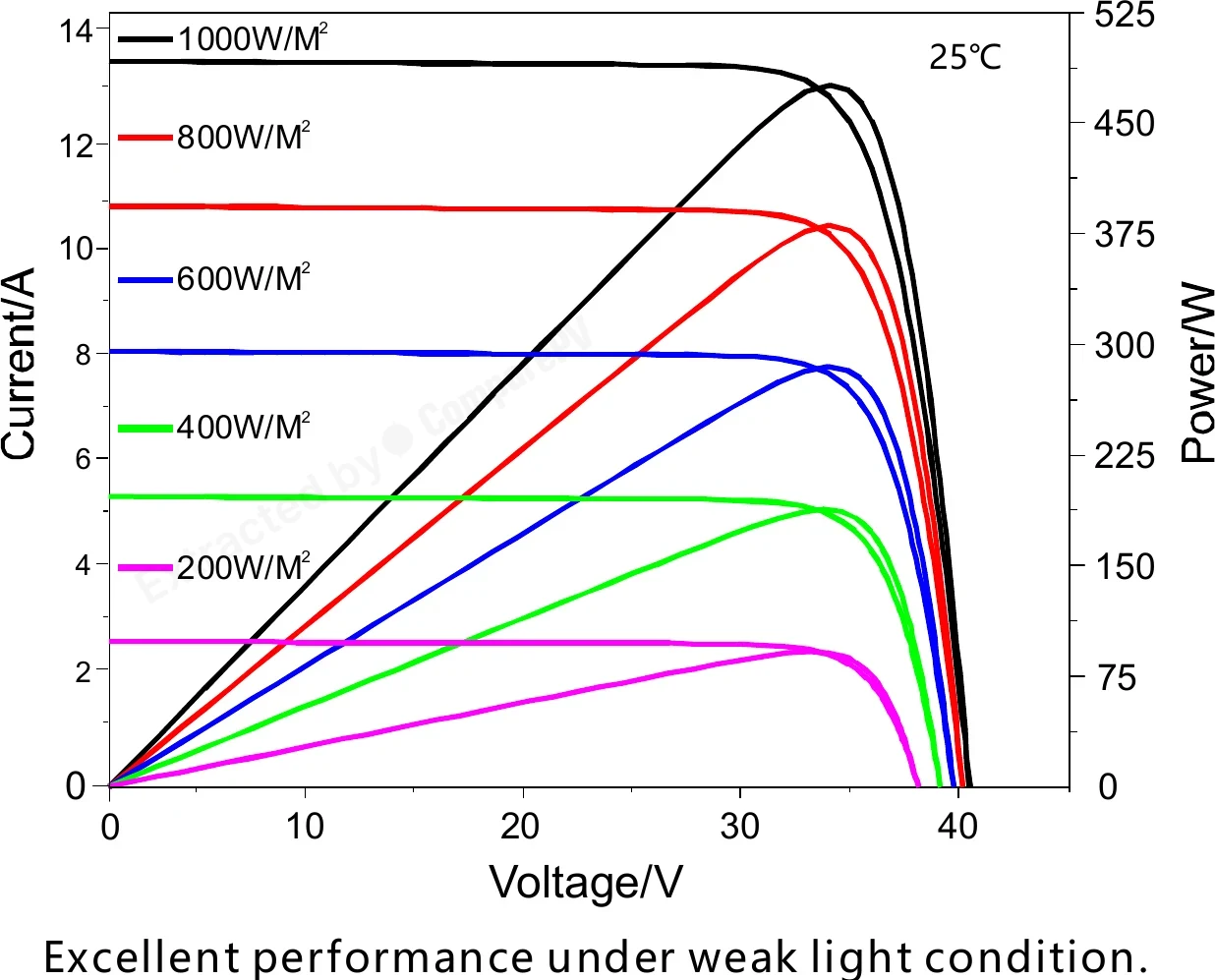
Nominal power (Pmax) 460 Wp Nameplate at 1000 W/m², 25 °C
Module efficiency 21.26 % Weak Segment median 22.52%
Vmpp · Impp 34.76 V · 13.24 A Operating point at max power
Voc · Isc 42.07 V · 13.99 A Sizes the string length
Max system voltage 1500 V Longer strings than 1000 V modules
Dimensions 1908×1134×30 mm · 2.16 m² of roof
Weight 26.7 kg Weak Weak · 2.7 kg above median
Cells 120 · TOPCon Monocrystalline
Bifaciality 80 % Rear output as a share of front
Coefficient Pmax -0.300 %/°C Weak bottom 20% of its segment
Coefficient Voc · Isc -0.260 · 0.046 %/°C
NOCT 45 °C At 800 W/m², 20 °C ambient
Product warranty 25 years Hardware defects only
Performance warranty 30 years Typical median 30 yrs · median 30 yrs
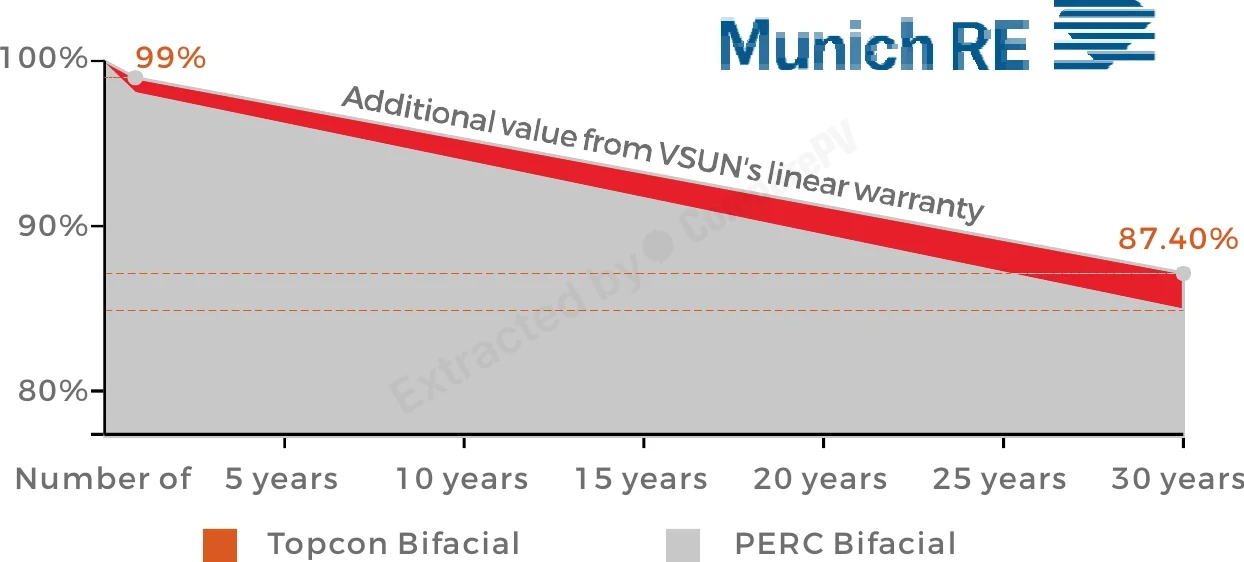
End-of-warranty output 87.4 % Equals 402 W guaranteed
Degradation 1.00 → 0.40 % First year, then annual

Datasheet charts

Open datasheet PDF

Measured curves published by VSUN in this model's datasheet. A chart carrying a wattage was measured on that variant alone - only the ones that describe 460 Wp appear here. The rest cover the whole series.
Simulations

Live - change any input
Lifetime output & value
30 years at 1200 kWh/kWp/year and €0.50 per kWh
Power in year 30
-
Lifetime energy
-
Energy value
-
With bifacial gain
-

Degradation from this panel's own datasheet figures. No inverter, soiling or shading losses.

Heat losses
-0.300 %/°C against a segment median of -0.290
-
Bifacial gain
Rear gain over light concrete: -
-

Model: bifaciality × albedo × 0.6 view factor. A first-order estimate, not a yield simulation.

Filter these
Size
Panel Power Eff. Temp. Weight Difference
VSUN VSUN460N-120BMH-DG-BB 460 W 21.26% -0.300 26.7 kg You are here
LR7-54HJD-510M 510 W 25.00% -0.240 23.5 kg +50 W, cooler, +3.7 pp
AIKO-A495-MCE54Mw 495 W 24.80% -0.260 21.0 kg Cooler, lighter, +3.5 pp
LR7-54HJD-505M 505 W 24.70% -0.240 23.5 kg +45 W, cooler, +3.4 pp
AIKO-A490-MCE54Mw 490 W 24.50% -0.260 21.0 kg Cooler, lighter, +3.2 pp
LR7-54HJD-500M 500 W 24.50% -0.240 23.5 kg +40 W, cooler, +3.2 pp
CIPRO-TN9C54M-500W 500 W 24.50% -0.260 21.4 kg +40 W, lighter, +3.2 pp
VSUN455N-120MH 455 W 21.03% -0.300 23.9 kg Lighter, -0.2 pp
VSUN465N-120BMH-DG-BB 465 W 21.49% -0.300 26.7 kg +0.2 pp
VSUN470N-120MH-BB 470 W 21.72% -0.300 23.9 kg +10 W, lighter, +0.5 pp
LR7-60HVH-560M 560 W 24.80% -0.260 25.0 kg +100 W, cooler, +3.5 pp
LR7-60HVH-555M 555 W 24.60% -0.260 25.0 kg +95 W, cooler, +3.3 pp
LR7-60HVHL-550M 550 W 24.40% -0.260 16.3 kg +90 W, lighter, +3.1 pp
JAT60S40-540/LR 540 W 24.40% -0.260 23.5 kg +80 W, cooler, +3.1 pp
GK-5-60HG-540M 540 W 24.40% -0.260 23.3 kg +80 W, cooler, +3.1 pp
JKM545-54QL6-DV-F1-EU 545 W 24.27% -0.260 27.5 kg +85 W, cooler, +3.0 pp
LR7-60HVH-545M 545 W 24.20% -0.260 25.0 kg +85 W, cooler, +2.9 pp

Found 746 panels of the same or similar size to this one, within ±10 mm. See them here Found 755 panels of the same or similar size to this one, within ±25 mm. See them here Found 910 panels of the same or similar size to this one, within ±50 mm. See them here Found 1489 panels of the same or similar size to this one, within ±100 mm. See them here

Common questions

6 answered
What does TOPCon and bifacial mean for the VSUN N-120BMH-DG-BB panel, and is it worth it?
TOPCon is an N-type cell technology offering lower degradation and better high-temperature performance than standard PERC. Bifacial design lets the panel generate power from the rear side using light reflected off the ground. In the VSUN N-120BMH-DG-BB these traits complement each other - the bifacial gain typically adds several to over ten percent extra yield, especially on bright roofs, gravel, or carport structures, shortening the payback period.
What is the maximum power and efficiency of the VSUN N-120BMH-DG-BB module?
The top variant in this series reaches 475 Wp at roughly 21.95% efficiency, thanks to 120 half-cut N-type TOPCon cells. Dimensions are about 1908x1134x30 mm and weight is around 26.7 kg - this needs to be factored into the mounting structure design, since the glass-glass build is heavier than standard backsheet panels.
Are VSUN N-120BMH-DG-BB panels a good fit for bright roofing or ground-mount installations?
Yes, this is one of the series' main strengths. The bifacial design makes best use of high-albedo surroundings - a bright roof, gravel, concrete, or winter snow all increase the amount of reflected light reaching the rear side of the module. Ground-mount racking and carports, where the panel has open clearance underneath, allow the bifacial gain to be fully realized.
What is the product and power warranty for the VSUN N-120BMH-DG-BB series?
The manufacturer provides a 25-year product warranty and a 30-year linear power warranty, guaranteeing at least 87.4% of rated power at the end of that period. First-year degradation is capped at 0.4%, with roughly 1% cumulative degradation per subsequent year - a standard consistent with modern TOPCon modules and a solid safeguard for a long-term investment.
Does the VSUN N-120BMH-DG-BB perform well on hot days?
Yes, thanks to TOPCon technology the temperature coefficient of power is only around -0.3%/°C, lower than typical PERC panels (usually -0.35% to -0.40%/°C). In practice this means a smaller output drop on hot summer days, when panel temperature on a roof can exceed 50-60°C, which matters for installations on poorly ventilated roof surfaces.
Is VSUN a Tier 1 manufacturer, and does that matter when choosing panels?
VSUN does not currently appear on the BNEF Tier 1 list, despite having a European headquarters. This doesn't imply lower technical quality - the Tier 1 classification mainly reflects financial stability and production scale rather than the panel's own specifications. It's still worth checking warranty service terms and local technical support availability from your distributor, rather than basing the decision on this label alone.
Add to compare