VSUN455N-96BMHR-DG-BB

455 Wp TOPCon Bifacial 80%
ComparePV verdict

Middle of its segment, heavy for its output

Rank 8,660 of 14,005
Compare panels Datasheet PDF
Power (Wp)
455
Typical for its class
Efficiency (%)
22.77
Typical · median 22.52%
Density (Wp/m²)
227.7
Typical · median 225.2
Temp (%/°C)
-0.300
Weak · bottom 20%
Weight (kg)
25.0
Weak · 1.0 kg above median
Warranty (yrs)
30
Typical · median 30 yrs

The VSUN N-96BMHR-DG-BB series features advanced modules based on N-type cells that redefine performance standards in challenging lighting conditions. Thanks to the use of TOPCon technology, these panels offer significantly lower annual degradation and higher energy yields compared to traditional P-type solutions. The Bifacial Dual Glass design allows for the efficient use of light reflected from the ground, which is crucial for installations on flat roofs or ground-mounted structures where every percent of additional power matters for the investment's profitability. The Black-on-Black aesthetics make these modules blend perfectly with modern architecture, eliminating compromises between appearance and functionality. Double tempered glass not only increases fire safety but also ensures exceptional resistance to extreme weather conditions, such as hail or strong winds, protecting the cells from micro-cracks for decades. This solution is dedicated to investors seeking maximum longevity and financial stability for their project. By choosing this series, the user receives a product highly resistant to PID and LID effects, which translates into a safe and stable return on investment over a long-term horizon.

Ranking

1,089 panels in the segment TOPCon 450-500 W
Metric This panel Median Position in segment Overall rank
Module efficiency 22.77% 22.52% Typical 3,073
Power density 227.7 225.2 Typical 2,888
Temperature coefficient -0.300 -0.290 Weak · bottom 20% 6,093
Weight per kWp 54.9 52.2 Weak · bottom 16% 9,326
Performance warranty 30 yrs 30 yrs Typical 21
Colour key Strong - top 25% Typical - middle 50% Weak - bottom 25%

Signals from the data

0 positive · 2 caution
Best for

Residential, commercial and BIPV.

Not ideal for

Weight-limited structures and hot climates.

Watch-outs
54.9 kg per kWp

Bottom 16% of the TOPCon 450-500 W segment, against a median of 52.2.

-0.300 %/°C temperature coefficient

Bottom 20% of the TOPCon 450-500 W segment, against a median of -0.290.

Notes from the database
  • Efficiency of 22.8% matches the TOPCon 450-500W median
  • Power density of 227.7 W/m² matches the TOPCon 450-500W median
  • At -0.30%/°C, hot weather performance is typical for TOPCon 450-500W panels
  • Weight of 25.0 kg is typical for TOPCon 450-500W panels
  • Bifaciality factor of 80% can add 4-12% extra yield with reflective mounting surface

Specifications

Open datasheet PDF
Nominal power (Pmax) 455 Wp Nameplate at 1000 W/m², 25 °C
Module efficiency 22.77 % Typical Segment median 22.52%
Vmpp · Impp 30.26 V · 15.04 A Operating point at max power
Voc · Isc 35.31 V · 16.10 A Sizes the string length
Max system voltage 1500 V Longer strings than 1000 V modules
Dimensions 1762×1134×30 mm · 2.00 m² of roof
Weight 25.0 kg Weak Weak · 1.0 kg above median
Cells 96 · TOPCon Monocrystalline
Bifaciality 80 % Rear output as a share of front
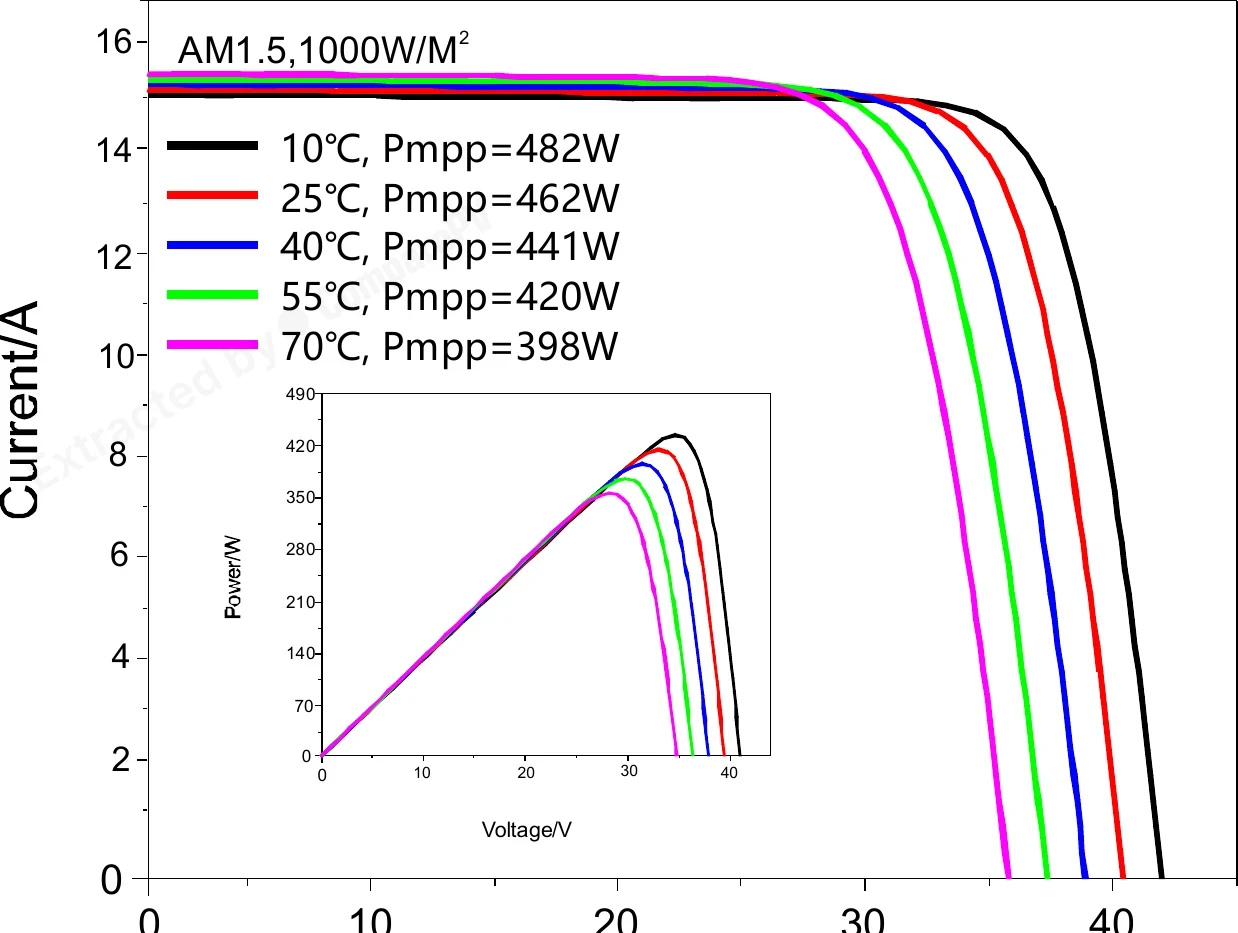
Coefficient Pmax -0.300 %/°C Weak bottom 20% of its segment
Coefficient Voc · Isc -0.250 · 0.046 %/°C
NOCT 45 °C At 800 W/m², 20 °C ambient
Product warranty 12 years Hardware defects only
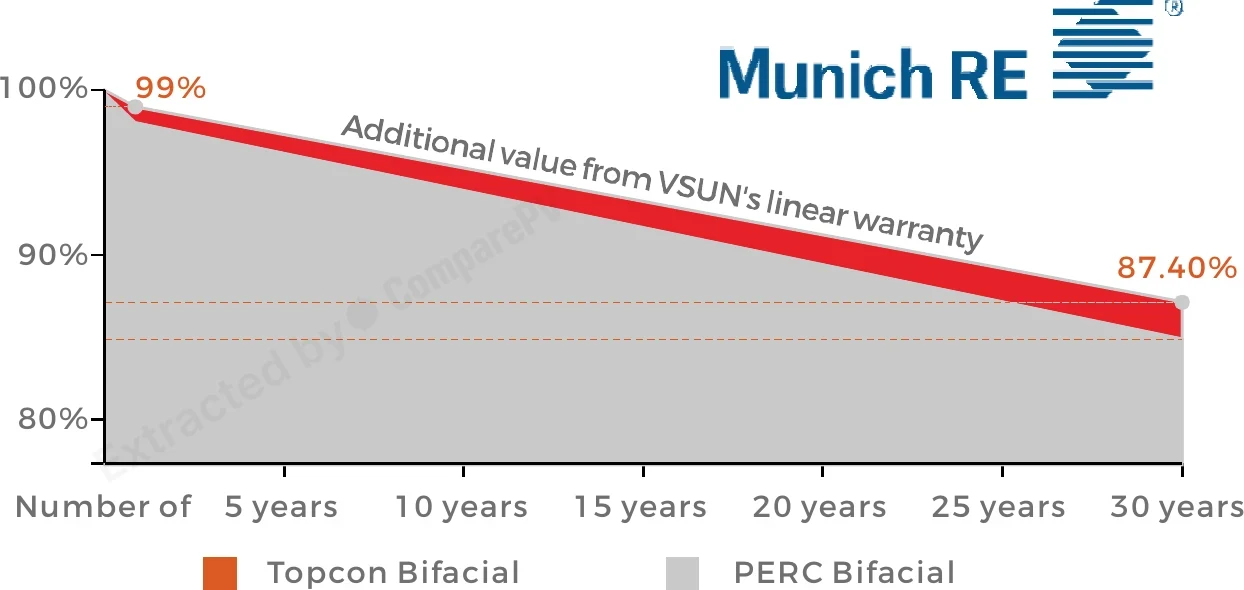
Performance warranty 30 years Typical median 30 yrs · median 30 yrs
End-of-warranty output 87.4 % Equals 398 W guaranteed
Degradation 1.00 → 0.40 % First year, then annual

Datasheet charts

Open datasheet PDF

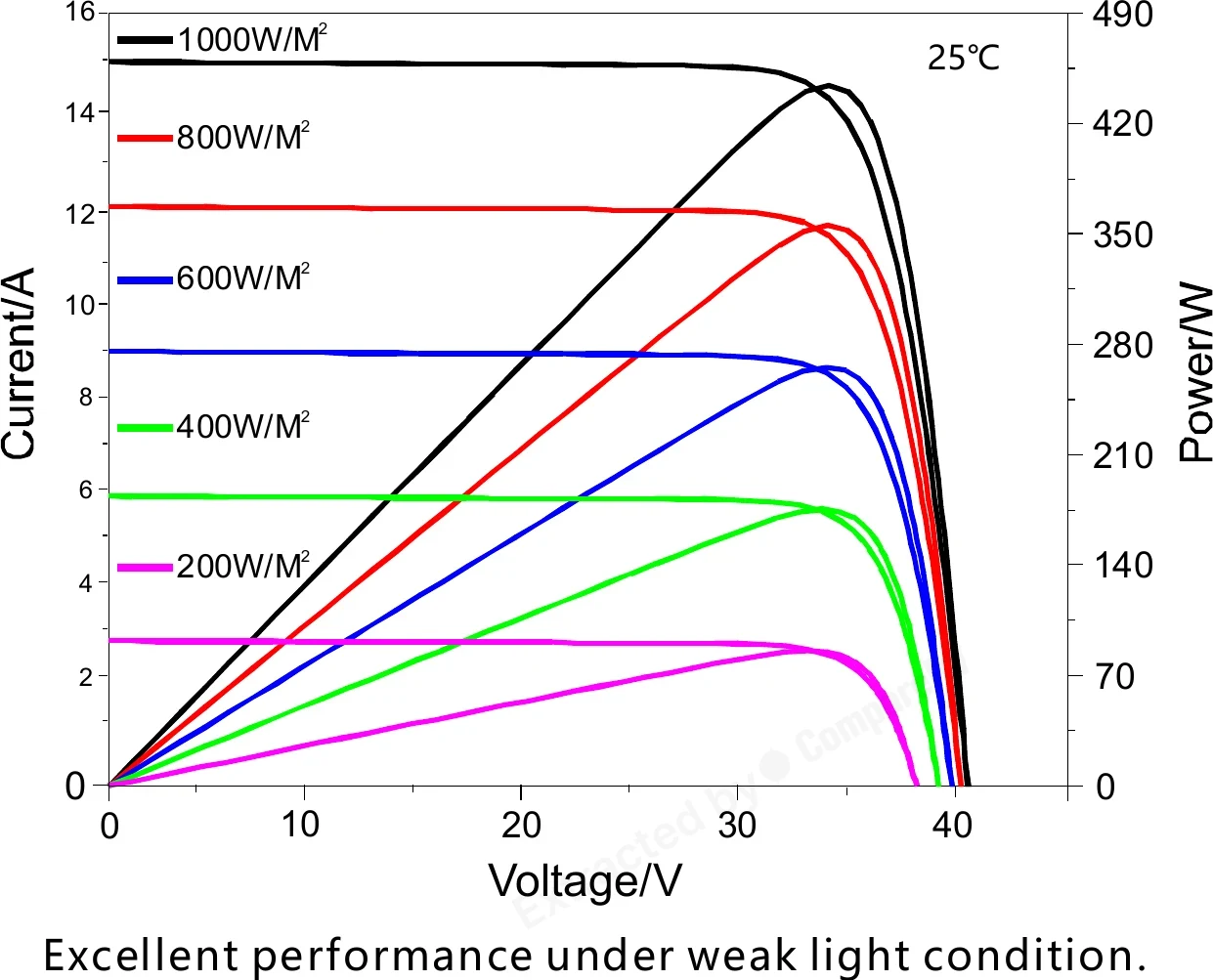
Measured curves published by VSUN in this model's datasheet. A chart carrying a wattage was measured on that variant alone - only the ones that describe 455 Wp appear here. The rest cover the whole series.
Simulations

Live - change any input
Lifetime output & value
30 years at 1200 kWh/kWp/year and €0.50 per kWh
Power in year 30
-
Lifetime energy
-
Energy value
-
With bifacial gain
-

Degradation from this panel's own datasheet figures. No inverter, soiling or shading losses.

Heat losses
-0.300 %/°C against a segment median of -0.290
-
Bifacial gain
Rear gain over light concrete: -
-

Model: bifaciality × albedo × 0.6 view factor. A first-order estimate, not a yield simulation.

Filter these
Size
Panel Power Eff. Temp. Weight Difference
VSUN VSUN455N-96BMHR-DG-BB 455 W 22.77% -0.300 25.0 kg You are here
AIKO-A495-MCE54Mw 495 W 24.80% -0.260 21.0 kg +40 W, lighter, +2.0 pp
LR7-54HJD-505M 505 W 24.70% -0.240 23.5 kg +50 W, cooler, +1.9 pp
AIKO-A490-MCE54Mw 490 W 24.50% -0.260 21.0 kg Cooler, lighter, +1.7 pp
LR7-54HJD-500M 500 W 24.50% -0.240 23.5 kg +45 W, cooler, +1.7 pp
CIPRO-TN9C54M-500W 500 W 24.50% -0.260 21.4 kg +45 W, cooler, +1.7 pp
GK-3-54HGb-500M 500 W 24.50% -0.260 21.4 kg +45 W, cooler, +1.7 pp
VSUN435N-96BMHR-DG-BB 435 W 21.77% -0.300 25.0 kg -20 W, -1.0 pp
VSUN440N-96BMHR-DG-BB 440 W 22.02% -0.300 25.0 kg -15 W, -0.8 pp
VSUN445N-96BMHR-DG-BB 445 W 22.27% -0.300 25.0 kg -10 W, -0.5 pp
VSUN450N-96BMHR-DG-BB 450 W 22.52% -0.300 25.0 kg -0.2 pp
VSUN460N-96BMHR-DG-BB 460 W 23.02% -0.300 25.0 kg +0.2 pp
LR7-54HJD-510M 510 W 25.00% -0.240 23.5 kg +55 W, cooler, +2.2 pp

Found 1395 panels of the same or similar size to this one, within ±10 mm. See them here Found 1425 panels of the same or similar size to this one, within ±25 mm. See them here Found 3614 panels of the same or similar size to this one, within ±50 mm. See them here Found 3962 panels of the same or similar size to this one, within ±100 mm. See them here

Common questions

6 answered
What is the maximum power and efficiency of the VSUN N-96BMHR-DG-BB panel?
The VSUN N-96BMHR-DG-BB series reaches up to 460 Wp with a module efficiency of around 23%. This is achieved through N-type TOPCon cells combined with multi-busbar (MBB) circular ribbon technology, which improves current collection and reduces resistive losses. For installations with limited roof space, this means higher total output than comparable P-type panels of similar dimensions.
Is the bifacial VSUN N-96BMHR-DG-BB suitable for flat roofs or ground-mount installations?
Yes, the Bifacial Dual Glass design of this series was built specifically for these applications. The rear side of the cells captures light reflected from bright surfaces, white gravel, or membrane roofing, which under good albedo conditions can add several percent to double-digit annual energy gains. This requires adequate mounting height and clearance beneath the module, so the best results come from ground-mount racks, carports, or east-west flat-roof systems.
What warranty comes with the VSUN N-96BMHR-DG-BB panels?
The manufacturer provides a 12-year product warranty against material and workmanship defects, plus a 30-year linear power output warranty ensuring strong energy production throughout that period. Thanks to TOPCon technology, annual degradation is lower than in P-type panels, resulting in higher real-world energy yield toward the end of the warranty period and more stable returns for commercial and ground-mount projects.
How does the TOPCon technology in the VSUN N-96BMHR-DG-BB differ from traditional PERC cells?
N-type TOPCon cells have an additional tunnel oxide passivation layer on the rear side, which reduces carrier recombination and increases efficiency compared to P-type PERC cells. In practice this means lower annual degradation, reduced sensitivity to PID and LID effects, and better performance at high temperatures and in low-light conditions. For an investor, this translates into higher yearly energy yield, especially on overcast days or at low sun angles.
Do the VSUN N-96BMHR-DG-BB panels perform well in high summer temperatures?
Yes, this series has a favorable power temperature coefficient of around -0.30%/°C, better than many P-type panels which show steeper losses. This means a smaller power drop as the module heats up on hot days, which matters for roofs with poor ventilation or in high-irradiance regions where panel surface temperatures can exceed 60°C.
Does the double tempered glass and Black-on-Black frame on the VSUN N-96BMHR-DG-BB reduce panel performance?
No, the Black-on-Black aesthetic results from a black rear glass and frame, not a change in cell technology, so electrical parameters are unaffected. Additionally, the double tempered glass (front and rear) increases mechanical resistance to hail and strong wind and improves fire safety class compared to standard backsheet panels. This combines a modern appearance with long-term structural durability, useful for visible facades or residential roofs.
Add to compare