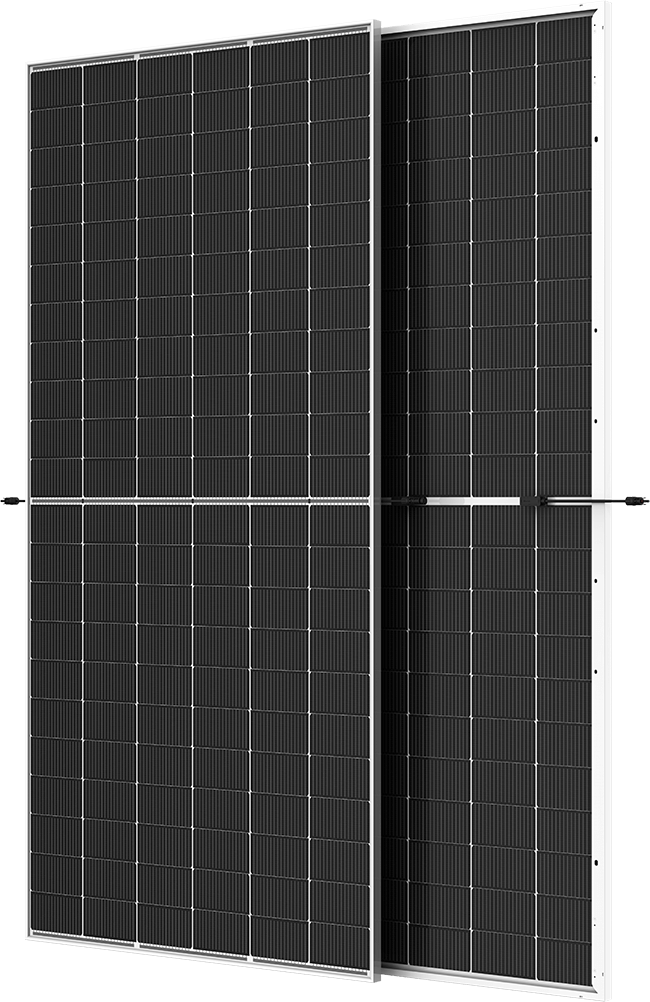
Trina Solar TSM-DEG18MC.20(II)-480

TSM-DEG18MC.20(II)-480

480 Wp PERC Bifacial 70%
ComparePV verdict

Strong in heat, heavy for its output

Rank 10,567 of 14,005
Compare panels Datasheet PDF
Power (Wp)
480
Typical for its class
Efficiency (%)
19.90
Weak · bottom 2%
Density (Wp/m²)
199.2
Weak · bottom 3%
Temp (%/°C)
-0.340
Strong · top 19%
Weight (kg)
30.1
Weak · 5.6 kg above median
Warranty (yrs)
30
Strong · top 20%

The Trina Solar Vertex series, in the bifacial dual glass version, was designed to genuinely increase energy yield not only from the front side but also from the rear side of the module - which is significant wherever the substrate reflects light (bright roof, gravel, concrete, membrane). The use of two glass sheets instead of the classic backsheet improves resistance to moisture and harsh environmental conditions, while also increasing long-term operational stability.

At the level of cell technology, it stands out with a modern monocrystalline architecture featuring multi-busbar solutions and a half-cut cell string design - this reduces resistive losses and helps maintain high production even under partial shading or weaker insolation. In practice, users get more energy from the same surface area, and installers have an easier product to design for newer inverters and optimizers.

This is an excellent proposition for PV farms, commercial installations, and rooftops, where a higher yield from bifaciality and the durability of the glass-glass construction matter.

Ranking

449 panels in the segment PERC 450-500 W
Metric This panel Median Position in segment Overall rank
Module efficiency 19.90% 20.82% Weak · bottom 2% 12,331
Power density 199.2 208.5 Weak · bottom 3% 12,320
Temperature coefficient -0.340 -0.350 Strong · top 19% 8,778
Weight per kWp 62.7 53.1 Weak · bottom 1% 12,808
Performance warranty 30 yrs 25 yrs Strong · top 20% 21
Colour key Strong - top 25% Typical - middle 50% Weak - bottom 25%

Signals from the data

2 positive · 3 caution
Best for

Commercial and shaded-installations.

Not ideal for

Weight-limited structures, tight roof space and roofs where every square metre has to count.

Strengths
-0.340 %/°C temperature coefficient

Top 19% of the PERC 450-500 W segment, against a median of -0.350.

30 year performance warranty

Top 20% of the PERC 450-500 W segment, against a median of 25 yrs.

Watch-outs
62.7 kg per kWp

Bottom 1% of the PERC 450-500 W segment, against a median of 53.1. Ranked 12,808th in the whole database.

19.90% module efficiency

Bottom 2% of the PERC 450-500 W segment, against a median of 20.82%. Ranked 12,331st in the whole database.

199.2 watts per square metre

Bottom 3% of the PERC 450-500 W segment, against a median of 208.5. Ranked 12,320th in the whole database.

Notes from the database
  • At 19.9% efficiency, this panel is 0.9pp below the PERC 450-500W median of 20.8%
  • 199.2 W/m² power density is 9.3 W/m² below PERC 450-500W median (208.5 W/m²) - requires larger installation area
  • At -0.34%/°C, hot weather performance is typical for PERC 450-500W panels
  • At 30.1 kg (5.6 kg above PERC 450-500W median of 24.5 kg), requires checking roof load capacity
  • Bifacial design (70% factor) captures reflected light - adds 4-10% yield on ground-mount or white roof

Specifications

Open datasheet PDF
Nominal power (Pmax) 480 Wp Nameplate at 1000 W/m², 25 °C
Module efficiency 19.90 % Weak Segment median 20.82%
Vmpp · Impp 42.20 V · 11.38 A Operating point at max power
Voc · Isc 50.70 V · 11.97 A Sizes the string length
Max system voltage 1500 V Longer strings than 1000 V modules
Dimensions 2187×1102×35 mm · 2.41 m² of roof
Weight 30.1 kg Weak Weak · 5.6 kg above median
Cells 150 · PERC Monocrystalline
Bifaciality 70 % Rear output as a share of front
Coefficient Pmax -0.340 %/°C Strong top 19% of its segment
Coefficient Voc · Isc -0.250 · 0.040 %/°C
NOCT 43 °C At 800 W/m², 20 °C ambient
Product warranty 12 years Hardware defects only
Performance warranty 30 years Strong top 20% · median 25 yrs
End-of-warranty output 85.0 % Equals 408 W guaranteed
Degradation 2.00 → 0.45 % First year, then annual

Simulations

Live - change any input
Lifetime output & value
30 years at 1200 kWh/kWp/year and €0.50 per kWh
Power in year 30
-
Lifetime energy
-
Energy value
-
With bifacial gain
-

Degradation from this panel's own datasheet figures. No inverter, soiling or shading losses.

Heat losses
-0.340 %/°C against a segment median of -0.350
-
Bifacial gain
Rear gain over light concrete: -
-

Model: bifaciality × albedo × 0.6 view factor. A first-order estimate, not a yield simulation.

Filter these
Size
Panel Power Eff. Temp. Weight Difference
Trina Solar TSM-DEG18MC.20(II)-480 480 W 19.90% -0.340 30.1 kg You are here
LR7-54HJD-510M 510 W 25.00% -0.240 23.5 kg Cooler, lighter, +5.1 pp
AIKO-A495-MCE54Mw 495 W 24.80% -0.260 21.0 kg Cooler, lighter, +4.9 pp
LR7-54HJD-505M 505 W 24.70% -0.240 23.5 kg Cooler, lighter, +4.8 pp
AIKO-A490-MCE54Mw 490 W 24.50% -0.260 21.0 kg Cooler, lighter, +4.6 pp
LR7-54HJD-500M 500 W 24.50% -0.240 23.5 kg Cooler, lighter, +4.6 pp
CIPRO-TN9C54M-500W 500 W 24.50% -0.260 21.4 kg Cooler, lighter, +4.6 pp
TSM-DE18M(II)-485 485 W 20.10% -0.340 26.3 kg Lighter, +0.2 pp, -5 yr warranty
TSM-DE18M(II)-490 490 W 20.30% -0.340 26.3 kg Lighter, +0.4 pp, -5 yr warranty
TSM-DEG18MC.20(II)-495 495 W 20.50% -0.340 30.1 kg +15 W, +0.6 pp
AIKO-A650-MAE72Mw 650 W 25.20% -0.260 27.0 kg +170 W, cooler, +5.3 pp
AIKO-A645-MAE72Mw 645 W 25.00% -0.260 27.0 kg +165 W, cooler, +5.1 pp
AIKO-A640-MAE72Mw 640 W 24.80% -0.260 27.0 kg +160 W, cooler, +4.9 pp
AIKO-A635-MAE72Mw 635 W 24.60% -0.260 27.0 kg +155 W, cooler, +4.7 pp
AIKO-A630-MAH72Dw 630 W 24.40% -0.260 32.5 kg +150 W, cooler, +4.5 pp

Found 41 panels of the same or similar size to this one, within ±10 mm. See them here Found 49 panels of the same or similar size to this one, within ±25 mm. See them here Found 119 panels of the same or similar size to this one, within ±50 mm. See them here Found 3244 panels of the same or similar size to this one, within ±100 mm. See them here

Common questions

6 answered
How much extra energy can a 505 Wp Trina Solar Vertex bifacial panel generate compared to a standard monofacial module?
In addition to the standard front-side yield of 505 Wp, the bifacial design captures light reflected onto the rear side of the module. Depending on the ground albedo - a light-colored roof, gravel, white membrane, or concrete - the additional annual energy gain can range from a few percent up to double digits compared to a monofacial panel of the same nominal power.
What is the difference between a dual glass construction and a classic backsheet panel?
In the dual glass version, the rear polymer backsheet is replaced with a second tempered glass sheet. This construction better protects the cells against moisture, microcracks, and PID degradation, resulting in longer and more stable module performance. Glass on both sides also enables the bifacial effect, allowing the module to generate power from its rear side as well.
What warranty comes with the Trina Solar Vertex bifacial dual glass series?
The manufacturer provides a 12-year product warranty covering material and workmanship defects, along with a 30-year linear power output warranty. This means that after 30 years of operation, the module should still deliver the power output level guaranteed by Trina Solar, which is an important factor when calculating the long-term return on investment of a PV installation.
Is the Trina Vertex series suitable for roofs or ground-mounted sites with light-colored surfaces, such as gravel or white membrane?
Yes, this is actually an ideal environment for this series. Light surfaces such as gravel, concrete, white roof membrane, or snow reflect a large amount of sunlight onto the active rear side of the bifacial panel. The higher the albedo of the surface beneath the installation, the greater the additional rear-side energy gain compared to a standard installation on a dark roof.
What do PERC and half-cut technology mean for Vertex panels, and how do they affect performance?
PERC is a cell technology featuring an additional rear passivation layer that improves light absorption and conversion efficiency. Half-cut cell technology combined with a multi-busbar layout reduces resistive losses and improves resilience to partial shading, such as from a chimney or leaves, so that shading on one section of the panel has a smaller impact on total module output.
Is Trina Solar a reliable manufacturer, and is it worth choosing its panels for a large commercial installation or a solar farm?
Trina Solar is a Chinese Tier 1 manufacturer, meaning it has a solid financial standing and long-standing experience in large-scale module production, which makes bank financing easier and reduces the risk of warranty servicing issues. The Vertex bifacial dual glass series is particularly popular for solar farms and commercial installations, where high yield per surface area and glass-glass durability matter most.
Add to compare