Trina Solar TSM-NEG18R.28-490

TSM-NEG18R.28-490

490 Wp TOPCon
ComparePV verdict

Middle of its segment, modest efficiency

Rank 7,493 of 14,005
Compare panels Datasheet PDF
Power (Wp)
490
Strong · top 12%
Efficiency (%)
22.00
Weak · bottom 18%
Density (Wp/m²)
220.3
Weak · bottom 19%
Temp (%/°C)
-0.290
Typical · median -0.290
Weight (kg)
23.5
Typical · median 24.0 kg
Warranty (yrs)
30
Typical · median 30 yrs

The Trina Solar Vertex S+ TSM-NEG18R.28 (485-510W) series was designed as a mid-size module with the so-called "golden size" - specifically to facilitate rooftop installation while maximizing energy yield from the available surface area. Its key advantage lies in the combination of N-type cells in i-TOPCon technology with glass-glass construction, which practically means more stable long-term performance and reduced susceptibility to typical operational issues, such as micro-cracking or accelerated degradation in challenging environments.

For commercial projects, it’s not just the power output that matters, but also the overall system cost - which is why the Vertex S+ supports LCOE optimization and BOS cost reduction through its thoughtful dimensions and compatibility with popular mounting solutions. This series is designed for investors and installers who want more energy per square meter without compromising on reliability. It is also distinguished by low degradation and long warranties, translating into predictable returns from installations over the long term.

Ranking

1,089 panels in the segment TOPCon 450-500 W
Metric This panel Median Position in segment Overall rank
Module efficiency 22.00% 22.52% Weak · bottom 18% 6,517
Power density 220.3 225.2 Weak · bottom 19% 6,276
Temperature coefficient -0.290 -0.290 Typical 2,165
Weight per kWp 48.0 52.2 Typical 1,984
Performance warranty 30 yrs 30 yrs Typical 21
Colour key Strong - top 25% Typical - middle 50% Weak - bottom 25%

Signals from the data

0 positive · 2 caution
Best for

Residential, commercial, cold-climate, hot-climate and shaded-installations.

Not ideal for

Tight roof space and roofs where every square metre has to count.

Watch-outs
22.00% module efficiency

Bottom 18% of the TOPCon 450-500 W segment, against a median of 22.52%.

220.3 watts per square metre

Bottom 19% of the TOPCon 450-500 W segment, against a median of 225.2.

Notes from the database
  • Efficiency of 22.0% is 0.5pp below the TOPCon 450-500W median (22.5%)
  • At 220.3 W/m², this panel generates 4.8 W/m² less per unit area than TOPCon 450-500W median (225.2 W/m²)
  • Temperature coefficient of -0.29%/°C matches the TOPCon 450-500W median
  • #6517 for efficiency, #2165 for temperature performance out of 14005 panels

Specifications

Open datasheet PDF
Nominal power (Pmax) 490 Wp Nameplate at 1000 W/m², 25 °C
Module efficiency 22.00 % Weak Segment median 22.52%
Vmpp · Impp 32.90 V · 14.91 A Operating point at max power
Voc · Isc 39.60 V · 15.80 A Sizes the string length
Max system voltage 1500 V Longer strings than 1000 V modules
Dimensions 1961×1134×30 mm · 2.22 m² of roof
Weight 23.5 kg Typical Typical · median 24.0 kg
Cells 108 · TOPCon Monocrystalline
Coefficient Pmax -0.290 %/°C Typical median -0.290 of its segment
Coefficient Voc · Isc -0.240 · 0.040 %/°C
NOCT 43 °C At 800 W/m², 20 °C ambient
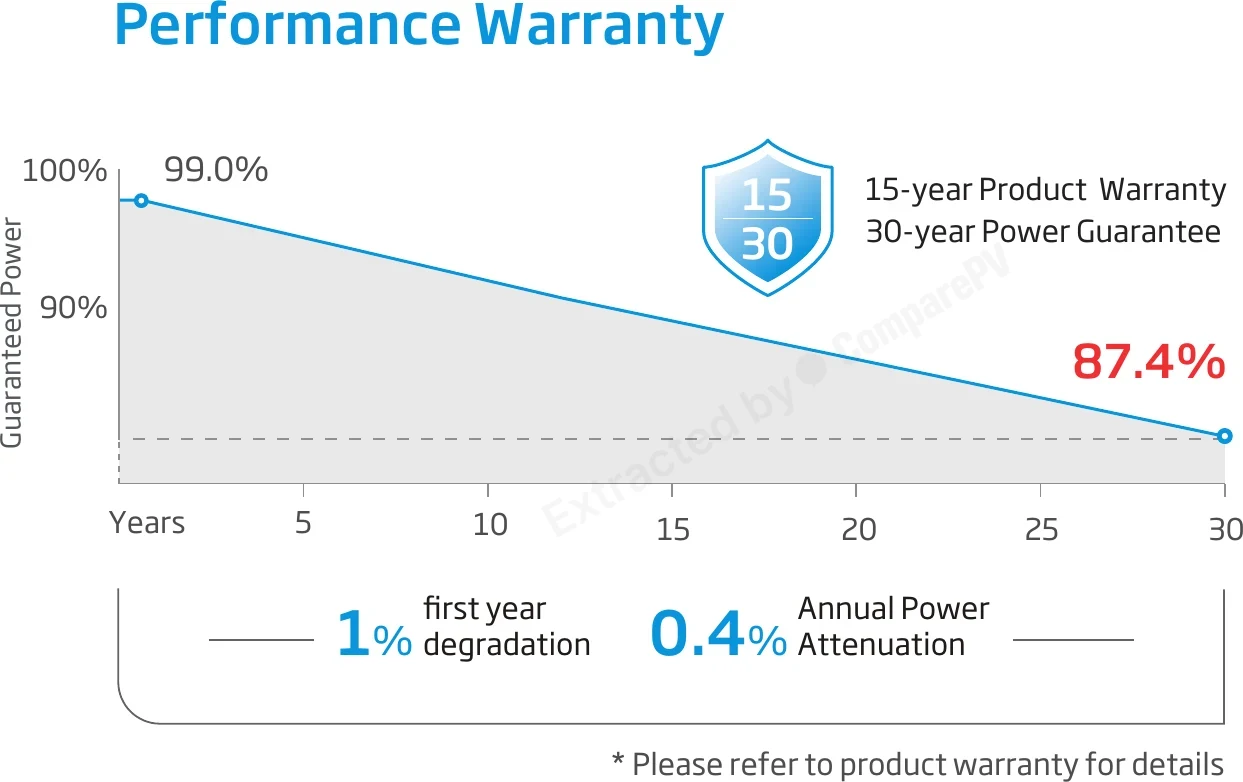
Product warranty 15 years Hardware defects only
Performance warranty 30 years Typical median 30 yrs · median 30 yrs
End-of-warranty output 87.4 % Equals 428 W guaranteed
Degradation 1.00 → 0.40 % First year, then annual

Datasheet charts

Open datasheet PDF

Measured curves published by Trina Solar in this model's datasheet. A chart carrying a wattage was measured on that variant alone - only the ones that describe 490 Wp appear here. The rest cover the whole series.
Simulations

Live - change any input
Lifetime output & value
30 years at 1200 kWh/kWp/year and €0.50 per kWh
Power in year 30
-
Lifetime energy
-
Energy value
-

Degradation from this panel's own datasheet figures. No inverter, soiling or shading losses.

Heat losses
-0.290 %/°C against a segment median of -0.290
-
Filter these
Size
Panel Power Eff. Temp. Weight Difference
Trina Solar TSM-NEG18R.28-490 490 W 22.00% -0.290 23.5 kg You are here
LR7-54HJD-510M 510 W 25.00% -0.240 23.5 kg +20 W, cooler, +3.0 pp
AIKO-A495-MCE54Mw 495 W 24.80% -0.260 21.0 kg Cooler, lighter, +2.8 pp
LR7-54HJD-505M 505 W 24.70% -0.240 23.5 kg +15 W, cooler, +2.7 pp
AIKO-A490-MCE54Mw 490 W 24.50% -0.260 21.0 kg Cooler, lighter, +2.5 pp
LR7-54HJD-500M 500 W 24.50% -0.240 23.5 kg +10 W, cooler, +2.5 pp
CIPRO-TN9C54M-500W 500 W 24.50% -0.260 21.4 kg Cooler, lighter, +2.5 pp
TSM-NEG18R.28-475 475 W 21.40% -0.290 23.5 kg -15 W, -0.6 pp
TSM-NEG18R.28-480 480 W 21.60% -0.290 23.5 kg -10 W, -0.4 pp
TSM-NEG18R.25-485 485 W 21.80% -0.290 23.5 kg Very close match
LR7-60HVH-560M 560 W 24.80% -0.260 25.0 kg +70 W, cooler, +2.8 pp
LR7-60HVH-555M 555 W 24.60% -0.260 25.0 kg +65 W, cooler, +2.6 pp
LR7-60HVHL-550M 550 W 24.40% -0.260 16.3 kg +60 W, lighter, +2.4 pp
JAT60S40-540/LR 540 W 24.40% -0.260 23.5 kg +50 W, cooler, +2.4 pp
GK-5-60HG-540M 540 W 24.40% -0.260 23.3 kg +50 W, cooler, +2.4 pp
JKM545-54QL6-DV-F1-EU 545 W 24.27% -0.260 27.5 kg +55 W, heavier, +2.3 pp
LR7-60HVH-545M 545 W 24.20% -0.260 25.0 kg +55 W, cooler, +2.2 pp

Found 471 panels of the same or similar size to this one, within ±10 mm. See them here Found 508 panels of the same or similar size to this one, within ±25 mm. See them here Found 662 panels of the same or similar size to this one, within ±50 mm. See them here Found 1471 panels of the same or similar size to this one, within ±100 mm. See them here

Common questions

6 answered
What is i-TOPCon technology used in Trina Vertex S+ TSM-NEG18R.28 panels and how does it differ from PERC?
i-TOPCon is an N-type cell technology featuring an additional passivation layer that reduces carrier recombination, resulting in higher cell efficiency and a lower temperature coefficient (approx. -0.29%/°C) compared to conventional P-type PERC cells. In practice, this means higher energy yield, especially in summer, and slower power degradation over the system's lifetime.
Are Trina Vertex S+ TSM-NEG18R.28 panels bifacial?
No, the TSM-NEG18R.28 series is a monofacial module despite its glass-glass construction. The manufacturer chose this configuration to optimize cost and weight while maintaining high mechanical durability. If you're looking for extra yield from reflected light off the ground surface, check Trina Solar's bifacial Vertex variants instead.
What warranty comes with Trina Solar Vertex S+ TSM-NEG18R.28 panels?
The manufacturer provides a 15-year product warranty covering material and workmanship defects, plus a 30-year linear power output warranty. This means the panel is expected to retain a substantial share of its rated performance after 30 years of operation, supporting predictable, long-term returns on your PV system investment.
How does glass-glass construction differ from a standard panel with a polymer backsheet, and why does it matter?
In a glass-glass module, cells are laminated between two glass layers instead of glass and a polymer backsheet. This design offers better protection against moisture, microcracks, and mechanical damage, reducing degradation risk in harsh climates. As a result, Trina Vertex S+ maintains more stable performance throughout its warranty period, though the panel is somewhat heavier than backsheet versions.
Are Trina Vertex S+ TSM-NEG18R.28 panels suitable for a residential pitched roof?
Yes, the mid-size 1961×1134 mm format was designed as a so-called golden size, balancing high yield with easy installation on typical pitched roofs. The panel dimensions align well with standard rafter spacing and commonly available mounting systems, allowing installers to make efficient use of roof area without needing custom racking.
What is the maximum power output in the Vertex S+ TSM-NEG18R.28 series, and what drives the 485-510W variation?
The series is offered in power classes ranging from 485 to 510 Wp, with differences stemming from natural manufacturing variance in i-TOPCon cell efficiency and post-production module binning. Choosing a higher-wattage class yields more energy from the same roof area, which matters most in commercial and industrial projects where mounting space is limited.
Add to compare