
TS-BG72(550)

550 Wp PERC Bifacial 70%
ComparePV verdict

Strong in heat, heavy for its output

Rank 6,356 of 14,005
Compare panels Datasheet PDF
Power (Wp)
550
Weak · bottom 15%
Efficiency (%)
21.29
Typical · median 21.29%
Density (Wp/m²)
212.9
Typical · median 212.9
Temp (%/°C)
-0.330
Strong · top 7%
Weight (kg)
32.3
Weak · 1.5 kg above median
Warranty (yrs)
30
Strong · top 25%

The Sunova TS-BG72 series consists of double-sided glass-glass modules, designed to maximize energy yield in installations where every square meter counts. The use of bifacial PERC technology allows for efficient utilization of reflected light from the ground, which will be particularly appreciated by investors installing panels on bright roofs, ground-mounted structures, or in PV farms.

Compared to many competing solutions, the double-glass construction enhances resistance to environmental factors and reduces the risk of degradation over time. Another advantage is the half-cut architecture, which improves module performance under partial shading and reduces losses due to internal resistance.

In practice, the TS-BG72 solves common design challenges, combining high power density with durability and stable energy yield, making it suitable for C&I installations, large roofs, and ground-mounted projects. The choice of this series is also supported by proven reliability in Kiwa PVEL tests, which is crucial for installations aimed at long-term returns on investment.

Ranking

589 panels in the segment PERC 550-600 W
Metric This panel Median Position in segment Overall rank
Module efficiency 21.29% 21.29% Typical 8,708
Power density 212.9 212.9 Typical 8,497
Temperature coefficient -0.330 -0.350 Strong · top 7% 8,545
Weight per kWp 58.7 52.7 Weak · bottom 19% 11,864
Performance warranty 30 yrs 27 yrs Strong · top 25% 21
Colour key Strong - top 25% Typical - middle 50% Weak - bottom 25%

Signals from the data

2 positive · 1 caution
Best for

Commercial, utility-scale and shaded-installations.

Not ideal for

Weight-limited structures.

Strengths
-0.330 %/°C temperature coefficient

Top 7% of the PERC 550-600 W segment, against a median of -0.350. Ranked 8,545th in the whole database.

30 year performance warranty

Top 25% of the PERC 550-600 W segment, against a median of 27 yrs.

Watch-outs
58.7 kg per kWp

Bottom 19% of the PERC 550-600 W segment, against a median of 52.7.

Notes from the database
  • Efficiency of 21.3% matches the PERC 550-600W median
  • Power density of 212.9 W/m² matches the PERC 550-600W median
  • At -0.33%/°C, hot weather performance is typical for PERC 550-600W panels
  • Weight of 32.3 kg is 1.5 kg above PERC 550-600W median (30.8 kg) - verify structural support
  • 70% bifaciality enables rear-side power generation, boosting yield by 4-10% on reflective surfaces

Specifications

Open datasheet PDF
Nominal power (Pmax) 550 Wp Nameplate at 1000 W/m², 25 °C
Module efficiency 21.29 % Typical Segment median 21.29%
Vmpp · Impp 40.83 V · 13.48 A Operating point at max power
Voc · Isc 49.60 V · 14.04 A Sizes the string length
Max system voltage 1500 V Longer strings than 1000 V modules
Dimensions 2278×1134×35 mm · 2.58 m² of roof
Weight 32.3 kg Weak Weak · 1.5 kg above median
Cells 144 · PERC Monocrystalline
Bifaciality 70 % Rear output as a share of front
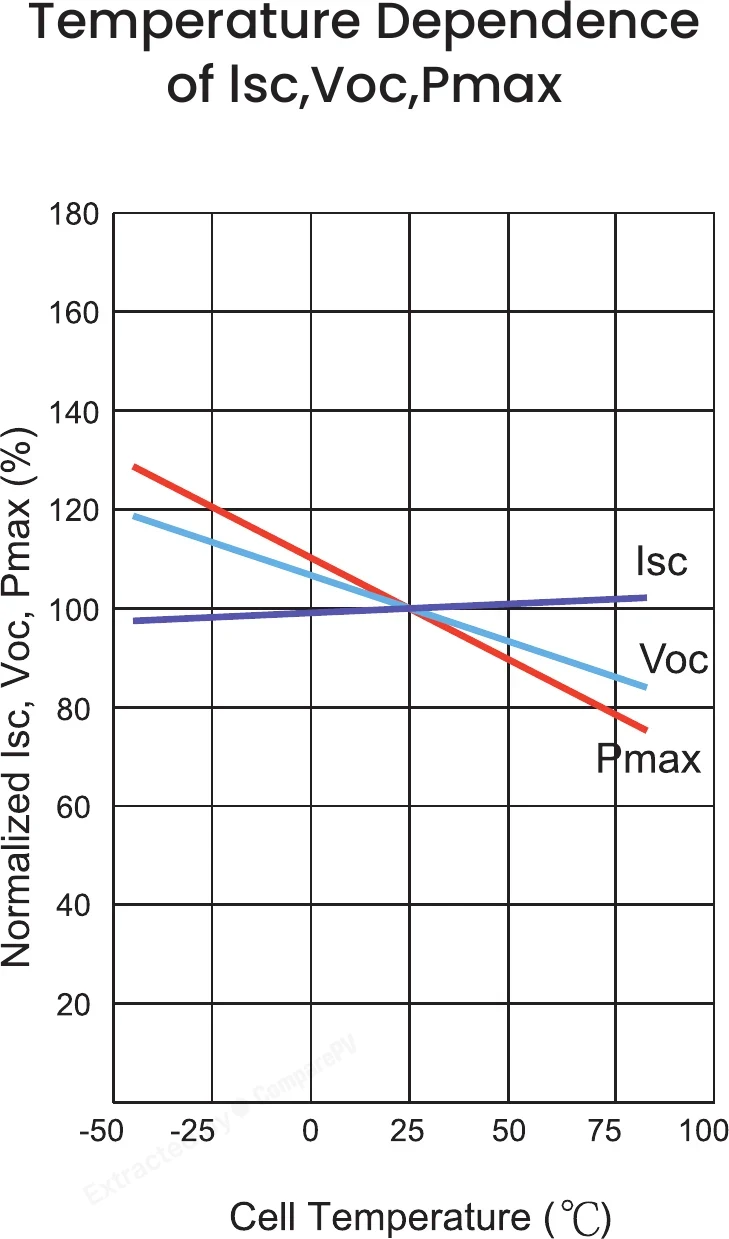
Coefficient Pmax -0.330 %/°C Strong top 7% of its segment
Coefficient Voc · Isc -0.260 · 0.060 %/°C
NOCT 45 °C At 800 W/m², 20 °C ambient
Product warranty 15 years Hardware defects only
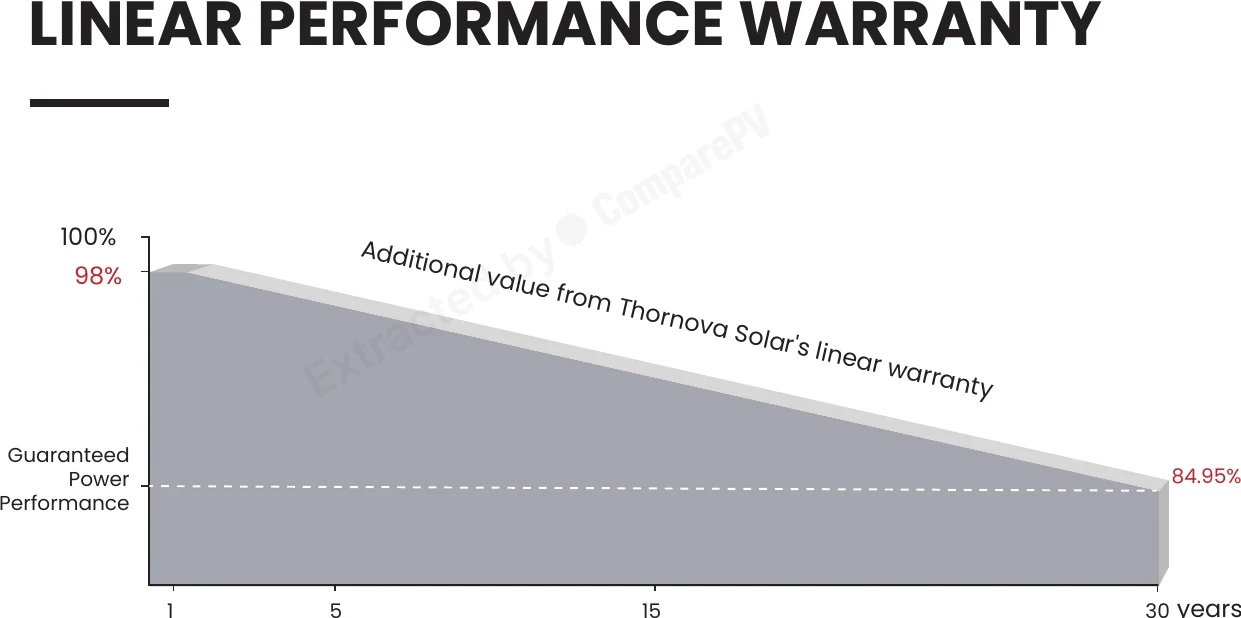
Performance warranty 30 years Strong top 25% · median 27 yrs
End-of-warranty output 85.0 % Equals 467 W guaranteed
Degradation 2.00 → 0.45 % First year, then annual

Datasheet charts

Open datasheet PDF

Measured curves published by Sunova in this model's datasheet. A chart carrying a wattage was measured on that variant alone - only the ones that describe 550 Wp appear here. The rest cover the whole series.
Simulations

Live - change any input
Lifetime output & value
30 years at 1200 kWh/kWp/year and €0.50 per kWh
Power in year 30
-
Lifetime energy
-
Energy value
-
With bifacial gain
-

Degradation from this panel's own datasheet figures. No inverter, soiling or shading losses.

Heat losses
-0.330 %/°C against a segment median of -0.350
-
Bifacial gain
Rear gain over light concrete: -
-

Model: bifaciality × albedo × 0.6 view factor. A first-order estimate, not a yield simulation.

Alternatives

All Sunova panels
Filter these
Size
Panel Power Eff. Temp. Weight Difference
Sunova TS-BG72(550) 550 W 21.29% -0.330 32.3 kg You are here
LR7-54HJD-510M 510 W 25.00% -0.240 23.5 kg Cooler, lighter, +3.7 pp
LR7-60HVH-560M 560 W 24.80% -0.260 25.0 kg Cooler, lighter, +3.5 pp
LR7-54HJD-505M 505 W 24.70% -0.240 23.5 kg Cooler, lighter, +3.4 pp
LR7-60HVH-555M 555 W 24.60% -0.260 25.0 kg Cooler, lighter, +3.3 pp
LR7-54HJD-500M 500 W 24.50% -0.240 23.5 kg Cooler, lighter, +3.2 pp
RS535~555S8-144GA (535W) 535 W 20.70% -0.340 32.5 kg -15 W, hotter, -0.6 pp
TS-BG72(540) 540 W 20.90% -0.330 32.3 kg -10 W, -0.4 pp
TS-BW72(545) 545 W 21.10% -0.330 27.6 kg Lighter, -5 yr warranty
AIKO-A650-MAE72Mw 650 W 25.20% -0.260 27.0 kg +100 W, cooler, +3.9 pp
AIKO-A645-MAE72Mw 645 W 25.00% -0.260 27.0 kg +95 W, cooler, +3.7 pp
AIKO-A640-MAE72Mw 640 W 24.80% -0.260 27.0 kg +90 W, cooler, +3.5 pp
AIKO-A635-MAE72Mw 635 W 24.60% -0.260 27.0 kg +85 W, cooler, +3.3 pp
AIKO-A630-MAH72Dw 630 W 24.40% -0.260 32.5 kg +80 W, cooler, +3.1 pp

Found 2326 panels of the same or similar size to this one, within ±10 mm. See them here Found 2368 panels of the same or similar size to this one, within ±25 mm. See them here Found 2382 panels of the same or similar size to this one, within ±50 mm. See them here Found 2547 panels of the same or similar size to this one, within ±100 mm. See them here

Common questions

6 answered
Is the Sunova TS-BG72 series still available for purchase?
No, production of the TS-BG72 series has been discontinued. Distributors may still offer remaining stock, but new orders can no longer be placed with the manufacturer. When buying, make sure the seller can still provide warranty support despite the model being phased out.
What is bifacial PERC technology in the TS-BG72 panels and is it worth it?
Bifacial PERC means the module generates power from both the front and rear side, capturing light reflected off the ground. In the TS-BG72, this works best on light-colored roofs, white gravel, or ground-mount installations, where the rear-side gain can add up to several extra percentage points of yield. On standard dark pitched roofs, the benefit is smaller.
What warranty comes with Sunova TS-BG72 panels?
The manufacturer provides a 15-year product warranty and a 30-year power performance warranty. The glass-glass construction further supports long-term durability by reducing cell degradation and lowering the risk of delamination compared to standard panels with a plastic backsheet.
How much power does one TS-BG72 panel produce and what installations suit it best?
The maximum power output is 560 Wp, placing it in the high-power module segment. Thanks to its high power density and half-cut cell architecture, the series is mainly suited for C&I (commercial and industrial) installations, large flat roofs, and ground-mount projects where maximizing power per available surface area matters.
Is Sunova a Tier 1 manufacturer and does that matter when buying?
Sunova is not listed among Tier 1 manufacturers, a financial classification (mainly relevant for bank financing eligibility) rather than a direct measure of technical quality. TS-BG72 panels have passed independent Kiwa PVEL reliability testing, offering additional quality assurance, though it's worth checking specific lender requirements before applying for bank financing.
What does half-cut cell architecture mean for TS-BG72 panels and how does it help with partial shading?
Half-cut technology splits standard cells in half, reducing resistive power losses and limiting the impact of partial shading on the whole panel's output. In practice, when part of the module is shaded (e.g., by a chimney or leaves), the unshaded half keeps generating power with minimal loss, resulting in higher and more stable annual energy yield.
Add to compare
