TS-BBT72(570)

570 Wp N-type Bifacial 80%
ComparePV verdict

Solid all-round for its segment

Rank 4,589 of 14,005
Compare panels Datasheet PDF
Power (Wp)
570
Typical for its class
Efficiency (%)
22.10
Typical · median 22.45%
Density (Wp/m²)
220.7
Typical · median 224.5
Temp (%/°C)
-0.290
Typical · median -0.290
Weight (kg)
27.2
Typical · median 29.5 kg
Warranty (yrs)
30
Typical · median 30 yrs

The Sunova TS-BBT72 series are modules designed for maximum energy yield on large rooftop and ground installations, where every square meter counts. The use of N-type cells in TOPCon technology helps minimize degradation-related losses, ensuring the module maintains stable performance under real-world conditions. This solution is ideal for investors seeking to boost production without expanding the structure - especially in commercial and industrial projects.

The key advantage of this series is the bifacial design, capable of utilizing reflected light from the back, increasing the yield where standard panels "see" only front illumination. Additionally, the tempered glass with anti-reflective coating improves performance under poor insolation and minimizes reflection losses. The IP68 connector box housing completes the package, crucial in installations exposed to moisture, dust, and varying weather conditions. The TS-BBT72 series stands out by combining high power density with practical durability, not just "paper" parameters.

Ranking

259 panels in the segment N-type 550-600 W
Metric This panel Median Position in segment Overall rank
Module efficiency 22.10% 22.45% Typical 6,012
Power density 220.7 224.5 Typical 6,058
Temperature coefficient -0.290 -0.290 Typical 2,165
Weight per kWp 47.7 52.3 Typical 1,825
Performance warranty 30 yrs 30 yrs Typical 21
Colour key Strong - top 25% Typical - middle 50% Weak - bottom 25%

Signals from the data

0 positive · 0 caution
Best for

Commercial, utility-scale and shaded-installations.

Notes from the database
  • At 22.1% efficiency, this panel is on par with typical N-type 550-600W modules
  • Power density of 220.7 W/m² is 3.8 W/m² below N-type 550-600W median (224.5 W/m²) - needs more roof space
  • At -0.29%/°C, hot weather performance is typical for N-type 550-600W panels
  • 27.2 kg weight - 2.3 kg lighter than N-type 550-600W median (29.5 kg), reducing installation effort
  • 80% bifaciality enables rear-side power generation, boosting yield by 4-12% on reflective surfaces

Specifications

Open datasheet PDF
Nominal power (Pmax) 570 Wp Nameplate at 1000 W/m², 25 °C
Module efficiency 22.10 % Typical Segment median 22.45%
Vmpp · Impp 43.62 V · 13.07 A Operating point at max power
Voc · Isc 51.52 V · 13.70 A Sizes the string length
Max system voltage 1500 V Longer strings than 1000 V modules
Dimensions 2278×1134×35 mm · 2.58 m² of roof
Weight 27.2 kg Typical Typical · median 29.5 kg
Cells 144 · N-type Monocrystalline
Bifaciality 80 % Rear output as a share of front
Coefficient Pmax -0.290 %/°C Typical median -0.290 of its segment
Coefficient Voc · Isc -0.280 · 0.040 %/°C
NOCT 45 °C At 800 W/m², 20 °C ambient
Product warranty 15 years Hardware defects only
Performance warranty 30 years Typical median 30 yrs · median 30 yrs
End-of-warranty output 87.4 % Equals 498 W guaranteed
Degradation 1.00 → 0.40 % First year, then annual

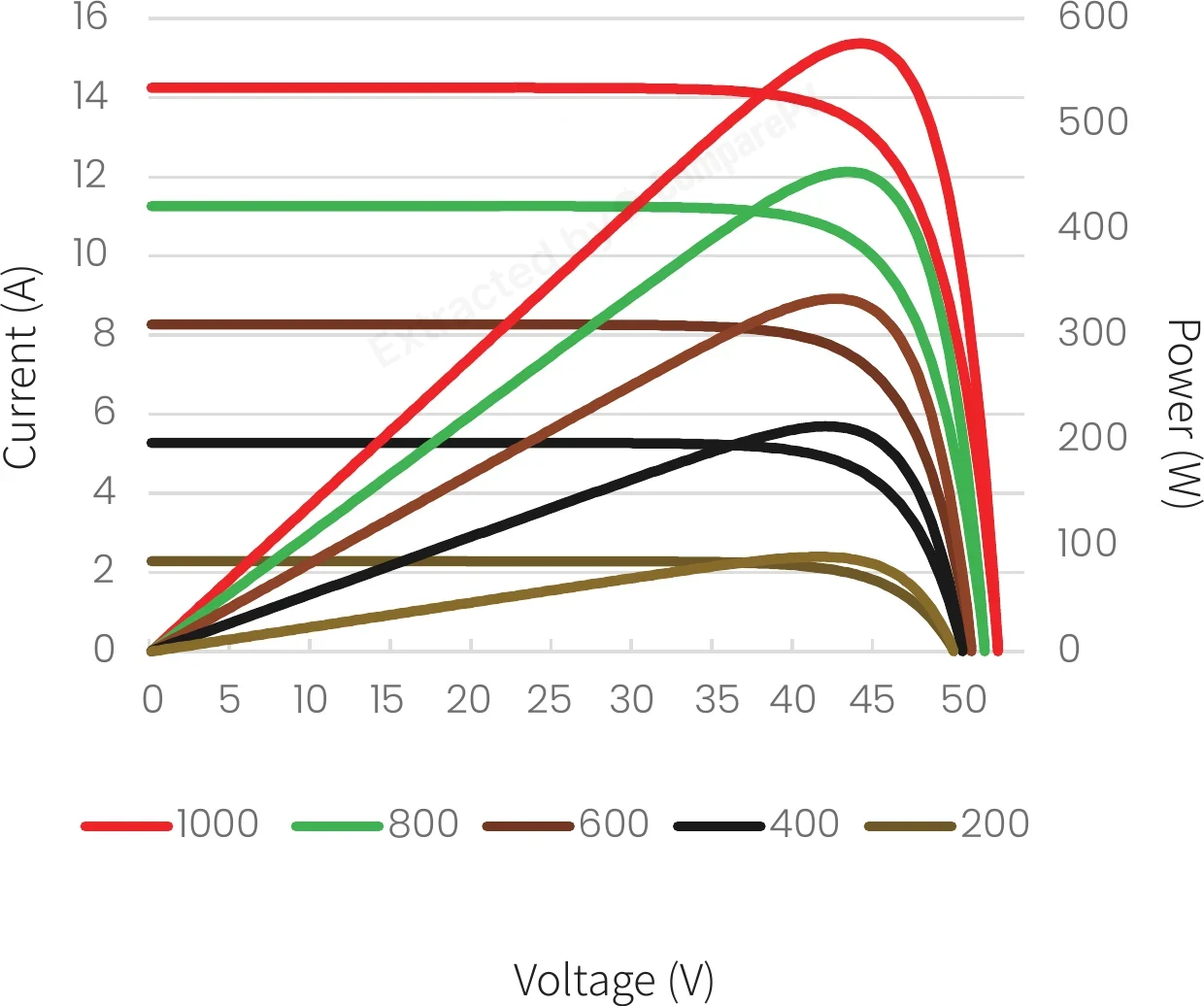
Datasheet charts

Open datasheet PDF

Measured curves published by Sunova in this model's datasheet. A chart carrying a wattage was measured on that variant alone - only the ones that describe 570 Wp appear here. The rest cover the whole series.
Simulations

Live - change any input
Lifetime output & value
30 years at 1200 kWh/kWp/year and €0.50 per kWh
Power in year 30
-
Lifetime energy
-
Energy value
-
With bifacial gain
-

Degradation from this panel's own datasheet figures. No inverter, soiling or shading losses.

Heat losses
-0.290 %/°C against a segment median of -0.290
-
Bifacial gain
Rear gain over light concrete: -
-

Model: bifaciality × albedo × 0.6 view factor. A first-order estimate, not a yield simulation.

Alternatives

All Sunova panels
Filter these
Size
Panel Power Eff. Temp. Weight Difference
Sunova TS-BBT72(570) 570 W 22.10% -0.290 27.2 kg You are here
LR7-60HVH-560M 560 W 24.80% -0.260 25.0 kg Cooler, lighter, +2.7 pp
LR7-60HVH-555M 555 W 24.60% -0.260 25.0 kg Cooler, lighter, +2.5 pp
LR7-60HVHL-550M 550 W 24.40% -0.260 16.3 kg Cooler, lighter, +2.3 pp
JAT60S40-540/LR 540 W 24.40% -0.260 23.5 kg -30 W, lighter, +2.3 pp
GK-5-60HG-540M 540 W 24.40% -0.260 23.3 kg -30 W, lighter, +2.3 pp
JKM545-54QL6-DV-F1-EU 545 W 24.27% -0.260 27.5 kg -25 W, cooler, +2.2 pp
LR7-60HVH-545M 545 W 24.20% -0.260 25.0 kg -25 W, cooler, +2.1 pp
RS535~555S8-144GA (535W) 535 W 20.70% -0.340 32.5 kg Hotter, heavier, -1.4 pp
TS-BG72(540) 540 W 20.90% -0.330 32.3 kg Hotter, heavier, -1.2 pp
TS-BW72(545) 545 W 21.10% -0.330 27.6 kg Hotter, -1.0 pp, -5 yr warranty
AIKO-A650-MAE72Mw 650 W 25.20% -0.260 27.0 kg +80 W, cooler, +3.1 pp
AIKO-A645-MAE72Mw 645 W 25.00% -0.260 27.0 kg +75 W, cooler, +2.9 pp
AIKO-A640-MAE72Mw 640 W 24.80% -0.260 27.0 kg +70 W, cooler, +2.7 pp
AIKO-A635-MAE72Mw 635 W 24.60% -0.260 27.0 kg +65 W, cooler, +2.5 pp
AIKO-A630-MAH72Dw 630 W 24.40% -0.260 32.5 kg +60 W, heavier, +2.3 pp

Found 2326 panels of the same or similar size to this one, within ±10 mm. See them here Found 2368 panels of the same or similar size to this one, within ±25 mm. See them here Found 2382 panels of the same or similar size to this one, within ±50 mm. See them here Found 2547 panels of the same or similar size to this one, within ±100 mm. See them here

Common questions

6 answered
What is the maximum power output of the Sunova TS-BBT72 panel and what drives it?
The top variants in the TS-BBT72 series reach up to 575 Wp. This high output comes from N-type TOPCon cells with low intrinsic losses combined with a half-cut cell layout that reduces resistive and thermal losses. Together with the bifacial dual-glass design, the module also captures rear-side reflected light, meaningfully boosting the total energy yield of the array.
How does the bifacial TS-BBT72 panel differ from a standard monofacial panel?
A monofacial panel only captures light hitting its front surface, while the TS-BBT72's bifacial design and transparent rear glass allow it to also collect light reflected off the roof, ground, or a bright surface beneath the array. In practice this means higher energy yield from the same footprint, especially in ground-mount systems installed over light-colored surfaces or gravel.
What warranty applies to Sunova TS-BBT72 modules?
The manufacturer provides a 15-year product warranty and a 30-year power performance warranty, with output guaranteed to remain at a high level throughout the module's service life. It is still worth confirming current service terms with the local distributor, since the manufacturer is based in China and is not a Tier 1 producer, which can affect the logistics of warranty claims.
Is the TS-BBT72 suitable for large ground-mount and utility-scale installations?
Yes, the TS-BBT72 series was designed for large rooftops and ground-mount solar farms, where maximizing power density per square meter matters most. Unit power up to 575 Wp reduces the number of modules needed, and the bifacial construction adds further energy gains in ground-mount systems, where reflected light plays a bigger role than on residential pitched roofs.
Is the TS-BBT72 junction box resistant to moisture and harsh weather?
Yes, the panel uses an IP68-rated junction box, the highest protection class commonly used in photovoltaics. This provides effective sealing against moisture, dust, and contaminants, which matters most in installations exposed to rain, fog, or dust, such as industrial rooftops and ground-mount projects.
Does the tempered anti-reflective glass on the TS-BBT72 improve performance in low-light conditions?
Yes, the front tempered glass with an anti-reflective coating reduces light reflection losses and helps the module make better use of diffuse radiation, for example on cloudy days or during early morning and evening hours. As a result, the panel maintains more stable energy production across variable sunlight conditions, not just under full direct sun.
Add to compare