SV120M.3.4-500

500 Wp N-type Bifacial 2500%
ComparePV verdict

Middle of its segment, weak in heat

Rank 5,418 of 14,005
Compare panels Datasheet PDF
Power (Wp)
500
Weak · bottom 8%
Efficiency (%)
22.60
Typical · median 22.54%
Density (Wp/m²)
225.5
Typical · median 225.3
Temp (%/°C)
-0.300
Weak · bottom 11%
Weight (kg)
27.0
Weak · bottom 23%
Warranty (yrs)
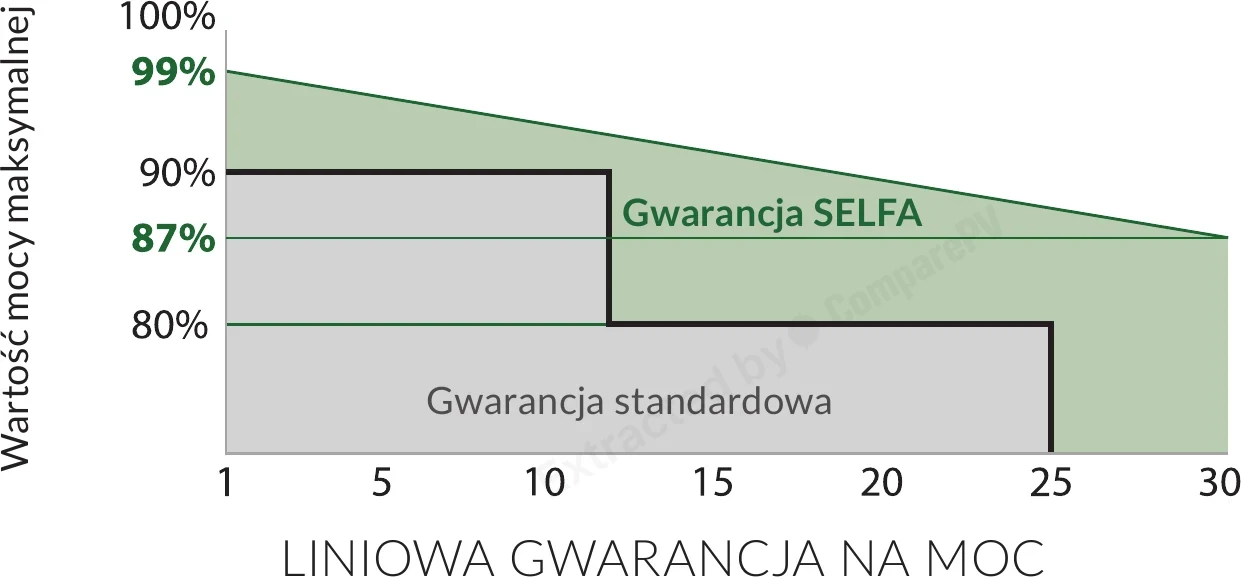
30
Typical · median 30 yrs

The SV120M.3.4 series is a line of bifacial solar modules from Selfa, designed for investors looking to maximize output from limited roof or ground space. The panels are built on TOPCon N-Type technology, allowing them to generate electricity more efficiently even under diffuse light and higher operating temperatures, translating into real energy gains under Polish climate conditions. The bifacial design, with tempered glass on both sides, captures light reflected from the ground to boost energy yield compared to standard single-sided modules - a solution especially valuable for installations on light-colored roofs, facades, or ground-mounted structures. Half-cut cell construction combined with multi-busbar technology reduces the risk of hot-spots, limits micro-cracks, and improves resistance to partial shading, resulting in longer service life and stable performance over years of operation. An added benefit is the self-cleaning surface, which allows the panels to largely clean themselves during rainfall, reducing the need for maintenance. The manufacturer backs the series with a 30-year warranty and a guaranteed positive power tolerance, making the SV120M.3.4 a solid choice for both residential installations and commercial PV projects.

Ranking

140 panels in the segment N-type 500-550 W
Metric This panel Median Position in segment Overall rank
Module efficiency 22.60% 22.54% Typical 3,658
Power density 225.5 225.3 Typical 3,882
Temperature coefficient -0.300 -0.290 Weak · bottom 11% 6,093
Weight per kWp 54.0 50.0 Weak · bottom 23% 8,183
Performance warranty 30 yrs 30 yrs Typical 21
Colour key Strong - top 25% Typical - middle 50% Weak - bottom 25%

Signals from the data

0 positive · 2 caution
Best for

Residential, commercial and shaded-installations.

Not ideal for

Hot climates and weight-limited structures.

Watch-outs
-0.300 %/°C temperature coefficient

Bottom 11% of the N-type 500-550 W segment, against a median of -0.290.

54.0 kg per kWp

Bottom 23% of the N-type 500-550 W segment, against a median of 50.0.

Notes from the database
  • Efficiency of 22.6% matches the N-type 500-550W median
  • Power density of 225.5 W/m² matches the N-type 500-550W median
  • At -0.30%/°C, hot weather performance is typical for N-type 500-550W panels
  • Ranked #3658 out of 14005 panels for efficiency in the database

Specifications

Open datasheet PDF
Nominal power (Pmax) 500 Wp Nameplate at 1000 W/m², 25 °C
Module efficiency 22.60 % Typical Segment median 22.54%
Vmpp · Impp 36.50 V · 13.70 A Operating point at max power
Voc · Isc 43.97 V · 14.18 A Sizes the string length
Max system voltage 1500 V Longer strings than 1000 V modules
Dimensions 1955×1134×30 mm · 2.22 m² of roof
Weight 27.0 kg Weak Weak · bottom 23%
Cells 120 · N-type Monocrystalline
Bifaciality 2500 % Rear output as a share of front
Coefficient Pmax -0.300 %/°C Weak bottom 11% of its segment
Coefficient Voc · Isc -0.250 · 0.050 %/°C
NOCT 41 °C At 800 W/m², 20 °C ambient
Product warranty 20 years Hardware defects only
Performance warranty 30 years Typical median 30 yrs · median 30 yrs
End-of-warranty output 87.0 % Equals 435 W guaranteed
Degradation 1.00 → 0.41 % First year, then annual

Datasheet charts

Open datasheet PDF

Measured curves published by Selfa in this model's datasheet. A chart carrying a wattage was measured on that variant alone - only the ones that describe 500 Wp appear here. The rest cover the whole series.
Simulations

Live - change any input
Lifetime output & value
30 years at 1200 kWh/kWp/year and €0.50 per kWh
Power in year 30
-
Lifetime energy
-
Energy value
-
With bifacial gain
-

Degradation from this panel's own datasheet figures. No inverter, soiling or shading losses.

Heat losses
-0.300 %/°C against a segment median of -0.290
-
Bifacial gain
Rear gain over light concrete: -
-

Model: bifaciality × albedo × 0.6 view factor. A first-order estimate, not a yield simulation.

Filter these
Size
Panel Power Eff. Temp. Weight Difference
Selfa SV120M.3.4-500 500 W 22.60% -0.300 27.0 kg You are here
LR7-54HJD-510M 510 W 25.00% -0.240 23.5 kg Cooler, lighter, +2.4 pp
AIKO-A495-MCE54Mw 495 W 24.80% -0.260 21.0 kg Cooler, lighter, +2.2 pp
LR7-54HJD-505M 505 W 24.70% -0.240 23.5 kg Cooler, lighter, +2.1 pp
AIKO-A490-MCE54Mw 490 W 24.50% -0.260 21.0 kg Cooler, lighter, +1.9 pp
LR7-54HJD-500M 500 W 24.50% -0.240 23.5 kg Cooler, lighter, +1.9 pp
CIPRO-TN9C54M-500W 500 W 24.50% -0.260 21.4 kg Cooler, lighter, +1.9 pp
SV120M.3.4-480 480 W 21.70% -0.300 23.5 kg -20 W, lighter, -0.9 pp
LR7-60HVH-560M 560 W 24.80% -0.260 25.0 kg +60 W, cooler, +2.2 pp
LR7-60HVH-555M 555 W 24.60% -0.260 25.0 kg +55 W, cooler, +2.0 pp
LR7-60HVHL-550M 550 W 24.40% -0.260 16.3 kg +50 W, lighter, +1.8 pp
JAT60S40-540/LR 540 W 24.40% -0.260 23.5 kg +40 W, cooler, +1.8 pp
GK-5-60HG-540M 540 W 24.40% -0.260 23.3 kg +40 W, cooler, +1.8 pp
JKM545-54QL6-DV-F1-EU 545 W 24.27% -0.260 27.5 kg +45 W, cooler, +1.7 pp
LR7-60HVH-545M 545 W 24.20% -0.260 25.0 kg +45 W, cooler, +1.6 pp

Found 488 panels of the same or similar size to this one, within ±10 mm. See them here Found 512 panels of the same or similar size to this one, within ±25 mm. See them here Found 1080 panels of the same or similar size to this one, within ±50 mm. See them here Found 1471 panels of the same or similar size to this one, within ±100 mm. See them here

Common questions

6 answered
What is the maximum power output of the Selfa SV120M.3.4 panel?
The SV120M.3.4 series reaches a maximum power output of up to 500 Wp with a conversion efficiency of around 21.5%. That's a strong result for this panel size, meaning each module delivers more energy per unit of roof or ground area, reducing the number of panels needed to reach a target system capacity.
How much extra energy does the bifacial design of the SV120M.3.4 produce?
With tempered glass on both sides, the panel also captures light reflected off the mounting surface. Depending on the albedo of that surface (bright roofing, gravel, snow), this can boost energy yield by up to 25% compared to a standard monofacial module. The gain is highest on light-colored, reflective surfaces and in ground-mount installations with sufficient clearance from the ground.
How does the N-type TOPCon technology in the SV120M.3.4 differ from standard PERC cells?
N-type TOPCon cells have lower power losses at high operating temperatures and handle diffuse, low-light conditions better than older P-type PERC cells. In practice, this means more stable energy output during summer heat, on overcast days, and during morning and evening sun angles, which translates into a real gain in annual yield under Poland's climate conditions.
What warranty comes with the Selfa SV120M.3.4 panels?
The manufacturer provides a 20-year product warranty along with a 30-year power output warranty, backed by a guaranteed positive power tolerance from day one. This means the panel should never underperform its rated nameplate power, and any performance degradation over the following decades is covered by the long-term warranty — an important safeguard for both residential and commercial PV investments.
Does the SELF-C self-cleaning surface mean the panels never need washing?
The SELF-C surface allows most dust, pollen, and dirt to be washed away naturally by rainfall, so under typical conditions the panels don't require regular cleaning. This doesn't eliminate maintenance entirely, though — during prolonged dry spells, heavy dust exposure (e.g., near farmland), or bird droppings, it's still worth inspecting the panels and washing them if needed.
Is the Selfa SV120M.3.4 a good fit for light-colored roofs or ground-mount installations?
Yes, these are exactly the scenarios that make the most of this series' bifacial design. Bright metal roofing, light-colored tiles, or ground surfaces covered with gravel or reflective sheeting increase the amount of radiation reaching the rear side of the panel. For ground-mount systems, maintaining adequate clearance between the module and the ground further maximizes the bifacial gain.
Add to compare