NS-380MH-80

380 Wp Monocrystalline
ComparePV verdict

Strong in heat, short guarantee

Rank 12,242 of 14,005
Compare panels Datasheet PDF
Power (Wp)
380
Weak · bottom 18%
Efficiency (%)
20.16
Weak · bottom 25%
Density (Wp/m²)
201.6
Weak · bottom 25%
Temp (%/°C)
-0.290
Strong · top 25%
Weight (kg)
20.0
Typical · median 22.0 kg
Warranty (yrs)
25
Weak · bottom 20%

The PolyCrown Solar Tech Monocrystalline60 series is an advanced solution based on monocrystalline silicon cell technology, which ensures high energy conversion efficiency even in less favorable lighting conditions. These panels are characterized by exceptional resistance to potential-induced degradation, which guarantees long-term stability of energy yields. Thanks to the use of high-transmittance anti-reflective tempered glass, these modules maximize solar radiation absorption, translating into a faster return on investment for the prosumer. The frame design has been optimized for extreme mechanical loads, such as heavy snow or strong wind gusts, making them an ideal choice for the Polish climate. The Monocrystalline60 series solves the problem of limited installation space by offering high power density per square meter of roof surface. It is a solution dedicated to both modern residential installations and smaller commercial systems, where trouble-free operation for decades is key. Compared to the competition, PolyCrown products stand out with an excellent price-to-quality ratio and a precise cell selection process, which minimizes the risk of micro-cracks. The use of PERC technology allows for more efficient use of the infrared spectrum, significantly increasing the efficiency of the entire system on hot days.

Ranking

5,932 panels in the 280-480 W band, all technologies
Metric This panel Median Position in segment Overall rank
Module efficiency 20.16% 21.22% Weak · bottom 25% 12,067
Power density 201.6 212.0 Weak · bottom 25% 12,026
Temperature coefficient -0.290 -0.310 Strong · top 25% 2,165
Weight per kWp 52.6 53.4 Typical 6,253
Performance warranty 25 yrs 30 yrs Weak · bottom 20% 9,798
Colour key Strong - top 25% Typical - middle 50% Weak - bottom 25%

Signals from the data

5 positive · 7 caution
Best for

Hot roofs and southern climates.

Not ideal for

Owners who want a long output guarantee, tight roof space and roofs where every square metre has to count.

Strengths
-0.290 %/°C temperature coefficient

Top 25% of the 280-480 W band, against a median of -0.310.

Watch-outs
25 year performance warranty

Bottom 20% of the 280-480 W band, against a median of 30 yrs.

20.16% module efficiency

Bottom 25% of the 280-480 W band, against a median of 21.22%.

201.6 watts per square metre

Bottom 25% of the 280-480 W band, against a median of 212.0.

What owners get
Up to 22.28% efficiency in top variant

The highest-power variant in the series reaches 22.28% efficiency, exceeding comparable M10 PERC modules such as GCL-M10/54H (21.5%), RedSolar P series (21.52%), and Jinko JS-PERC (21.7%). This is a genuine advantage within the PERC-based module segment.

Power up to 420 Wp matches segment leaders

The series' upper power limit of 420 Wp matches the strongest variants among peer comparables (GCL, RedSolar, Jinko Solar), enabling competitive power density per square meter of roof space where mounting area is limited.

Reinforced frame for snow and wind loads

The frame construction is optimized for extreme mechanical loads (accumulated snow, strong wind gusts) and is directly tailored to Polish climate conditions, reducing the risk of microcracks and failures during winter.

High PID resistance

Cells resistant to potential-induced degradation (PID), combined with anti-reflective tempered glass, ensure stable long-term energy yield, which is relevant given the 25-year power warranty.

Trade-offs
PERC technology instead of N-type TOPCon

P-type PERC cells are approaching their theoretical efficiency ceiling and show a higher temperature coefficient than newer N-type cells. The global market shifted toward TOPCon in 2026 (roughly 49-60% share), which comparable manufacturers such as Jinko Solar already offer in their flagship series.

Wide efficiency spread within the series

The series' lower efficiency bound is 19.66%, about 1.8-2 percentage points below the average efficiency of the peer comparables (21.5-21.7%). Variants closer to 320 Wp perform noticeably worse than the series' top-bin variants.

Standard, not extended warranty

The 15-year product warranty and 25-year power warranty match the market baseline but fall short of leading N-type manufacturers (e.g., Jinko Tiger Neo's 30-year linear power warranty guaranteeing at least 87.4% output).

Limited production scale and brand recognition

The Ningbo facility's annual production capacity is about 200 MW - a small scale compared to gigawatt-level tier-1 manufacturers like Jinko Solar, which may affect warranty service availability and project bankability for financing institutions.

Notes from the database
  • Efficiency of 20.2% is 1.7pp below the database median (21.8%)
  • 201.6 W/m² power density is 16.5 W/m² below database median (218.1 W/m²) - requires larger installation area
  • Temperature coefficient of -0.29%/°C matches the database median
  • 20.0 kg weight - 6.5 kg lighter than database median (26.5 kg), reducing installation effort
  • Ranked #12067 out of 14005 panels for efficiency in the database

Specifications

Open datasheet PDF
Nominal power (Pmax) 380 Wp Nameplate at 1000 W/m², 25 °C
Module efficiency 20.16 % Weak Segment median 21.22%
Vmpp · Impp 38.12 V · 9.97 A Operating point at max power
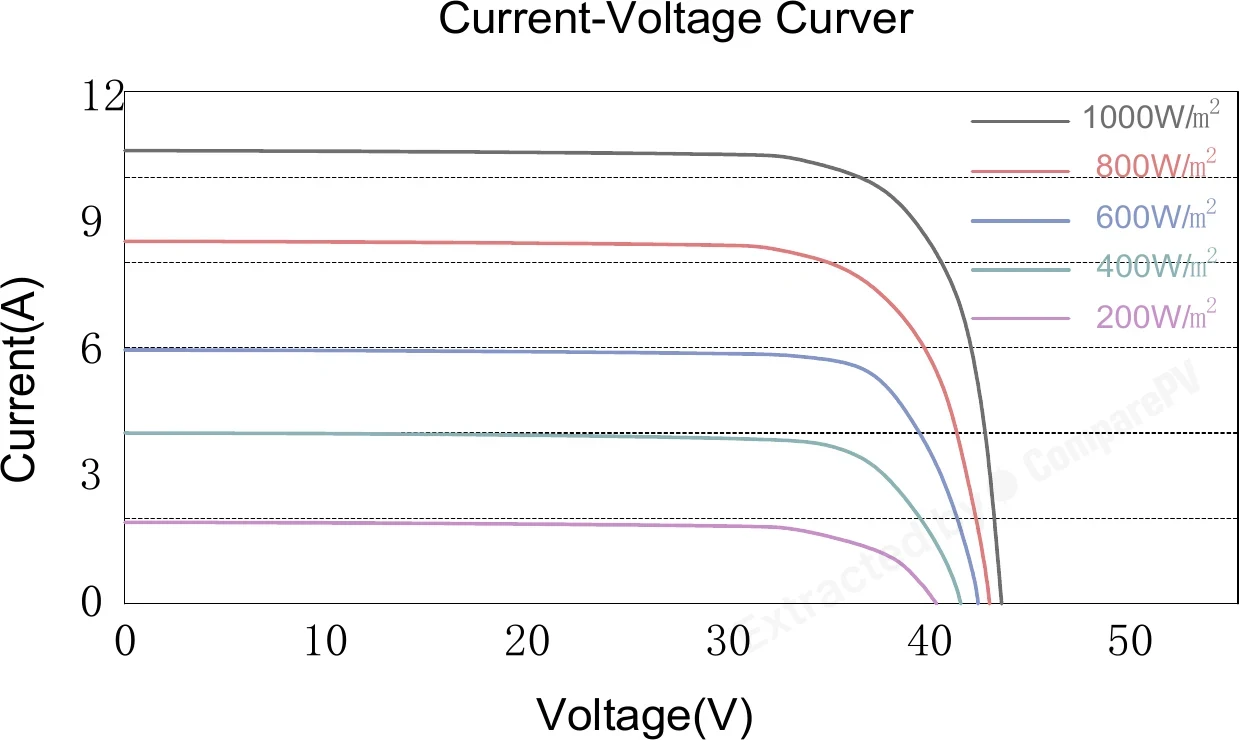
Voc · Isc 44.58 V · 10.65 A Sizes the string length
Max system voltage 1500 V Longer strings than 1000 V modules
Dimensions 1900×992×30 mm · 1.88 m² of roof
Weight 20.0 kg Typical Typical · median 22.0 kg
Cells 70 Monocrystalline
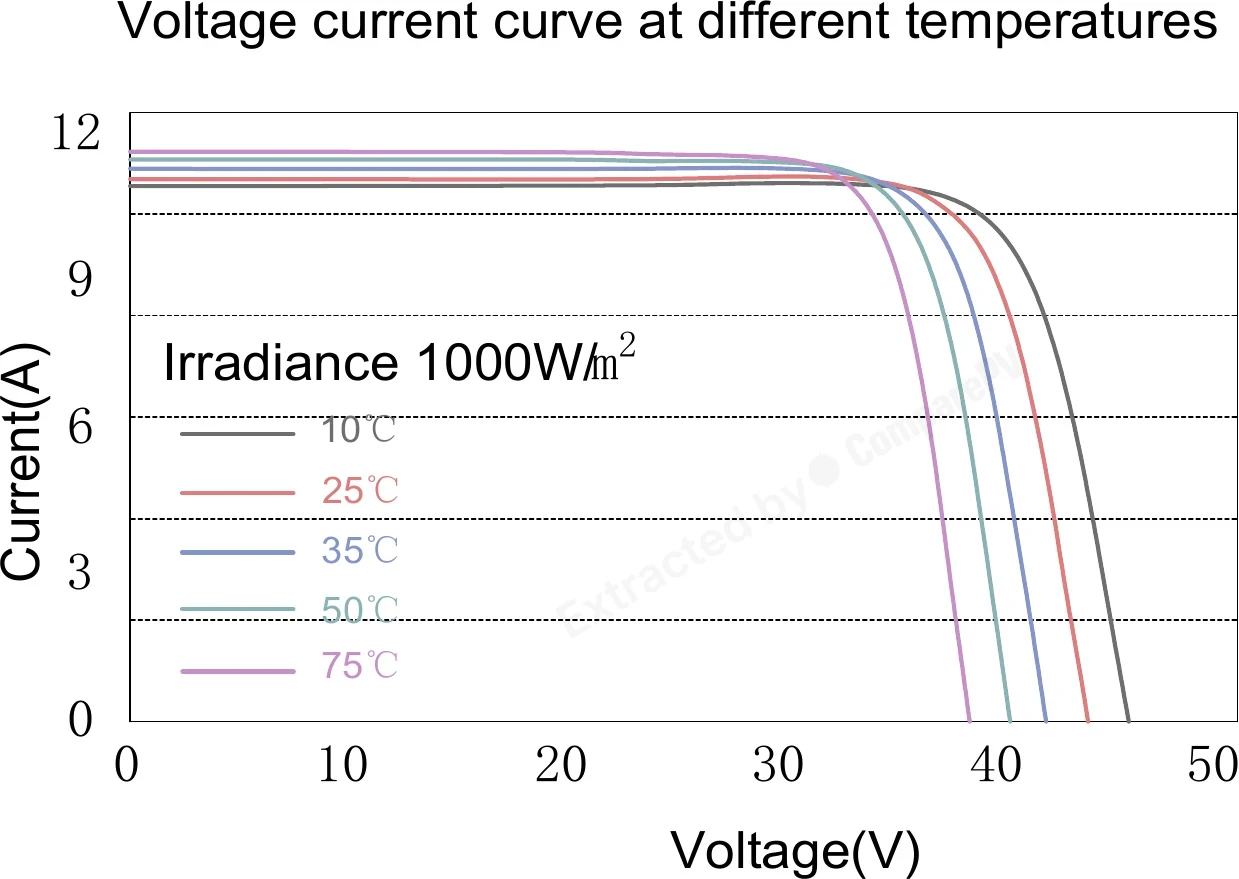
Coefficient Pmax -0.290 %/°C Strong top 25% of its segment
Coefficient Voc · Isc -0.250 · 0.045 %/°C
NOCT 45 °C At 800 W/m², 20 °C ambient
Product warranty 15 years Hardware defects only
Performance warranty 25 years Weak bottom 20% · median 30 yrs
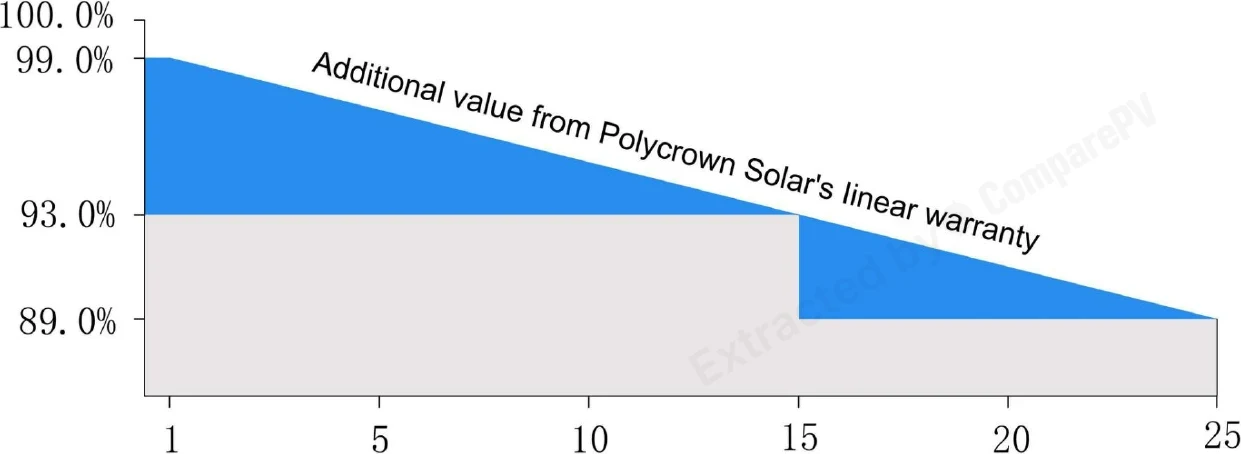
End-of-warranty output 89.0 % Equals 330 W guaranteed
Degradation 1.00 → 0.42 % First year, then annual

Datasheet charts

Open datasheet PDF

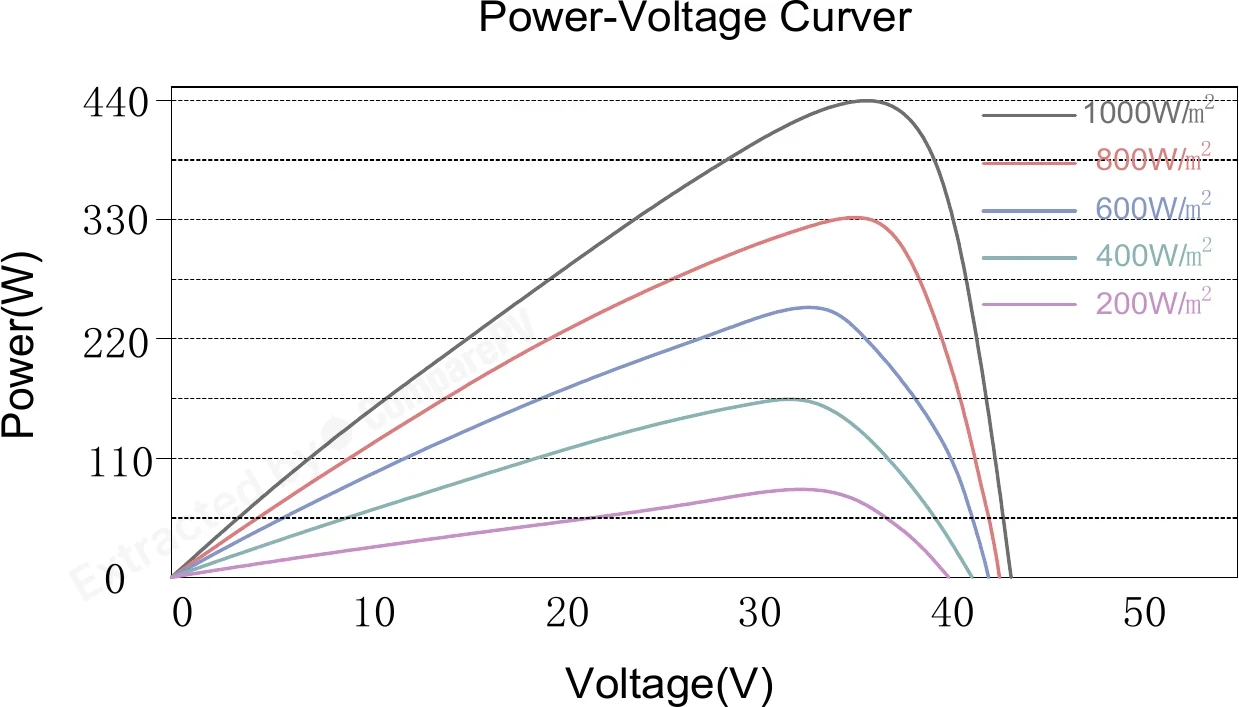
Measured curves published by PolyCrown Solar Tech in this model's datasheet. A chart carrying a wattage was measured on that variant alone - only the ones that describe 380 Wp appear here. The rest cover the whole series.
Simulations

Live - change any input
Lifetime output & value
30 years at 1200 kWh/kWp/year and €0.50 per kWh
Power in year 30
-
Lifetime energy
-
Energy value
-

Degradation from this panel's own datasheet figures. No inverter, soiling or shading losses.

Heat losses
-0.290 %/°C against a segment median of -0.310
-
Filter these
Size
Panel Power Eff. Temp. Weight Difference
PolyCrown Solar Tech NS-380MH-80 380 W 20.16% -0.290 20.0 kg You are here
NS-330MH-80 330 W 23.15% -0.290 15.0 kg -50 W, lighter, +3.0 pp
GKA210M340W 340 W 23.00% - 16.2 kg -40 W, +2.8 pp, +5 yr warranty
GKA210M360W 360 W 23.00% - 16.2 kg Lighter, +2.8 pp, +5 yr warranty
GKA210M380W (1/4*4*38) 380 W 23.00% - 17.1 kg Lighter, +2.8 pp, +5 yr warranty
GKA210M400W (1/2*4*20) 400 W 23.00% - 18.0 kg +20 W, +2.8 pp, +5 yr warranty
GKA210M400W (1/4*4*40) 400 W 23.00% - 18.0 kg +20 W, +2.8 pp, +5 yr warranty
GKA210M380W (1/2*4*19) 380 W 23.00% - 17.1 kg Lighter, +2.8 pp, +5 yr warranty
SPR-MAX3-430-R 430 W 22.70% -0.270 21.2 kg +50 W, +2.5 pp, +15 yr warranty
SPR-MAX3-400-COM 400 W 22.60% -0.270 19.0 kg +20 W, +2.4 pp, +15 yr warranty
NS-390MH-80 390 W 20.69% -0.290 20.0 kg +10 W, +0.5 pp
NS-400MH-80 400 W 21.22% -0.290 20.0 kg +20 W, +1.1 pp
NS-410MH-80 410 W 21.75% -0.290 20.0 kg +30 W, +1.6 pp
NS-420MH-80 420 W 22.28% -0.290 20.0 kg +40 W, +2.1 pp
SPR-MAX7-475 475 W 24.00% -0.270 21.1 kg +95 W, +3.8 pp, +15 yr warranty
SPR-MAX7-470 470 W 23.70% -0.270 21.1 kg +90 W, +3.5 pp, +15 yr warranty

Found 10 panels of the same or similar size to this one, within ±10 mm. See them here Found 10 panels of the same or similar size to this one, within ±25 mm. See them here Found 106 panels of the same or similar size to this one, within ±50 mm. See them here Found 440 panels of the same or similar size to this one, within ±100 mm. See them here

Common questions

6 answered
What warranty does the PolyCrown Solar Tech Monocrystalline60 series come with?
PolyCrown Solar Tech provides two independent warranties for the Monocrystalline60 series: a 15-year product warranty covering material and manufacturing defects, and a 25-year linear power output warranty protecting against excessive cell degradation. This means the manufacturer guarantees a minimum percentage of the rated 420 Wp output for a full quarter-century — a solid protection level consistent with premium-tier PV module standards.
Can PolyCrown Monocrystalline60 panels handle heavy snow loads and strong winds typical of Central European winters?
Yes, the Monocrystalline60 series is engineered for demanding climate conditions. The aluminum frame is optimized for extreme mechanical loads from snow accumulation and strong wind gusts. PolyCrown specifically positions this series as well-suited for the Polish climate, making it a reliable choice for roof-mounted systems exposed to significant winter weather stress without risk of frame deformation or glass damage.
What is PERC technology and what advantages does it provide in the Monocrystalline60 series?
PERC (Passivated Emitter and Rear Cell) adds a passivation layer on the rear side of each cell, reflecting unabsorbed photons back into the silicon structure for a second absorption pass. In the Monocrystalline60 modules, this improves utilization of the infrared spectrum and helps sustain higher efficiency on hot days when standard monocrystalline cells typically lose output due to elevated operating temperatures — resulting in measurably better annual energy yield per installed kilowatt-peak.
Does the Monocrystalline60 series perform well under overcast skies common in Northern and Central Europe?
Yes, the monocrystalline cells in the Monocrystalline60 series respond well to diffuse irradiance. The high-transmittance anti-reflective tempered glass maximizes photon absorption even under heavy cloud cover, which is a significant advantage in climates where direct irradiance is limited throughout much of the year. This translates to better annual energy output compared to older polycrystalline technology at equivalent installed capacity.
How many PolyCrown Monocrystalline60 panels do I need for a 10 kWp system and how much roof space will they require?
At a peak output of 420 Wp per module, a 10 kWp system requires approximately 24 panels. The high power density of the Monocrystalline60 series is especially valuable on roofs with limited available area — you achieve greater nameplate capacity from fewer modules and a smaller footprint compared to older-generation panels, reducing BoS costs and simplifying the racking design.
How does the Monocrystalline60 series differ from bifacial panels, and is the lack of bifaciality a drawback?
The Monocrystalline60 is a monofacial module — it generates power exclusively from the front cell surface. Bifacial modules can produce an additional 5–20% energy from rear-side albedo reflection, but require elevated racking and a light-colored ground surface to realize that gain. For standard pitched roof installations or ground mounts without a reflective substrate, the difference is marginal, and the Monocrystalline60 delivers a more favorable price-to-yield ratio for typical residential and small commercial deployments.
Add to compare