Philadelphia Solar PS-M144(HCBF)-555W

555 Wp PERC Bifacial 65%
ComparePV verdict

Space saver, short guarantee

Rank 7,684 of 14,129
Compare panels Datasheet PDF
Power (Wp)
555
Typical for its class
Efficiency (%)
21.50
Strong · top 18%
Density (Wp/m²)
215.1
Strong · top 14%
Temp (%/°C)
-0.350
Typical · median -0.350
Weight (kg)
29.0
Typical · median 30.8 kg
Warranty (yrs)
25
Weak · bottom 24%

PHENex is Philadelphia Solar's bifacial module series, engineered to maximize energy yield from every square meter of roof or ground-mounted project. At the heart of the series are half-cut monocrystalline PERC cells, which reduce resistive losses through cell segmentation and improve performance under partial shading - a real-world issue for rooftop installations where a chimney or antenna can drag down output across an entire string. The bifacial technology captures additional irradiance reflected from the ground surface, a feature particularly valued by developers building PV farms on light-colored soil or gravel. The modules use a 10-busbar layout, ensuring even current distribution and higher long-term connection reliability. The PHENex design also stands out for its high mechanical resistance to snow and wind loads, making it a solid choice for both commercial rooftops and large utility-scale projects in demanding climates. The PHENex series suits investors looking for a balance between low LCOE and long-term energy production stability, backed by the manufacturer's extended warranty.

Ranking

589 panels in the segment PERC 550-600 W
Metric This panel Median Position in segment Overall rank
Module efficiency 21.50% 21.29% Strong · top 18% 8,022
Power density 215.1 212.9 Strong · top 14% 7,942
Temperature coefficient -0.350 -0.350 Typical 10,489
Weight per kWp 52.3 52.7 Typical 5,753
Performance warranty 25 yrs 27 yrs Weak · bottom 24% 9,912
Colour key Strong - top 25% Typical - middle 50% Weak - bottom 25%

Signals from the data

7 positive · 2 caution
Best for

Utility-scale, commercial and shaded-installations.

Not ideal for

Owners who want a long output guarantee.

Strengths
215.1 watts per square metre

Top 14% of the PERC 550-600 W segment, against a median of 212.9.

21.50% module efficiency

Top 18% of the PERC 550-600 W segment, against a median of 21.29%.

Watch-outs
25 year performance warranty

Bottom 24% of the PERC 550-600 W segment, against a median of 27 yrs.

What owners get
Half-cut PERC cells with 10 busbars

The use of half-cut monocrystalline PERC cells in a 10-busbar layout reduces resistive losses and improves module behavior under partial shading (e.g., chimneys, antennas), resulting in higher and more stable energy yield in typical rooftop installations.

High bifacial gain up to 65%

Per Philadelphia Solar's datasheet, PHENex modules deliver an additional bifacial gain of up to 65%, making them attractive for ground-mount PV farms built on high-albedo surfaces such as light soil, gravel, or reflective membranes.

Very high mechanical load resistance

The module withstands front loads of up to 5400 Pa and rear loads of up to 2400 Pa, exceeding typical segment specs and making the series well suited for utility-scale projects in regions with heavy snow and wind loads.

Tier-1 manufacturer with a 19-year track record

Philadelphia Solar has operated since 2007 and holds BNEF Tier-1 bankable status, easing project financing through commercial banks and reducing investor risk when choosing the PHENex series.

21.5% efficiency on par with segment leaders

The top-bin variant reaches 21.5% efficiency, matching the best comparable PERC/half-cut modules such as JA Solar DEEP BLUE 3.0 (21.5%) and outperforming ET Solar Elite PLUS (21.4%) and Boviet VEGA (21.3%) at the same 555 Wp maximum power.

Trade-offs
Lower efficiency on the base variant

The weakest bin within the 4-variant PHENex lineup reaches only 20.9% efficiency, below comparable competitor models (ET Solar 21.4%, Boviet 21.3%, JA Solar 21.5%) at the same 555 Wp maximum power - selecting a lower bin gives up part of the series' technological edge.

Notes from the database
  • Efficiency of 21.5% matches the PERC 550-600W median
  • At 215.1 W/m² power density, roof space requirements are typical for PERC 550-600W panels
  • At -0.35%/°C, hot weather performance is typical for PERC 550-600W panels
  • At 29.0 kg, this panel is 1.8 kg lighter than PERC 550-600W median (30.8 kg) - easier handling during installation
  • Bifacial design (65% factor) captures reflected light - adds 3-10% yield on ground-mount or white roof

Specifications

Open datasheet PDF
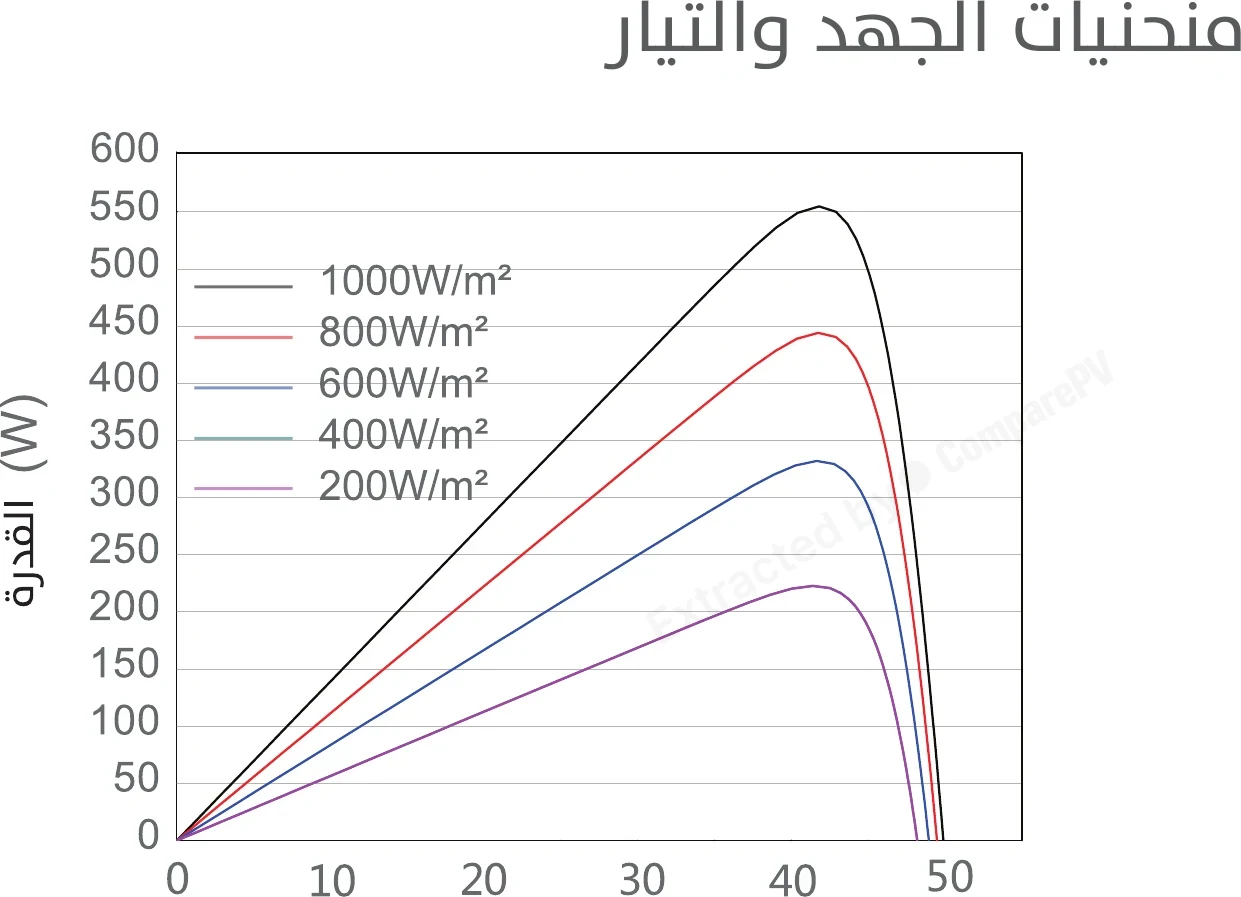
Nominal power (Pmax) 555 Wp Nameplate at 1000 W/m², 25 °C
Module efficiency 21.50 % Strong Segment median 21.29%
Vmpp · Impp 42.42 V · 13.09 A Operating point at max power
Voc · Isc 50.50 V · 13.73 A Sizes the string length
Max system voltage 1500 V Longer strings than 1000 V modules
Dimensions 2277×1133×35 mm · 2.58 m² of roof
Weight 29.0 kg Typical Typical · median 30.8 kg
Cells 144 · PERC Monocrystalline
Bifaciality 65 % Rear output as a share of front
Coefficient Pmax -0.350 %/°C Typical median -0.350 of its segment
Coefficient Voc · Isc -0.220 · 0.050 %/°C
NOCT 45 °C At 800 W/m², 20 °C ambient
Product warranty 12 years Hardware defects only
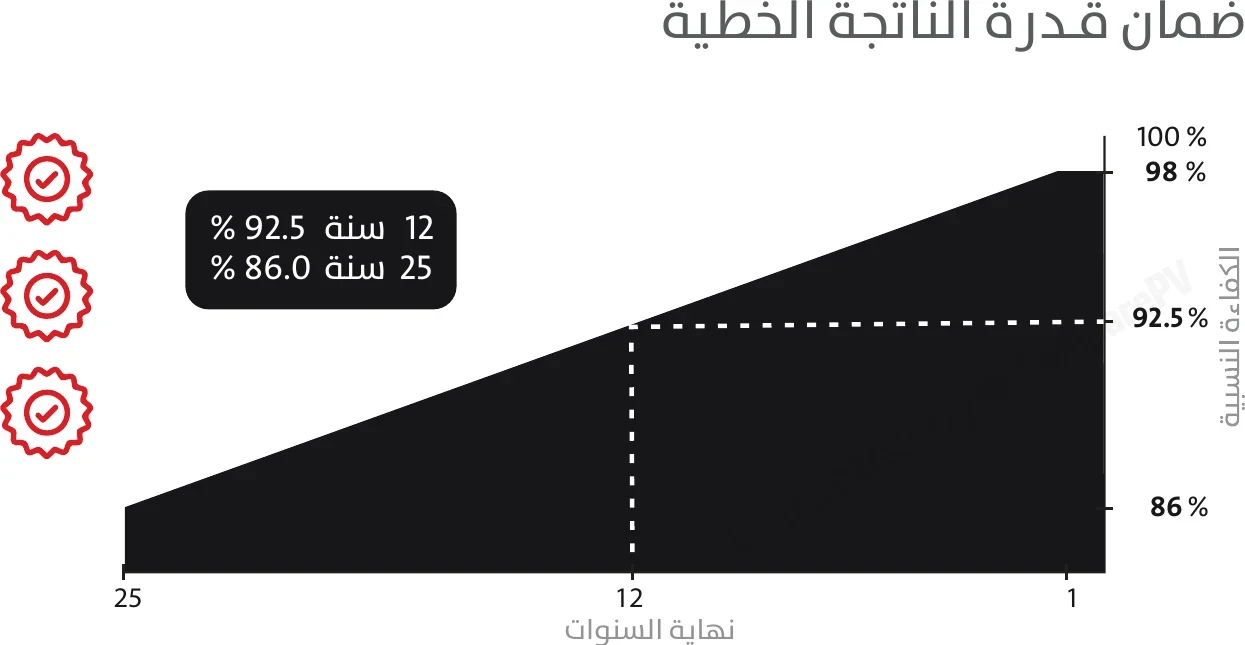
Performance warranty 25 years Weak bottom 24% · median 27 yrs
End-of-warranty output 86.0 % Equals 463 W guaranteed
Degradation 2.00 → 0.50 % First year, then annual

Datasheet charts

Open datasheet PDF

Measured curves published by Philadelphia Solar in this model's datasheet. A chart carrying a wattage was measured on that variant alone - only the ones that describe 555 Wp appear here. The rest cover the whole series.
Simulations

Live - change any input
Lifetime output & value
30 years at 1200 kWh/kWp/year and €0.50 per kWh
Power in year 30
-
Lifetime energy
-
Energy value
-
With bifacial gain
-

Degradation from this panel's own datasheet figures. No inverter, soiling or shading losses.

Heat losses
-0.350 %/°C against a segment median of -0.350
-
Bifacial gain
Rear gain over light concrete: -
-

Model: bifaciality × albedo × 0.6 view factor. A first-order estimate, not a yield simulation.

Filter these
Size
Panel Power Eff. Temp. Weight Difference
Philadelphia Solar PS-M144(HCBF)-555W 555 W 21.50% -0.350 29.0 kg You are here
LR7-54HJD-510M 510 W 25.00% -0.240 23.5 kg Cooler, lighter, +3.5 pp
LR7-60HVH-560M 560 W 24.80% -0.260 25.0 kg Cooler, +3.3 pp, +5 yr warranty
LR7-54HJD-505M 505 W 24.70% -0.240 23.5 kg Cooler, lighter, +3.2 pp
WST-505BKX54-A2 505 W 24.70% -0.260 25.0 kg -50 W, cooler, +3.2 pp
LR7-60HVH-555M 555 W 24.60% -0.260 25.0 kg Cooler, +3.1 pp, +5 yr warranty
LR7-60HVHL-550M 550 W 24.40% -0.260 16.3 kg Cooler, lighter, +2.9 pp
PS-M144(HCBF)-GG-535W 535 W 20.71% -0.349 32.5 kg Heavier, -0.8 pp, +5 yr warranty
PS-M144(HCBF)-GG-540W 540 W 20.90% -0.349 32.5 kg Heavier, -0.6 pp, +5 yr warranty
PS-M144(HCBF)-540W 540 W 20.90% -0.350 29.0 kg -15 W, -0.6 pp
PS-M144(HCBF)-GG-545W 545 W 21.10% -0.349 32.5 kg Heavier, -0.4 pp, +5 yr warranty
PS-M144(HCBF)-545W 545 W 21.10% -0.350 29.0 kg -10 W, -0.4 pp
PS-M144(HCBF)-550W 550 W 21.30% -0.350 29.0 kg Very close match
AIKO-A650-MAE72Mw 650 W 25.20% -0.260 27.0 kg +95 W, cooler, +3.7 pp
AIKO-A645-MAE72Mw 645 W 25.00% -0.260 27.0 kg +90 W, cooler, +3.5 pp
AIKO-A640-MAE72Mw 640 W 24.80% -0.260 27.0 kg +85 W, cooler, +3.3 pp
AIKO-A635-MAE72Mw 635 W 24.60% -0.260 27.0 kg +80 W, cooler, +3.1 pp

Found 2322 panels of the same or similar size to this one, within ±10 mm. See them here Found 2369 panels of the same or similar size to this one, within ±25 mm. See them here Found 2383 panels of the same or similar size to this one, within ±50 mm. See them here Found 2551 panels of the same or similar size to this one, within ±100 mm. See them here

About the PHENex series

6 answered

These answers cover the whole series. Where a figure differs, the specification above is this module's own.

How does bifacial technology in PHENex panels differ from standard monofacial modules?
PHENex panels have both sides active, capturing not only direct sunlight but also light reflected off the surrounding surface - a roof, gravel, or light-colored ground. Depending on the albedo of the surroundings and mounting height, this can deliver an additional energy yield of several to over ten percent compared to a monofacial module of the same rated power.
What is the maximum power output of the PHENex module and who is it best suited for?
The PHENex series reaches up to 555 Wp of maximum power, reducing the number of modules needed to reach a given installation capacity. This output level suits both commercial installations on large roof areas and utility-scale projects, where a low cost per watt of installed capacity matters most.
What warranty covers PHENex panels and what does it include?
Philadelphia Solar provides a 12-year product warranty covering material and workmanship defects, along with a 25-year linear power warranty guaranteeing sustained performance throughout the module's service life. This is in line with warranty terms offered by other tier 1 manufacturers.
Does the 10-busbar design in PHENex panels have a real impact on module durability?
Yes, the 10-busbar layout spreads current across more conduction paths, reducing the load on any single solder joint and lowering the risk of microcracks or connection degradation over time. In practice this translates into higher long-term reliability, especially under significant temperature fluctuations.
Do PERC half-cut cells in PHENex handle partial shading better?
Yes, splitting cells into half-cells reduces resistive losses, so shading part of the module - from a chimney or antenna, for example - has a smaller impact on the whole string's output than in standard full-size cell panels. This is a notable advantage for rooftop installations with irregularly shaped roof planes.
Is Philadelphia Solar a reliable and established manufacturer for the PHENex series?
Philadelphia Solar is a tier 1 manufacturer headquartered in Jordan, active in the PV market for many years and supplying modules for commercial and utility-scale projects worldwide. Tier 1 status confirms financial stability and the real likelihood of warranty support over the long term, reducing risk for investors.
Add to compare