Light for its output, weak in heat
The Panasonic EVERVOLT Solar Module (390H) series is designed for maximum energy yield in situations where every square meter of roof space matters. A key advantage is the HJT heterojunction cell technology in a half-cut configuration, which minimizes losses and stabilizes module performance in real-world conditions, not just in a laboratory. This translates to improved performance at high temperatures, which is particularly important in summer and on roofs with poor ventilation, where standard panels often lose efficiency.
Another distinguishing feature of the series is high resistance to LID and PID degradation thanks to the use of n-type cells, which is important for investors who expect predictable performance from their solar installations over many years. The modules have been optimized for performance under partial shading, which is helpful in typical Polish installations with chimneys, skylights, or trees.
This is a good choice for single-family homes and small businesses that want to maximize energy production from a limited area, and also for improved stability compared to many traditional PERC modules.
Ranking
Signals from the data
Residential, commercial, shaded-installations and hot-climate.
Hot climates and owners who want a long output guarantee.
Top 24% of the HJT 350-400 W segment, against a median of 59.2.
Bottom 9% of the HJT 350-400 W segment, against a median of -0.259. Ranked 511th in the whole database.
Bottom 19% of the HJT 350-400 W segment, against a median of 30 yrs.
N-type HJT technology delivers a power temperature coefficient of 0.26%/°C, notably better than the typical 0.35-0.40%/°C seen in conventional PERC modules. This translates into higher real-world yield during summer and on poorly ventilated roof arrays.
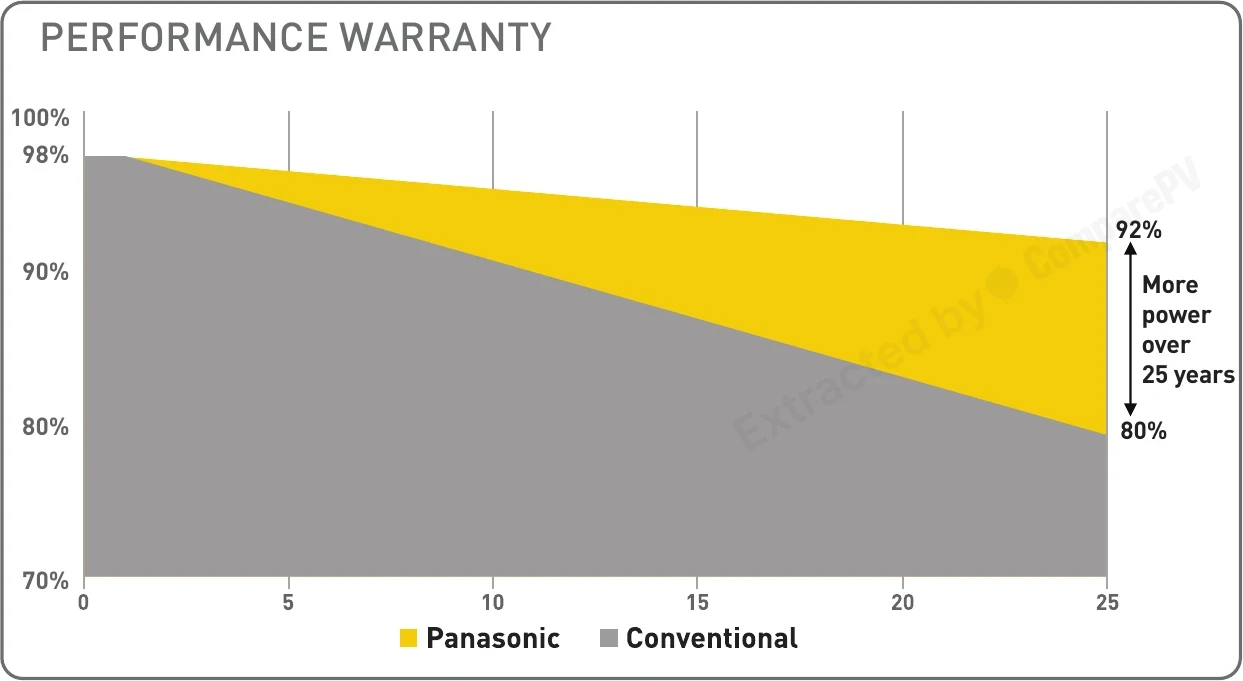
The manufacturer guarantees at least 92% of rated power after 25 years, corresponding to an annual degradation rate of roughly 0.25% - well below the 0.45-0.55%/year typical of PERC modules. This provides a more predictable energy yield over the investment's lifetime.
At 21.1% efficiency, the series is on par with Meyer Burger Glass (21.2%) and ahead of JA Solar JAM60S21 (21.0%), meaning a smaller module footprint per kWp at the same 390 Wp rating.
Panasonic backs the module with a 25-year warranty covering both the product and power output - unlike many Tier-1 manufacturers that offer a shorter product warranty (10-12 years) alongside a 25-year power guarantee. This simplifies claims in the event of a defect.
N-type cells eliminate the Light Induced Degradation typical of PERC panels and limit Potential Induced Degradation, resulting in more stable output in the first years of operation and under partial shading.
The EVERVOLT series (including the 390H variant) has been discontinued, and Panasonic announced in 2025 a full exit from the global solar and energy storage business. Despite pledges to honor existing warranties, long-term availability of spare parts and service support remains uncertain.
At 21.1% efficiency, the series falls slightly behind Phono Solar Twinplus M4-9B-R (21.3%) - a small 0.2 pp gap, but in the premium HJT/mono segment every tenth of a percent per square meter of roof matters.
The module is not offered in a bifacial configuration, which with suitable mounting (e.g., on high-albedo racking) can add 5-15% extra yield - some competing HJT series on the market already offer double-sided variants.
- Efficiency of 21.1% matches the HJT 0-400W median
- At 210.8 W/m² power density, this panel generates 4.4 W/m² more per unit area than HJT 0-400W median (206.4 W/m²)
- Temperature coefficient of -0.26%/°C matches the HJT 0-400W median
- At 20.5 kg, weight matches the HJT 0-400W median
- #9297 for efficiency, #511 for temperature performance out of 14005 panels
Specifications
Datasheet charts
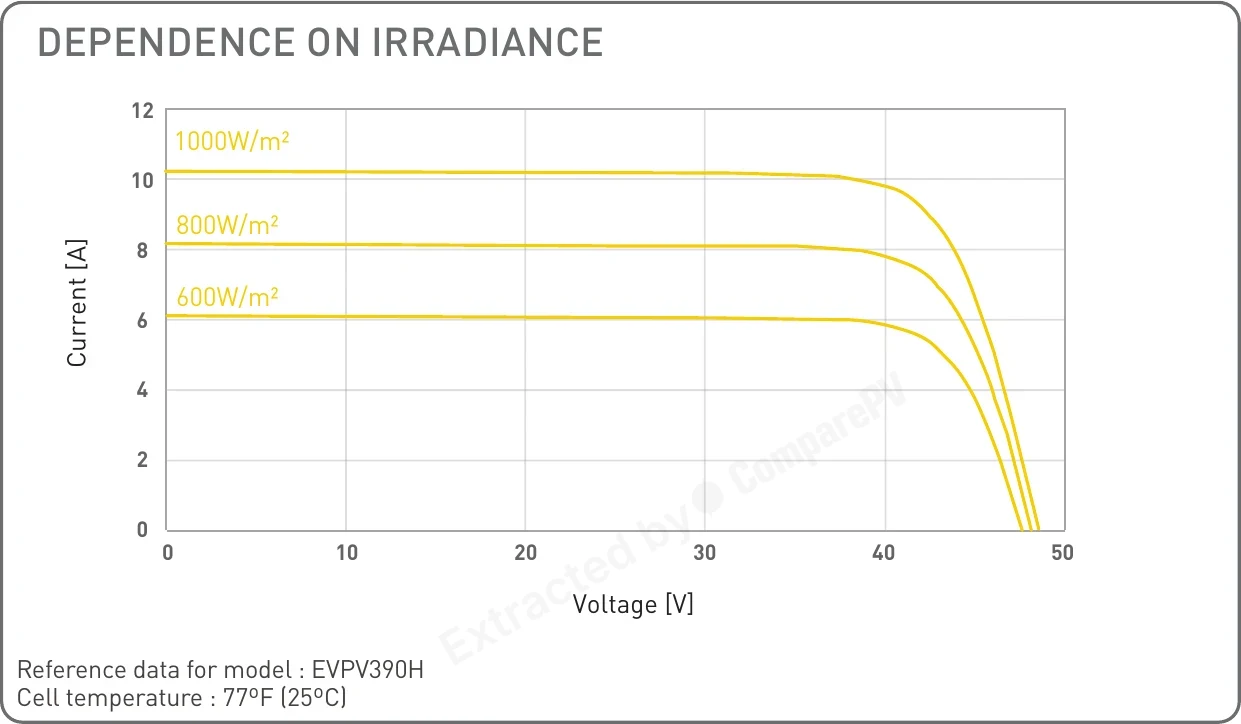
Measured curves published by Panasonic in this model's datasheet. A chart carrying a wattage was measured on that variant alone - only the ones that describe 390 Wp appear here. The rest cover the whole series.
Simulations
Degradation from this panel's own datasheet figures. No inverter, soiling or shading losses.





Found 6 panels of the same or similar size to this one, within ±10 mm. See them here Found 10 panels of the same or similar size to this one, within ±25 mm. See them here Found 86 panels of the same or similar size to this one, within ±50 mm. See them here Found 532 panels of the same or similar size to this one, within ±100 mm. See them here